Chief Strategy Officer at Ridgeline | Reporter at Reading Ambitiously https://teapawt.org/t.co/rN1Fw5OYmL
Chicago, IL
Joined June 2009
- Tweets323
- Following796
- Followers564
- Likes672





Jack Lynch retweeted

.@lynchjw explains why AI spending is soaring while returns remain difficult to measure.
As companies like $UBER burn through AI budgets, $MSFT, $AMZN, $GOOGL, OpenAI, and Anthropic are investing heavily in helping businesses turn AI adoption into real results.
For more market news, tune in at: SchwabNetwork.com/?CID=SM:Tw…


The first time I smoked a pork shoulder, the first few hours made me feel smarter than I was.
I bought the meat, set the cooker to 225, inserted the digital probe, and watched the internal temperature climb exactly as I thought it should.
For a while, it all felt wonderfully mechanical.
Heat goes in. Number goes up. Dinner gets closer.
Then the temperature stopped climbing.
Everything looked like it was working, until suddenly it did not.
Pitmasters call it the stall.
What makes the stall so unsettling is not just the delay. It is the psychology of it.
You did the setup right. You followed the process. The early feedback looked good.
Then the signal disappears, and your confidence goes with it.
From the outside, it looks like nothing is happening. Underneath, a great deal still is.
That pattern shows up everywhere: in business, in fitness, in writing, in life.
At the beginning, progress is visible enough to keep you encouraged.
Then comes the middle, the part where effort is still required, but reassurance is harder to find. The part where people start making emotional decisions.
That is why I keep coming back to systems over goals.
A good system gives you something sturdier than mood.
And one of the best uses of AI may be to apply it first to the oldest management problem you have: yourself.
Because the most important forms of progress do not announce themselves in real time.
Consistency first. Proof later.
1
69


The pax SaaS may be over. And I'm reminded of this timely piece from @bhorowitz a16z.com/peacetime-ceo-warti…

1
95
Not all software is created equally. The market is trying to re-price roughly $3T of software as if it were.
The market’s shorthand is: “vibe coding kills software.”
Vibe coding compresses software creation into natural language. Code gets dramatically cheaper to generate.
But some software is nice to have. Other software is needed.
So the question is: how do you tell the difference?
If the cost of writing code approaches zero, where are the moats? Ask these questions:
Where does the company keep the “official truth”? When finance, legal, compliance, or a customer challenges something, which system has the final answer?
Which system is trusted to take action? What has the keys to do real work: approve, release, provision, pay, book, ship, or deprovision?
What happens if you try to rip it out? Not “can you migrate the data,” but “does the business still run during the switch,” and “what breaks on day two?”
Where does work actually start? What is the default place teams begin the day: the queue, the workflow, the command center, the system they live inside?
When it’s wrong, how expensive is wrong? Does failure show up fast, get contained, and get reversed, or does it quietly pollute the business and surface weeks later?
That checklist helps separate software that is easy to recreate from software that is hard to replace.
As industries mature, they tend to be barbell-shaped. SaaS may start to take this shape.
On one end: systems that hold ground truth and are trusted to take action at scale.
On the other: specialists that handle the messy parts of a domain where “mostly right” is not enough.
The middle will be a tough place to be. More AI clones, bundling, consolidation, and churn. Less pricing power.
You don’t want to be in the middle.
1
105
Today, we’re building AI agents with Claude Code to power Reading Ambitiously.
Every Friday, the newsletter shows up finished.
What you don’t see is the system behind it, or how much work happens before a single sentence earns its way into the final draft.
This edition is different.
I’m going to walk through how I’m actually using Claude Code, and AI agents to build what I now think of as AmbitiousOS, the operating system behind the newsletter.
Why does this matter?
As a team of one, my leverage comes from protecting the highest-value minutes, the time spent selecting content, doing the actual thinking, and giving you all the power of the big ideas. This is what humans are good at.
If AI can reliably be our editor-in-chief and take the rest, the setup work, first-pass structure, research organization, formatting, and workflow glue, I get more time back for what you actually come here for.
Let the robots do the rest.
What we’ll cover:
• Getting started with Claude Code
• Why context is king, and how to think about inputs
• System design and planning before writing a word
• Building AmbitiousOS, the workflow that runs the newsletter
• Lessons learned, and what’s next
If you’re trying to get started with AI Agents & Claude Code, our 98th edition is for you.
76

Every AI demo you have ever seen has the same hidden dependency: a box of text that the underlying LLM can hold in its “mind” at once.
That box is the context window.
Think of it as the model’s working memory at run time. Models learn enormous amounts during training, but at runtime, they can only condition on what fits within the current window: the system prompt, your message, tool outputs, documents, and custom instructions. All of it competes for the same space. If it’s not in the window, it’s not reliably in play.
If you feel the pace of AI development is dizzying, you’re not alone. Skills libraries, sub agents, MCPs, tools and plugins, Ralph Wiggum (yes, from the Simpsons) loops, it’s a lot to keep up with.
Until you realize most of it converges on the same problem: protecting and compounding context.
That pressure is turning into a discipline. And the context window is becoming what RAM was to early computing. It is the scarce resource around which the whole system organizes, at least for now.
This feels like the future of software engineering. And I don’t think we’re going back.
76
Jack Lynch retweeted

We’ve made investments in the best investing applications we’ve come across
Here’s the stack
- @canopycapital
- @ArcanaAnalytics
- ridgelineapps.com/
- @RogoAI
- @PassthroughInc
- @TegusHQ
- Casa
- @AlpacaHQ
What’s missing?

Tokens Make the World Machine-Readable
I used to think of tokens mainly in the context of cryptocurrencies like Bitcoin. I was not thinking big enough.
Tokens are the atomic unit of a digitized economy. A token is a standardized packet of information that software can store, move, and interpret. It can represent text, money, identity, or ownership, but the essence is the same: tokens make the world machine-readable. They are how software perceives and transacts with reality.
Tokenizing everything is what will let machines understand everything. And over the next decade, tokens of every kind will multiply:
Access and identity tokens: decide who can participate, with permissions and entitlements
Memory and context tokens: capture preferences and intent
Knowledge and expertise tokens: encode the capabilities that make AI useful
Asset tokens: move money, credit, and ownership through digital rails
Software is becoming the world’s accounting system, and tokens are its entries.
The token era will not arrive all at once. It will seep in quietly through products that look familiar but behave differently. An AI model that lets you export memory. A payment network with instant settlement. A digital wallet that already knows who you are.
Step by step, the world becomes legible to machines. Tokenization is what makes it possible.
More in this week’s edition: inside Cursor; Howard Marks on private credit; SoftBank’s Nvidia exit; YC’s Chad IDE; Kimi K2 vs GPT-5; Anthropic vs OpenAI spend; and 1.3Q AI tokens at Google.
1
56

Jack Lynch retweeted

Great guest today on Future of Finance @lynchjw ex-IBM working with billionaire Dave Duffield of (Cornell Fame!) displacing portfolio management labor with AI
Jack Lynch retweeted

Another briliant -- and optimistic -- discussion of the AI bubble by @BenThompson of @Stratechery.

The Benefits of Bubbles
We are in an AI Bubble: the big question is if this bubble will worth it for the physical infrastructure and coordinated innovation that result?
stratechery.com/2025/the-ben…

We’ve all experienced the "Okay, this changes everything" reaction when seeing or using new technology for the first time.
The first time you used the internet. The first time you unlocked an iPhone. First ride in a Waymo. Or when a SpaceX rocket returns to earth and is captured by two robotic arms.
And while part of you says, “Oh sh*t,” another part of you might notice others saying, “So what?”
The first iPhone? People mocked it for lacking a keyboard. The internet? Too slow for commerce.
There is a pattern to technology diffusion:
• Dismissal — “It doesn’t work.”
• Displacement — “It doesn’t work here.”
• Diffusion — it works so smoothly you stop asking if and start asking how.
This diffusion cycle repeats not because the tech changes, but because we don’t. These phases challenge how we work, who we are, and what we believe we can control. Each phase poses a threat to a group’s identity.
“It doesn’t work” is often a defense mechanism to really mean, “it doesn’t match how I work.”
Traditional knowledge work is changing fast. If you define yourself by what you know, AI feels like a threat. If you define yourself by how you use what you know, by the questions you ask, and the decisions you make, it becomes a form of leverage instead.
Are you ready?
lynchjw.substack.com/p/readi…

53
It’s getting frothy out there.
Nvidia invests in OpenAI. OpenAI spends those funds on Oracle’s cloud. Oracle uses that demand to justify new data centers that require more Nvidia chips. Growth appears, but some of it is the same dollar changing hands.
We have seen this kind of creativity before. During Web 1.0, companies traded ad space, logistics, and bandwidth to boost growth without creating new demand. It's not ad space that's being traded this time, it's compute.
Each deal makes sense on its own. Together, they test how much of the AI boom is organic and how much is financial choreography.
Jeff Bezos recently said, “We’re in an AI bubble.” Then he added, “The benefits will be gigantic.” Both statements can be true.
The voting machine rewards creativity for a while. The weighing machine asks the harder question: what will endure when the music slows?
lynchjw.substack.com/p/readi…
78
Would you still get hired for that first job in today’s world? Would you still have been admitted to your alma mater? If the bar feels higher, and you sometimes wonder, you are not alone.
A friend described a job candidate who absolutely crushed their case interview. Were we that skilled when we interviewed for our first jobs?
Maybe. But probably not.
The market is more skilled and thus more competitive today. And luck plays a bigger role than we like to admit.
Michael Mauboussin, at Morgan Stanley’s Counterpoint Global, refers to this as the Paradox of Skill. In activities where both skill and luck drive outcomes, as average skill rises, the spread in performance narrows. With less separation in skill, luck explains more of who wins.
Consider golf. When Tiger Woods arrived on tour in 1998, his dominance triggered talk of “Tiger-proofing” golf courses.
But over the subsequent decades, the field caught up. The average driving distance increased from approximately 257 yards in 1980 to around 295 yards by 2018. Better coaching, technology, and training equipment. Winning got harder because everyone got better.
That candidate had something we didn’t have at the start of our careers: access to a free interview coach and data scientist called ChatGPT, available 24 hours per day, trained on a knowledge base from Harvard Business School.
AI is raising everyone’s skill level, and that’s going to make the field more competitive. In arenas where we’ve historically competed on technical skill, AI is now democratizing many of those skills. And when combined with your actual brain, AI can provide a real edge. And it’s going to make skills that only humans can do even more valuable.
The full story and list of human-only skills that are going to increase a ton in value are in this week's edition of Reading Ambitiously.
1
52
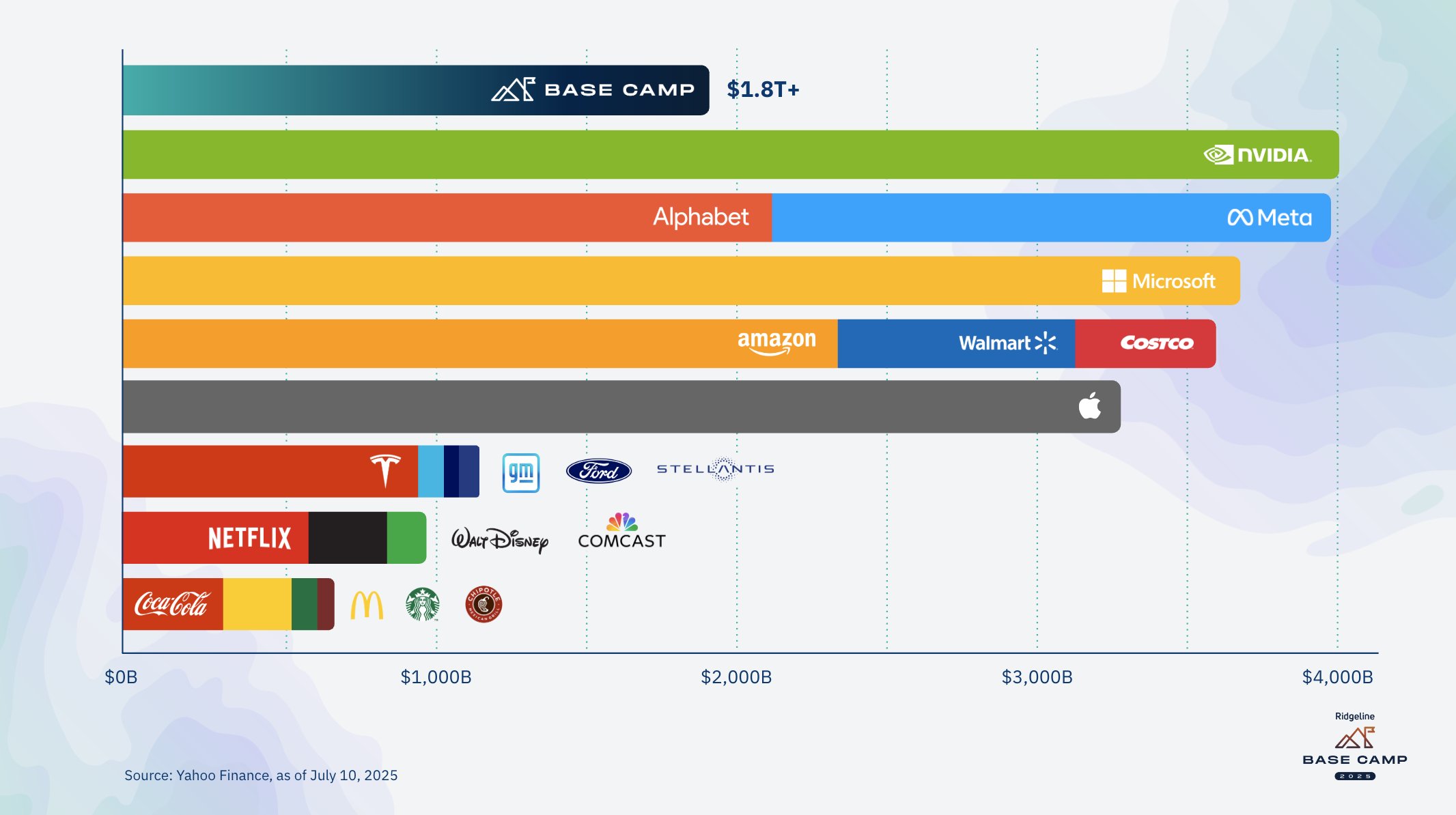
As of this writing, Nvidia’s market cap is $4.59 trillion. That’s double the GDP of Canada. It’s also six times the combined value of McDonald’s, Coca-Cola, Starbucks, and Chipotle.
My relationship with Nvidia goes back to my first job at Milwaukee PC, a local competitor to Gateway and Dell. Employees could buy hardware at a discount to build their own machines.
When building a computer, the first thing you buy is the CPU. It’s the brain. But the flagship part of every system I ever built was always the graphics card. Expensive, often scarce, and made by Nvidia.
The question is: Is Nvidia still a chip company that once sold me my first GPU, or are they now building AI factories capable of augmenting the intelligence of 55–65% of the world’s knowledge workers?
I wish I knew the answer. But what is coming into clarity are the fundamental driving forces behind the economics of AI.
The power of that understanding is what we aspire to give you in this week’s edition of Reading Ambitiously.
lynchjw.substack.com/p/readi…