

Econ x AI research @ Google | personal account
Palo Alto, CA
Joined June 2020
- Tweets153
- Following1.1K
- Followers1.8K
- Likes6.7K




Mihai Codreanu retweeted

New essay in @ForeignAffairs with James Manyika and @elerianm on steps that can be taken to help AI deliver on its economic promise, drawing on lessons from cooperative game theory as a guide.
Most conversations treat AI as a general-purpose technology (GPT), and some compare it to the Industrial Revolution. But we think it is more than that: it is also a method for creating new inventions, like the microscope or the scientific method. Economist Zvi Griliches famously called such discoveries IMIs--inventions of a method of invention. Seen this way, AI carries the potential of the Industrial Revolution and the Enlightenment combined.
Yet realizing this potential is a coordination problem. Delivering on the promise of AI requires progress not just on furthering its capabilities, but on building out infrastructure, deep adoption across the economy, and buy-in from many different groups. This is unlikely to happen if people do not feel they have a stake in the upside of the technology. Promises of abstract scientific and medical breakthroughs in the future won't change this when anxieties about near-term disruption are running hot.
Rather than treating AI like a zero-sum game, we argue that it is useful to look to cooperative game theory as a guide. Because models, compute, organizational change, and human upskilling are strong complements, AI has the structure of a "convex game": Each group that joins makes everyone else's contributions more valuable. That makes it possible to form stable coalitions of workers, communities, firms, and developers where incentives are aligned and everyone has a stake in the gains.
The cooperative approach will of course not be easy, but we will make the case that coalitions can start small and grow as the mutual gains become tangible. We provide concrete examples of how this can be done in practice and at scale.
Link to essay here: foreignaffairs.com/guest-pas…

I had a wonderful time talking to @AnneliesGamble about our AI in Science paper. You should check out her other interviews, she has very cool (much much cooler than me!) folks there.
Link to paper: arxiv.org/abs/2609.28504


Mihai Codreanu retweeted

There’s a lot of uncertainty around AI & its economic effects. Much focus so far has been on 1st order questions, but 2nd order questions are also important.
Today we lay out an AI research agenda for @Stripe Economics & invite thoughts & proposals.
stripeeconomics.com/p/an-emp…

Mihai Codreanu retweeted
New essay for the @GoogleDeepMind Institute with James Manyika on AI x Science, "Bending the Curve of Discovery".
While accelerating existing scientific practices is certainly useful, the real promise of AI is its potential to act as an invention of a method of invention (IMI) a la Griliches--e.g., the microscope or statistical inference--which would unlock questions and whole modes of discovery that were previously beyond human reach.
Today, LLMs and specialized models like AlphaFold act as economic complements. LLMs handle analysis, coding, and writing, while specialized tools handle domain-specific predictions. Most handoffs between them run through the scientist.
What may the future of science look like? LLMs orchestrating those handoffs automatically--prompting specialized models, auditing outputs, and looping until either the question is answered or a non-automated stage is reached (e.g., wet lab testing). The scientist's role shifts from running each step to designing this loop. We saw a glimpse of this workflow with Anthropic’s enzyme discovery a few weeks ago, and we're seeing this in our own work too.
This raises foundational epistemic questions:
1. What will scientific understanding look like when discoveries are made by black-box models whose output is increasingly difficult to interpret?
2. How do we extract underlying mechanisms, not just outputs, as science becomes more automated? What will theory look like?
3. If AI automates the writing and junior lab work, how do we train the next generation of scientists to push the frontier?
4. What will motivate scientists in this epistemic reality?
There's an economics angle too. Hypothesis generation gets cheap, so bottlenecks move downstream to verification and to choosing which questions are worth asking. Realizing AI’s full potential will take investment in infrastructure and institutional reform--making this as much an organizational challenge as a technical one
We don't have the answers yet, and I'd love to hear what others think.
Paper here: bit.ly/ai-in-science


Mihai Codreanu retweeted

"Scientific Work"
The methods paper describing the scientific task taxonomy we used in our AI x science report is a great example of creative method recombination. Features classification, clustering, LLM labelling & more. Data scientist catnip!
Network visualisation by Gemini 4.

Really cool to see (well, hear!) our AI in Science work mentioned in this excellent podcast as an example of good research!
Paper link here: arxiv.org/abs/2609.28504

How is AI changing the nature of economic research? And how should we think about the AI labs' output?
New ep of The Economics Show with Soumaya Keynes, feat. @AraKharazian (Ramp), @PeterMcCrory (Anthropic) and my brilliant @FT colleague @JBurnMurdoch
pod.fo/e/67c394

Mihai Codreanu retweeted
Very nice coverage of our piece on how AI is changing science from the FT today: ft.com/content/45088042-61e6…


Is AI turbocharging science?
Nice @FT coverage of our AI x Science paper. When you look at adoption & impact comprehensively you often find that complementarities & equilibrium effects offset some AI productivity gains - deployment in complex systems is complicated!

Mihai Codreanu retweeted
Is AI turbocharging science?
Nice @FT coverage of our AI x Science paper. When you look at adoption & impact comprehensively you often find that complementarities & equilibrium effects offset some AI productivity gains - deployment in complex systems is complicated!
Mihai Codreanu retweeted

And its a 3-way race again….


Mihai Codreanu retweeted

Happy to share this article which emphasizes the difficulties of using AI in science.
Why AI is speeding up scientific research but not lab experiments | Scientific American scientificamerican.com/artic…

Mihai Codreanu retweeted
Nice to see AlphaFold and other bio ML models being used in Anthropic's novel enzyme system research.
Illustrates the complementarities between LLMs and specialized models that we described in our recent AI for science paper. www-cdn.anthropic.com/225736… ai.google/static/documents/A…

Mihai Codreanu retweeted
Nice write up of our AI & Science piece in @sciam.
Link to piece: ai.google/static/documents/A…
scientificamerican.com/artic…
Mihai Codreanu retweeted

A couple months ago I joined the AI x Economy Research team @Google to help lead the program. This is a critically important time to study how AI is transforming work, productivity, and economic activity. Excited to collaborate with an incredible crew doing foundational research.
Mihai Codreanu retweeted
Google has been on a roll recently in releasing really interesting papers taking AI seriously and considering the policy implications.

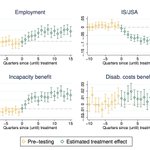
Second, no single policy is a silver bullet; there are serious tradeoffs across every dimension and durability scenario; policies that are easier to implement and command broad support are not durable to more transformative scenarios. At the same time, the analysis identifies policies that lay on the Pareto frontier of the dimensions we study, which points to a sequence of ``least-regret'' policies, which are triggered based on different economic scenarios.
This sequence includes an expanded Unemployment Insurance, modernized Earned Income Tax Credit, and employee-led retraining programs for Mild scenarios; the EITC transitioning to a Negative Income Tax for Moderate scenarios; and a Universal Basic Capital backstop for more extreme, full transformation scenarios. 4/n

Mihai Codreanu retweeted

This is an nice report tackling one of the most important questions: How might AI affect science and innovation? What impact is it already having today?
Great work, Mihai and team.

I've had the most wonderful time working on this project for the last few months. This was (equally) co-led w/ @JMateosGarcia , @alexolegimas and a fantastic team.

Mihai Codreanu retweeted
Study from Google about AI use in science, complex impacts: acceleration (7 hours saved per week) along with shifts in the kind of work (more verification) and what research gets done (possibly safer topics).
Also a good diagram of the jagged frontier ai.google/static/documents/A…

Mihai Codreanu retweeted

AI is already reshaping scientific research, according to an MIT & Google study.
Scientists use LLMs & specialized AI models for different tasks, save ~7 hours a week, & reinvest much of that time in research — but new bottlenecks are emerging: bit.ly/3UT2G7Q

Mihai Codreanu retweeted

Check out our new paper (and Arthur's excellent thread) on early empirical evidence for AI's impact on science ⭐️. Work led by the excellent @m_codreanu , @alexolegimas , @JMateosGarcia

Today @Google, we published work led by @m_codreanu on AI in Science, drawing on 15 million Gemini interactions, 2,600 specialised AI models & a 600-scientist survey. What did we find about how AI is changing science? Read on...
