Maddie Quam (@madquam) header
Maddie Quam (@madquam) profile picture

PhD in developmental psychology, studying sign language emergence and numerical cognition

University of Connecticut
Joined April 2018
Photo by Maddie Quam (@madquam)Photo by Maddie Quam (@madquam)Photo by Maddie Quam (@madquam)Photo by Maddie Quam (@madquam)Photo by Maddie Quam (@madquam)Photo by Maddie Quam (@madquam)Photo by Maddie Quam (@madquam)Photo by Maddie Quam (@madquam)
I may be a little biased bc I made the box plots 😅 but check out this very cool new article!
This Post is from a suspended account. Learn more
1
7
185
Considering grad school in Psych/related areas? Could you use some one-on-one advice? The MAGIC program provides underrepresented students/former students with mentors & application help! tinyurl.com/2p9enym9 Sign up by Fri Sept 15 to get a mentor in Sept! Please RT!
2
34
3
42
9,336
Had a great time at #MCLS2023 and glad I got to present some of our findings from the @SLAM_UConn project
1
2
8
402
Current theories argue that small quantity representation should not depend on language (e.g., you don’t need to count 2 dots to know it’s 2). HOWEVER, before now, no one had looked at how delayed/reduced access to a first language may impact early number concept development.
1
2
70
Still investigating the mechanisms that may be behind these unexpected results, so stay tuned 👀 And thanks to everyone who asked questions and gave feedback! It was so great to be able to share this research with all of you in Loughborough!
47
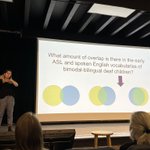
Great talk from @ejacobsp with Amy Lieberman, Jennie Pyers and Naomi Caselli about translational equivalents (knowing a word/concept in both languages) in bimodal bilingual deaf children’s ASL and English vocabularies! #BUCLD47
1
1
5
First presentation I’ve ever seen using ProTactile! Incredible work from Deanna Gagne and Hayley Broadway with Marjorie Bates and Jessica Ennis on early interactions between a DeafBlind child and a DeafBlind adult #BUCLD47 (alt text below in comments)
1
6
3
34
ALT: Hayley and Deanna seated onstage next to an English interpreter. Their slide on the emergence of ProTactile is projected beside a live video of the presenters. Hayley explains how before ProTactile, DeafBlind adults had to go through interpreters so no direct communication
1
Really interesting presentation on deaf children’s gaze-shifting patterns from @its_mhiggins with Allison Fitch and Amy Lieberman. Looking forward seeing future work! #BUCLD47
6
Presenting in Friday’s poster session with @MarieCoppola68 at #BUCLD47. If you’re curious about how language may be involved in nonverbal IQ tests, check out our poster! drive.google.com/file/d/1PLF…
2
4
1
13
Great parallel talk by Maddie Quam and Marie Coppola, also with author Diane Brentari on "Lexical conventionalization requires a community of primary users, communicative interactions are not enough" @TISLR14_Japan #TISLR14
2
10
Replying to @madquam
@madquam and @MarieCoppola68 presented to us their work on home signers and what strategies they use (handling vs object) for signs. They also found adult homesigners will combine both strategies, while children homesigners do not. Very interesting! #TISLR14
1
1
6
Excited to present at #TISLR14 today! We’ll be discussing how homesigners and their communication partners in Nicaragua share (spoiler: and do not share) iconic handshape strategies
This Post is from a suspended account. Learn more
1
1
1
12
Excited to announce my first ever publication!! Conventionalization of Iconic Handshape Preferences in Family Homesign Systems co-authored by @madquam, Diane Brentari and @MarieCoppola68 Read the full article here! mdpi.com/2226-471X/7/3/156/h…
1
1
1
11
Age also played a role! Adult homesigners combined iconic handshape forms more often Younger communication partners shared more handshape forms (high conventionalization) with the rest of their family
1
tldr; a community of primary users (deaf signers) is important for the conventionalization of signs in an emerging sign language, communicative interactions (one deaf homesigner in an otherwise all-hearing family) are not enough
1