

Co-Founder & CEO of Parloa. Redefining customer experience with AI.
New York City
Joined February 2020
- Tweets97
- Following614
- Followers700
- Likes140



One of the biggest mistakes founders make is setting “reasonable” goals.
Building businesses is about chasing what you believe in, even if it sounds impossible and even if it’s never been done before.
There’s no better signal to keep going than people calling you crazy.
Malte Kosub retweeted

need an agent watching over all of my personal agents (instinct, muse, grok bot, dot, etc).
not always trivial to know *who* did *what* when everyone is operating on the same data store and APIs - essentially email and calendars.
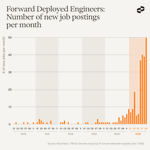
Companies use the term FDE (Forward Deployed Engineer) for two quite different roles that a lot of people misunderstand.
It gets treated as the golden weapon to destroy any problem, but what’s missed is that it’s actually split into two different jobs.
In my view, FDEs fall into two categories:
- Type 1 FDEs build 80-90% of the solution with each customer.
- Type 2 FDEs work on top of a product that already delivers most of the value, and bridge the last mile by connecting the backends and setting up the customer’s logic inside the platform.
This matters for two reasons, it tells you:
1. Whether you’re building a product or a service business
2. Who you specifically need to hire, because each type needs a different profile.
We wanted one platform where customers could build their own agents on top of it.
That is a Type 2 model.
A bunch of smart founders are hiring FDEs right now.
But it’s important to know which type you’re hiring: Ask yourself how much of the solution exists before the FDE shows up.
If the product already delivers most of it, it’s a Type 2.
If the FDE builds most of it with the customer, it’s a Type 1.
That decides how you build the product and which salespeople & FDEs you hire.

Malte Kosub retweeted

2 weeks ago we said we’d build a real wedding chapel on the @money2020 floor.
Well here it is!! The @taktile_org Chapel of Chance, plus Elvis officiant included. What happens in Vegas should never happen in financial services.

Malte Kosub retweeted

An AI agent can sound confident and still get the answer wrong.
Customers expect accurate answers, whether it’s a return policy, a price, or a shipping window - across every brand, channel and market. But without verified information, AI agents can end up guessing - causing escalations and poor customer experience.
Parloa Knowledge Skill grounds AI agent responses in your company’s own indexed content. With Knowledge Skill, you can go beyond simply linking to a knowledge base and instead:
→ Organize knowledge by brand, region, or product line so agents access the right information
→ Control what happens when an answer isn't available rather than relying on model-based improvisation
→ Create and update knowledge connections fast without code, using MCP-based Agent Skills
With Parloa’s Knowledge Skill, enterprises can confidently manage AI agent responses across every scenario and accelerate customer lifetime value.
🔗 Learn more: parloa.com/knowledge-hub/wha…
If anyone can build an agent, your edge is…
- Deterministic boundaries on critical actions
- Only the right context at the right moment
- Guardrails that hold under pressure
- Evals that define good before you ship
- Successful agent-to-agent interactions
- Authentication when calls are agent-to-agent
- Dedicated capacity so latency holds at peak
- Observability once agents are loose in production
Malte Kosub retweeted

Introducing FLUX 3 Max.
Fastest in the west. Fast enough to try anything. And everything.
Generate a 10-second video in 12 seconds.
Tied for #1 in image-to-video. 22× faster than Seedance 2.5 at the same quality.
FLUX 3 is a model designed for customization. @fal adapted and optimized it to create FLUX 3 Max.
Companies blocking AI agents is pretty understandable right now.
Delta is blocking agents from booking flights. Yelp is charging for access to its data. Others are restricting automated access to their websites.
I think companies have two options going forward:
Option 1: Keep blocking agents. You protect your data, ad revenue and for the time being direct customer relationships. But as personal agents become more common, customers may move to services their agents can actually use.
Option 2: Find a safe way to let agents in. Middleware verifies who they represent, what they’re allowed to do, and makes sure they follow your internal processes. This is what we have built and offer to our customers.
I think companies that don’t start building on agent middleware now are setting themselves up for a competitive disadvantage.

notice..
> Delta is blocking AI agents from booking flights
> JPMorgan Chase and Charles Schwab block agents from accessing accounts
> Yelp requires paid data licensing for agents
> Amazon has blocked Grok bot and other shopping agents.
the internet is starting to block AI agents that were supposed to do everything for us
When I interview candidates, I only test for 3 things:
1. Can they solve a hard problem in front of me? (talent)
2. How do they react if I try talking them out of it? (hard work)
3. Can they change their mind when proven wrong? (low ego)
If I see more excitement when I say it’ll be painful, that makes me really bullish.

The most important process we run before agents go live is the gym.
Simulation and evaluation.
It runs on 2 pillars:
- Test it before pushing to production
- Own the definition of right and wrong
The gym is where we put agents through 1000s of “new” conversations before they go near real customers.
If you’re deploying AI agents and you’re not sure they’ll hold up, build this continuous circle first and see what it does to your production quality.
It has a fixed structure:
1. Simulation.
We run the agent against simulated conversations before it goes live. During those runs, we push it through situations the demo doesn’t cover, and change the conditions to see where it breaks.
2. Evaluation.
After the simulations, every conversation gets scored against the criteria our experts define, surfacing the failures and showing us what to fix in the briefing.
The gym helps to identify, quantify and essentially improve the weak spots on a continuous basis.
It’s the process that makes sure our agents train before they play.
Malte Kosub retweeted

FLUX 3 is the strongest world model in the world.


FLUX 3 is #1 on Physics-IQ, @GoogleDeepMind's benchmark for physical world understanding in video models.
How Physics-IQ works: given the start of a real filmed experiment, can a model predict what physically happens next? Tests span fluid dynamics, optics, solid mechanics, magnetism and thermodynamics, covering how liquids flow, light behaves and objects interact.
In most cases, we substantially outperform all other frontier models, Seedance 2.5, MiniMax H3, Gemini Omni 1.1 Flash, Veo 3.1 and Sora 2, Cosmos3.
The FLUX 3 base model outperforms all other foundation models, while FLUX 3 paired with a physics verification layer scores even higher.
The FLUX 3 backbone, with its strong physics understanding, gives FLUX 3 Action it’s strong action prediction for robotics, while also giving FLUX 3 Video physically accurate motion when you’re creating content, making ads, films and product shots.


One of the biggest insights we’ve gained from running agents at scale is not judging their performance solely based on containment.
Because containment only indicates that the customer didn’t escalate.
An agent who frustrates someone into hanging up scores just as low as one who successfully resolves the issue.
Here are the key metrics we focus on:
1. Resolution rate
Did the issue the customer called about get resolved?
2. Sentiment trajectory
Was the customer's sentiment better at the end of the call than before?
It’s easy to become blind to agents once they handle millions of conversations. This approach finds a middle ground between listening to every call and judging performance based on a single bad metric.
It also makes managing them much easier.

A Harvard professor once invited some students over to dinner.
I ended up sitting next to him, and halfway through the evening he told a story about a student he’d once wanted as a teaching assistant for his computer science class.
The student said no. He had something important going on.
So I asked who it was.
He said the student was Mark Zuckerberg...
That dinner was one of the most memorable moments that pushed my thinking of ambition.
Anyone who makes an impact is just an ordinary human like you and me.
So here’s what I do now:
1. I reset the bar the second we reach it.
When we raised our seed at a $20M valuation, I told the team our next target was 50x. We hit the billion. Then I told them we’re aiming for $50B.
2. I hire for ambition over résumé.
Grit, intellectual capability and ambition matter more than anything else. Experience tells you what a person has already done, but if the goal has never been done, my team needs something else.
3. I allow myself to break things that work.
At the end of 2022, we had a product and customers, but we need to rebuild it on LLMs. So we took 95% of our engineers off the revenue-generating product and spent 18 months fixing it.
4. I’m always willing to dive deeper.
You delegate ownership as you scale, but when something isn’t at the bar you believe it should be, go in yourself and reset it. Gets your hands dirty.
5. I ask customers about the impossible.
I’m never asking about things we could ship in three months, I want to know what 10x solution would look like for them. Always aim for the moon.
One of our core values: “If other people aren’t telling you that your ambitions sound crazy, you’re probably not thinking big enough.”
We’re partnering with @Zalando!
Zalando has built one of Europe’s leading fashion and lifestyle platforms, serving millions of customers across markets and languages.
Very proud to work together and bring AI-powered customer conversations to Zalando’s customers across Europe!

Interesting directional result from our eval work:
We tested JEV against 13 models on 532 real world CX agent evaluations.
JEV: 88.7% accuracy
Next best: 79.5%
Still early, but a strong first signal.
If this holds up at scale, specialized decision models could become the default for a huge part of agent evals, with dramatically better economics and latency.

Being unfazed by rejection is one of the main traits you learn as a founder.
During our seed round, we spoke to 40+ investors and we also got a life-changing acquisition offer.
We could have sold Parloa. But we didn’t.
On December 23, with two weeks of runway left, one investor said yes.
It changed our company’s trajectory
We’ve raised $550M+ since then and we’re building what we dreamed of back then.
If you’re facing rejection, remember… it only takes ONE yes.