

ETH/CLS PhD candidate, interested in reinforcement learning and pizza making.
Joined November 2021
- Tweets99
- Following207
- Followers316
- Likes525



Marco Bagatella retweeted

On-policy learning is wasteful. Trajectories following an early mistake often don’t recover and waste many tokens on non-useful signal.
We study speculative self-distillation: sampling as on-policy as possible while correcting “stupid” mistakes early.
This improves the efficiency-accuracy-forgetting frontier.
Every token counts!
Awesome work with @talaei_shayan, @chewing_a_gum, @ckodser, Amin Saberi, and @Azaliamirh.

Introducing Speculative Self-Distillation (SSD, NeurIPS 2026), which pushes the accuracy–efficiency–forgetting frontier of self-distillation.
In SSD, student and teacher (the same model with additional information) write the rollouts together. Like a private tutor, the teacher lets the student write and takes over only when the student drifts too far. As a result, SSD trains on rollouts that stay as close to the student's own writing (on-policy) as possible while the teacher keeps them on track.
📉 38–69% fewer training tokens than on-policy, matching its accuracy
⏱️ Reaches on-policy accuracy in ~130 vs ~414 min (Science Q&A)
🧠 Forgets less in a stress test: −1.4 vs −4.5 points for on-policy
Over the last few months, we have gradually assembled the ingredients for generalist post-training of generalist policies.
In short: value estimation enables broader and more efficient improvement as task diversity scales.

Thanks to @MichalAKorniak and @ralfroemer99 for co-leading, to @max_simchowitz and
@ajwagenmaker for advising, and to the many great collaborators for the support :)
Check out Michal's thread for more!
📄 Paper: arxiv.org/abs/2611.06905
🔗 Website: lasgroup.github.io/generalis…
3
90
Marco Bagatella retweeted

SSL shouldn't require complex training recipes to scale, but the current SotA needs them.
Introducing JEM: a principled SSL method derived from information theory. The first latent patch-level objective demonstrated from 300M→7B params. Stable training, matches or beats DINOv3.
Spectral methods provide an elegant way to train representations for world modeling. Check out our work expanding the JEPA cinematic universe, led by @williamgpeng and @holger_molin with @randall_balestr :)

How do we tell a world model what’s interesting?
For JEPA, there are two open problems: what should be in the latent, and how do we put it there. We solved the second with spectral manifold learning. Spectral alignment is a framework for training world model embeddings to preserve a chosen similarity structure (i.e. depth, temporal distance, or other metadata).
Using our method, we get an average 51% relative improvement over LeWorldModel across three robot environments, including CALVIN. We also provide a theoretical analysis of the objective— check out the paper for details.
Paper: arxiv.org/abs/2610.15429
Blog: spectral-alignment.github.io…
Huge thanks to @holger_molin, @mar_baga, and @randall_balestr for a great collaboration! 🎉
22
561
Marco Bagatella retweeted

Doing proper science in robotics is hard, because human demonstrations are expensive and less controllable.
OCBench is a new benchmark providing "human-like" scripted policies. This enables scientific studies of BC and RL with virtually unlimited data!
Marco Bagatella retweeted

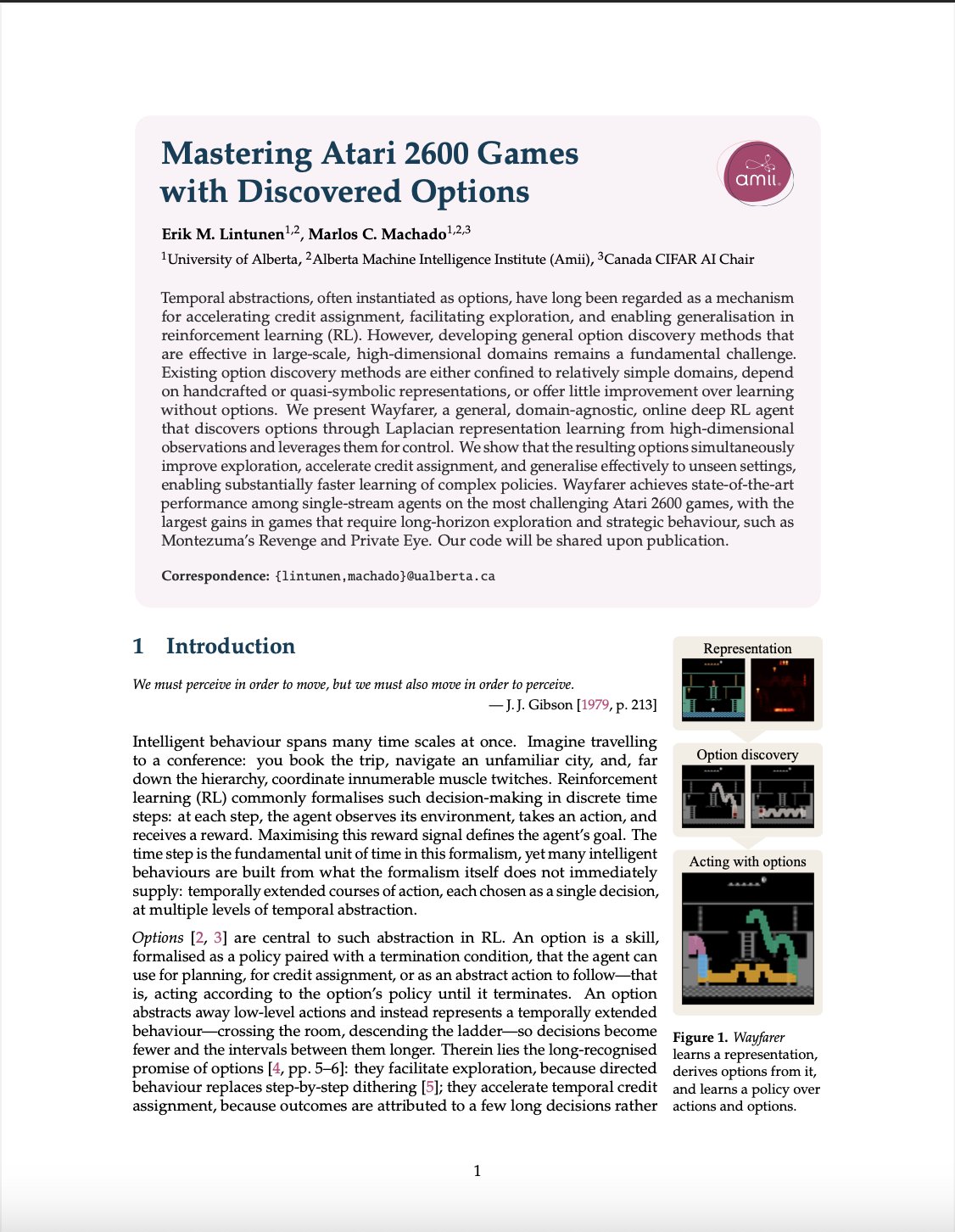
I'm excited to share Erik's work!
Mastering Atari 2600 Games with Discovered Options
We have a general-purpose option-discovery method that works w/ high-dimensional observations, tabula rasa, using a single stream of experience! It outperforms DreamerV3, Rainbow, and IQN! 1/9
Check out @MichalAKorniak and @dybek_kamil's latest work highlighting a neat synergy between action chunking and contrastive RL! This was a lot of fun :)
Self-supervised RL usually models one action at a time. We extended contrastive RL over action chunks instead, and found large gains: +31.7% offline, +93.1% online. Many explanations exist for why chunking helps. We find a new one: it improves the critic's representations.
25
1,717
Really cool work and cool joystick demo :)

Excited to introduce FB-MEBE, led by @jhu486 ! A Behavior Foundation Model (BFM)🤖 for quadrupedal control trained without rewards AND without pre-collected data! Given a reward at test-time, it recovers an optimal policy zero-shot and transfers seamlessly to real hardware.🧵
4
386
Marco Bagatella retweeted

Ontic Labs is coming out of stealth! and we're hiring!
We're excited to announce that Ontic Labs is one of 10 teams selected from over 500 across Europe to build the next Frontier Lab in Physical AI. Thanks to SPRIND for backing these teams with up to €125M in equity-free funding to build Europe's next frontier AI labs.
At Ontic Labs, we're building world models that teach robots how the world works, and reconstructing 3D humans to teach them how to act in it—all from plain video, at scale.
The founding team:
@omidtaherii
@mikel_zhobro
@wielandbr
@GMartius
@GerardPonsMoll1
If you are passionate about 3D/4D world modeling, 3D humans, or robotics and apply now! Let's build this together!
onticlabs.io

Check out our work on uncertainty quantification and active learning for VLAs!

How can Vision-Language-Action Models (VLAs) tell when they don't know?
Our new paper, "Uncertainty Quantification for Flow-Based Vision-Language-Action Models", tackles this challenge.
Paper: arxiv.org/abs/2606.18043
Website & code: tum-lsy.github.io/uq_vla/
Details: 🧵


Marco Bagatella retweeted

What’s the right representation for physical intelligence?
3DGSim uses a unified 3D particle representation for both state and action. This makes the model embodiment-agnostic: one arm, two arms, or any embodiments can interact with the world without requiring special treatment
Marco Bagatella retweeted

Vision foundation models predict hurricane intensity from satellite imagery remarkably well — and pass out-of-distribution tests.
Yet their internal representations collapse exactly where physics matters most.
We call this the Perception–Physics Paradox. New at ICML 2026 🧵
Congratulations to @AnselmPaulus, @Nmndsingh and team! Excited to see what you've been cooking :)

Today we are announcing our new startup: Exponential Security Labs.
AI agents are being deployed everywhere, making high-stakes decisions and increasingly automating research itself. Yet their reliability and security remain unsolved technical problems, on a frontier that keeps shifting. Our mission is to secure agentic systems through self-improving red-teaming and guardrail agents, leveraging autonomous AI research.
We sit at the intersection of safety and self-improvement, building on a decade of research in adversarial robustness and AI safety. We're looking for exceptional people to join us!
We're looking for exceptional people to join us on this mission, and we're also eager to talk to companies deploying AI agents who want to improve their security. Please get in touch!
More details: expsec.ai/
Founding team: @Nmndsingh, @AnselmPaulus, @maksym_andr, Matthias Hein

1
8
727
Marco Bagatella retweeted
Today and tomorrow we’ll be presenting self-distillation with orals at ICLR in Rio 🇧🇷
1. “Self-Distillation enables Continual Learning” at lifelong agents workshop (Sun 11:30am)
2. “Reinforcement Learning via Self-Distillation” at scaling post-training workshop (Mon 2:40pm)
3. “Test-Time Self-Distillation” at test-time updates workshop (Mon 4:15pm)


Marco Bagatella retweeted

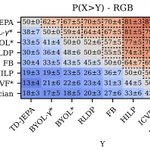
If you're at ICLR🇧🇷 come check out OpTI-BFM at poster P4-4504 tomorrow morning or as an oral at 4:03pm in the Amphitheater.


Which representations are meaningful for control?
We're presenting TD-JEPA as an oral at ICLR🇧🇷: a zero-shot reinforcement learning algorithm using self-prediction (JEPA) to learn representations that are predictive of long-term, policy-dependent behavior. It works pretty well!🧵
We are also open sourcing a codebase to accelerate research and train zero-shot agents across proprioception and visual domains. We reimplemented and tuned several algorithms to work as well as possible across 65 tasks: github.com/facebookresearch/…

Huge thanks to my great collaborators from META: Andrea Tirinzoni, @teopir, Ahmed Touati and Alessandro Lazaric.
Catch you at the conference!
Oral: Sat 25, 3:15PM, Amphitheater
Poster: Sat 25, 10:30AM, P4-#4606
arXiv: arxiv.org/abs/2510.00739
