

Technical Writer • $TAO Disciple Bright mind 💡 | Learning and unlearning... 🇳🇬 https://xitter.cf/t.co/UbLQjYSyJI
Point Nemo 🛟
Joined January 2022
- Tweets185
- Following460
- Followers672
- Likes140






𝚖𝚊𝚢𝚢𝚛𝚎𝚡 τ retweeted

Insurance claims run on photos. So what happens when the photo is lying?
I built my #PerturbVideo submission around that question, using Angle 3: The claim that never happened
A real example was reported by The Guardian in May 2024. A van photo was taken from a tradesman's social media, edited to show a cracked bumper, and sent to UK insurer LV= with a fake invoice for more than £1,000. LV= had concerns and passed it to its fraud team. Allianz UK said claims involving app-edited images, videos and documents rose 300% between 2021-22 and 2022-23
My video then plays out a clearly labeled, made-up scenario where an automated claims model approves a doctored photo. A few tuned pixels that a person would never notice can leave a model wrong and still confident
The cost doesn't just vanish. Insurers cover the payout, and honest policyholders feel it in their premiums. The Coalition Against Insurance Fraud estimates US insurance fraud at $308.6 billion a year in its 2022 study, which is an industry figure and not something Perturb measured
Perturb @perturbaix flips the usual order and breaks the model first, before a fraudster gets the chance. On Bittensor Subnet 26, miners search for the smallest change that makes a model's answer flip. Validators confirm the flip is real and the change stays invisible, copied work gets no reward, and whoever finds the best attacks earns the most $TAO
For the team behind the model, that testing turns into a robustness score, a vulnerability heatmap, verified attack data to retrain on and an on-chain certificate of testing. Details live at perturbai.io
As of now, image-model testing is live and the network has been running since May 2026. Text, LLM and multimodal attacks are still on the roadmap, and November presales are a target rather than a done deal
𝚖𝚊𝚢𝚢𝚛𝚎𝚡 τ retweeted

AlphaRidge puts research, screening, and automation in one place instead of five tabs and three subscriptions.
A trader finds a setup on the screener, turns it into a rule, and the rule keeps running and alerting even with the browser closed.
@alpharidge_ai maps a few ways the workflow actually closes:
> Screening on news: Sort the whole market by 7-day sentiment, event clusters, and impact scores instead of just price and volume.
> From idea to rule: Paste a TradingView Pine script into RidgeScript, test it, then arm alerts to Discord, Telegram, or email.
> AI that shows its work: The analyst writes screens and marks up charts, then surfaces the exact platform data it used so you can check it.
The neat part is the news layer. Miners on SN45 turn hundreds of thousands of articles a day into screenable sentiment and events, so the screener can look at what is being said, not just what already happened.
Paper trading is free today. Live brokerage execution is still rolling out. The AI cites its sources, but you still have to confirm before anything is placed.

𝚖𝚊𝚢𝚢𝚛𝚎𝚡 τ retweeted

I saw that @heydittoai walked through Ditto v2 at Exploit Summit, including the bit where an agent switches platforms and keeps the context.
Their own write-up uses a case that is basically one sentence: point the new agent at the old one and tell it to mind meld. No rebuild.
To give you some more context on this, a normal chat remembers you only inside that app. Claude does not know what you told Cursor, and a new agent starts from zero.
But if the spec changed in Telegram, or you moved from one coding agent to another, Ditto v2 keeps one memory under the tools and waits for a yes before it sends or edits anything risky.
So the flow would look something like this:
▸ You say it once, in Claude, Cursor, Codex or Grok, and the others can already use it.
▸ Telegram and Slack sit next to the docs and the code, so the agent can search the decision, not just the repo.
▸ A workflow or browser agent runs the job, and the step that could do damage waits for your approval.
Depending on the tool, you stay in that chat or leave with the memory exported.
This ties back to what I wrote before: the models got good at answering, but you are still the switchboard between them.
That’s the part Ditto v2 is building for, even when the handoff is a single sentence.
What other agent handoffs should I look into?

𝚖𝚊𝚢𝚢𝚛𝚎𝚡 τ retweeted

SayGM (SN28) might be the best AI altcoin that noone is talking about 💎
This $TAO subnet has rapidly become a blue chip in the Bittensor ecoystem
Why?
First of all, their new desktop app allows anyone to access Claude, ChatGPT, Gemini, and Llama for up to 70% cheaper and privately
Currently at $5M ARR and growing 🤑
Secondly, their new growth marketing affiliate program "Proof of Customer affiliate pool" is turning heads:
- @say_gm_ pays people who refer new developers that actually spend money on its AI gateway
- You can earn up to $1 worth of SayGM Subnet 28 alpha for every $1 your referrals spend during their first 30 days
Example: you refer a developer who spends $1,000 -> you could earn up to $1,000 worth of SN28 alpha
- The rewards do not come from SayGM's normal business revenue or marketing budget. They come from a pool funded by Subnet 28 emissions
So now they have an amazing product and an effective growth strategy
Sky is the limit here 🚀

𝚖𝚊𝚢𝚢𝚛𝚎𝚡 τ retweeted

One of the biggest announcements from @ExploitSummit Montreal may have flown under the radar.
@green_compute_ $SN110 announced another $4M data center expansion after already bringing a $3M facility online.
Their target? Roughly $300K/month in revenue from renewable-powered compute.
This comes after Green Compute reported $82K+ in profitable revenue in its FIRST month on Bittensor.
Real GPUs / Real enterprise customers / Real revenue. AND 10% of contract revenue flowing toward alpha buybacks.
If you missed them present at Exploit, here's the link to the full presentation:
xitter.cf/green_compute_/status/…

For those who were not able to join us, here`s our full presentation from Exploit Summit 2026 @ExploitSummit where we proudly announced our next big step. 🚀
𝚖𝚊𝚢𝚢𝚛𝚎𝚡 τ retweeted
TAO wallets are becoming portfolio tools, not just key storage.
@CrucibleLabs is building the place where a Bittensor position should stay usable.
The wallet can hold TAO and alpha in one balance, swap across subnets, claim rewards, and route root yield through Smart Allocator.
The goal is keep custody with the user, cut the spreadsheet, and put earned rewards back to work.
Over time, the same surface expands into:
▸ Subnet-level performance
▸ Ledger on mobile
▸ Multi-address control
That gives the wallet a bigger role than sending and receiving.
It can support swaps, staking visibility, and reward allocation without a separate tool for each step.
The wallet becomes the balance sheet for a TAO position.

Most AI security testing asks whether a model works under expected conditions.
@perturbaix focuses on a different question: what small change would make the model get it wrong?
On Bittensor SN26, miners compete to find adversarial inputs that flip an image model's answer while keeping the change imperceptible. Validators verify the results, and rewards favour successful attacks rather than duplicated work.
That produces something useful beyond a leaderboard: structured evidence of model weaknesses that customers can use to assess robustness and support retraining.
The customer-facing outputs include robustness scores, vulnerability heatmaps, verified attack data and an on-chain certificate of testing.
This matters for applications where image-model mistakes have real consequences, including identity verification and claims processing. The point is to expose weaknesses through testing, not to assume a model is reliable because it performs well on ordinary inputs.
Perturb's image-model testing is live today. Broader text and LLM testing remains planned, not live.
You can find what the network is building here: perturbai.io
#Bittensor #SN26 #AIsecurity
[BITCAST BRIEF]
An AI model can be confidently wrong because of a tiny change to its input.
That creates a problem for anyone relying on AI for image-based verification: if a small, hard-to-notice alteration can flip a model's answer, how do you find that weakness before someone exploits it?
Perturb is tackling this on Bittensor Subnet 26.
Its miners compete to discover minimal changes that fool image models. Validators then check whether the attack actually changes the model's answer and whether the alteration remains imperceptible. Simply copying another miner's result isn't enough.
Customers can get robustness scores, vulnerability heatmaps, verified attack data to support retraining, and an on-chain testing certificate.
Image-model testing is live. Text, LLM and multimodal attack testing are still on the roadmap.
The idea is straightforward: use AI to find weaknesses in AI before attackers do.
Explore Perturb at perturbai.io
@perturbaix #Bittensor #SN26 #AI
[BITCAST BRIEF]

One thing worth paying attention to in Bittensor is the difference between a subnet with a roadmap and a subnet with a product people already pay to use.
AlphaRidge is in the second category.
It brings market research and trading automation into one platform: stock charts and ratings, a screener covering roughly 4,500 US stocks plus crypto, Pine-compatible scripting through RidgeScript, backtesting, alerts and an AI analyst that can build screens and scripts.
The Bittensor connection is specific: AlphaRidge's news and events engine is powered by SN45. Its miners process roughly 275,000 articles a day, grouping related coverage into events and tagging them with information such as sentiment, impact and affected tickers.
That output is part of a live product, not just a subnet demo.
That's a useful example of how Bittensor infrastructure can connect to a product with paying customers.
Explore it: alpharidge.ai
@alpharidge_ai #Bittensor #SN45
[BITCAST BRIEF]
A Bittensor subnet is more interesting when you can point to a product and explain what it actually does.
Ditto is SN118, built by Omni Aura. Its V2 release brings shared memory across AI tools into a practical workflow: connect Claude, Cursor, Codex and other supported clients, bring in existing conversations, and make that context available where you work.
You can also connect apps like GitHub and Google Workspace, ask questions about your connected information, automate recurring tasks, and build small apps through Ditto Code.
The subnet has a feedback loop behind the product: miners compete to improve memory quality on DittoBench, and winning work can ship to users. Ditto also uses inference from other Bittensor subnets.
Want to try it rather than just read about it?
Sign up at heyditto.ai. You get $1 in starting credit without a card, plus opportunities to earn more credit by connecting eligible apps.
@heydittoai #Bittensor
[BITCAST BRIEF]

One frustrating part of using multiple AI tools is having to rebuild context every time you switch.
Claude knows one part of your project. Cursor knows another. ChatGPT has a conversation the others can't access.
Ditto V2 gives them a shared memory.
Connect supported tools through MCP, bring in your existing AI conversations, and let Ditto build a memory from what you tell it. Switch models without starting over, or ask about information stored across your connected chats, documents and code.
It goes beyond memory, too. Ditto can run scheduled workflows, use a cloud browser for website tasks, and build small apps through Ditto Code. Actions that send, spend or delete require your approval.
Ditto V2 is live.
New accounts get $1 in free credit, with no card required. Connecting eligible apps can add up to $4 more during your first 14 days.
Try it: heyditto.ai
@heydittoai #Bittensor #SN118
[BITCAST BRIEF]
Most Bittensor subnet emissions reward the supply side: compute, models, data, and other contributions.
But who gets rewarded for bringing in paying customers?
That’s the idea behind SayGTM from SayGM (Bittensor SN28).
Its new Proof of Customer affiliate pool directs a portion of subnet emissions to affiliates who refer customers that actually pay for AI inference.
You share your referral link. When a referred customer pays SayGM, your share of the pool is based on their qualifying spend during their first 30 days.
It connects subnet emissions to something measurable on the demand side: customer revenue.
Explore the model: saygm.com/affiliates
@say_gm_
#Bittensor #SN28
Green Compute's model starts with a problem outside crypto:
energy that isn't being fully monetised.
Its approach is to turn that underutilised energy into GPU infrastructure, then connect that compute to businesses that need reliable, permanent capacity.
That's where the flywheel starts:
More infrastructure → larger contracts → more demand → more infrastructure.
The recent ~$3M deployment followed by another ~$4M announcement is important because it shows that flywheel beginning to operate at a larger scale.
If Green Compute can keep connecting energy producers, infrastructure capital and enterprise compute demand, SN110 could become a coordination layer for bringing permanent compute into Bittensor.
@green_compute_ #Bittensor
[BITCAST BRIEF]
𝚖𝚊𝚢𝚢𝚛𝚎𝚡 τ retweeted
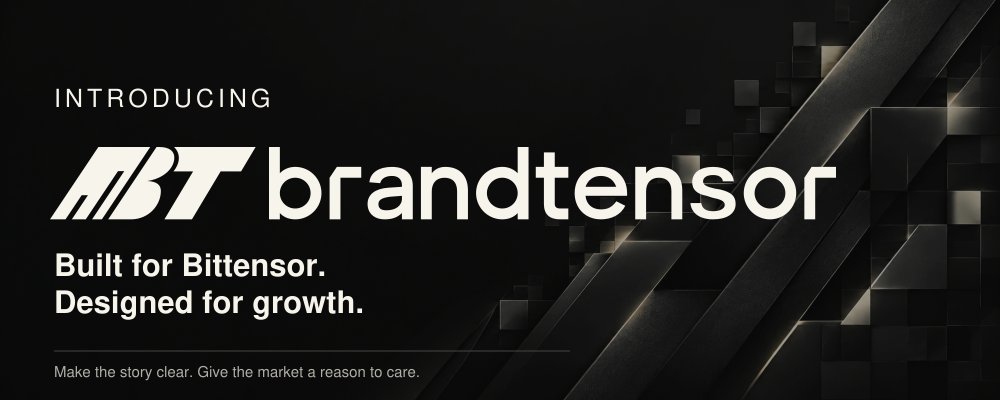
imo @brandtensorAI is attacking subnet growth from too many angles at once.
i'm really curious how one team keeps brand, proof, community, and outside demand in the same system.
skip the agency-brochure side for a sec and look at what they actually force a subnet team to ship:
+ a clear value prop before the launch thread even exists
+ different messaging for miners and validators vs AI users and enterprises
+ a proof system so the strongest claims have evidence behind them
+ use-case and demo plans instead of another architecture dump
+ distribution that does not stop at the TAO timeline
for founders there's also a shared growth plan: what to say, where to say it, and how to measure if it worked
this is the brandtensor playbook: make the tech choosable, then take it to market
➜ the goal is simple: turn technical progress into trust, adoption, and people who actually use the product
respect to the team for going this hard on a problem most subnet founders treat as an afterthought.


𝚖𝚊𝚢𝚢𝚛𝚎𝚡 τ retweeted

SN80 OpenRoboto is breaking one of robotics’ biggest walls: data locked inside closed companies and single ecosystems.
Shift turns real-world human work into robot training data, while @openroboto is distributing that network across Base and Robinhood Chain.
Physical AI, opened up. bittensor:native robinhood:0x6f63d869011f95274498023b4abfc00b30c34378


The rebuilt Crucible Wallet Chrome extension is more than a UI refresh.
The new version brings much more of the Bittensor workflow directly into the browser.
One feature I find particularly useful is the subnet discovery + detailed subnet views.
Instead of treating the wallet as somewhere you only send and receive TAO, it becomes a place to actually explore the subnet ecosystem.
Add unified TAO + alpha balances, Universal Swap, reward claiming, transfers and multi-address support, and the extension starts looking much more like a Bittensor workspace.
That’s a meaningful direction for a wallet built specifically around Bittensor.
@CrucibleLabs $TAO
cruciblelabs.com
[BITCAST BRIEF]

Bittensor is getting easier to manage from a phone.
I’ve been looking at Crucible Wallet on mobile, and the part that stands out is how much of the Bittensor workflow it keeps in one place.
You can manage TAO and subnet tokens, stake or unstake, swap assets, send/receive TAO + alpha, and track your portfolio from the same wallet.
I particularly like the ability to choose your validator rather than having that decision abstracted away.
For anyone actively moving between TAO and subnet positions, having that workflow available on iOS/Android is useful.
Crucible Wallet is also now available on iOS in Canada.
Check it yourself at: cruciblelabs.com
@CrucibleLabs #Bittensor $TAO
[BITCAST BRIEF]