

Systems thinker. AI alignment, infrastructure & governance. When incentives shift, behavior reorganizes. Form precedes intention.
Groningen
Joined January 2010
- Tweets230
- Following189
- Followers42
- Likes22




Pinned Tweet
I just published Instrumentation Scope Is Context, Not Ownership medium.com/@glindje/instrume…
1
2
67
Two Bumps, one question:
What does 9 have to do with the Riemann hypothesis?
Move two bumps apart and 3² leaves a trace. Keep sliding and watch the primes pull away from their smooth average. The Riemann hypothesis puts a limit on how far they can stray.
weil-bump-lab.mcgluut.chatgp…

17

Removing a name doesn’t remove an idea.
In its Navier–Stokes post, OpenAI can’t rule out de-identified usage data helping improve its models, though unlikely.
@OpenAI @sama: do training opt-outs cover derived data and internal research models?
openai.com/index/navier-stok…

1
36
A local synthetic OTLP replay against the v0.26.0 release binary kept two otherwise identical spans distinguishable by scope. Remove scope, and that distinction disappears. Change the selected span name, and the policy finds nothing. 3/4
```
1
10
Instrumentation scope is context—not operation ownership or authorization. Inspect the instrumenting software associated with telemetry; bring separate evidence for who initiated, authorized or owns the operation. Implementation: github.com/open-telemetry/we… 4/4

10
Two spans can have the same name and attributes yet come from different instrumenting software. Scope preserves that distinction: name, optional version, schema URL and attributes. Useful context for policy—not a verdict about who owns the work. 2/4
1
22
A local synthetic test at the merged commit kept two otherwise identical spans distinguishable by scope. Remove scope, and that distinction disappears. Change the selected span name, and the policy finds nothing. The release binary was not rerun. 3/4
1
20
Instrumentation scope is context—not operation ownership or authorization. Inspect the instrumenting software associated with telemetry; bring separate evidence for who initiated, authorized or owns the operation. Implementation: github.com/open-telemetry/we… 4/4
7
The Last Science doesn't seek the theory of everything.
It maps which relations travel, how far, and where reality makes them stop.
16
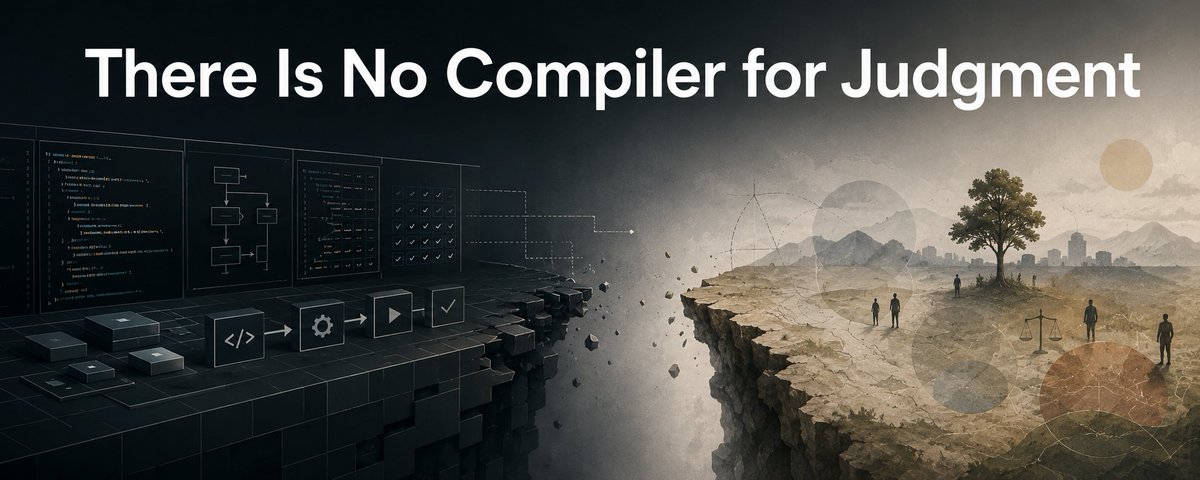
There is no compiler for judgment.
That is why AI looks least jagged in code, and most slippery where legitimacy, architecture, responsibility, or long-term consequence matter.
I wrote this to separate local demonstration from actual adequacy:
teapawt.org/mcgluut/status/2054270…

1
1
55
The @garrytan / @demishassabis YC conversation was one push here.
The part that stayed with me was the agent question underneath: what kind of environment lets a system improve without quietly inheriting authority?
That is where judgeability and containment meet.
1
26
First the McGluut gstack fork landed in @garrytan’s main repo.
Now gbrain has the same treatment: Windows/CRLF portability, path handling, postinstall, and default-gate hardening rebased onto v0.27.
PR #647 is open and locally green: 3820 pass / 0 fail / 11 skip.
47
An agent does not need to "go rogue" to become dangerous.
It only needs interpretation and irreversible authority inside the same loop.
Longer piece: why containment beats accidental agent sovereignty.
teapawt.org/mcgluut/status/2051272…
🤖 Made with AI

43