

CEO & Founder at https://teapawt.org/t.co/PbMuvR5xHF, https://teapawt.org/t.co/NfC0ehCkMf, https://teapawt.org/t.co/zqxU0rXwnD and https://teapawt.org/t.co/Ta7uTJKakx.
London
Joined January 2012
- Tweets27K
- Following8.4K
- Followers4.4K
- Likes33.6K





Pinned Tweet
A regulatory case can change direction because of a few words.
In the Bet3000 case, Malta Media examined how externally supplied information was communicated to the GGL, referenced in court submissions and later clarified.
The issue is not whether information should be reported to regulators. It should be.
The real question is what happens next.
Was the information treated as an initial report, a verified finding or something strong enough to support arguments before a court?
The documents do not allow sweeping conclusions about internal procedures. But they do raise legitimate questions about verification, evidential framing and procedural fairness in urgent administrative proceedings.
malta-media.com/bet3000-case…

Evolution could win its November court battle, only to face a bigger nightmare. If the Black Cube lawsuit survives, discovery could expose sensitive business records.
With Playtech waiting in the wings, is Evolution winning the battle but losing the war?

1
8
64,179
What happens when confidential information from gambling regulators becomes part of an international investigation? And how do we balance the public interest in exposing wrongdoing with the privacy of people whose records are involved?
In our latest video, we examine @LilithWittmann 's recent @finanzfluss interview, her investigations into online gambling and the questions surrounding access to confidential regulatory information in Malta and Curaçao.
We also look at the involvement of international media partners, the handling of sensitive documents and the information reportedly provided to German prosecutors.
The purpose isn't to dismiss investigative journalism. Quite the opposite. Serious investigations deserve proper scrutiny, including questions about how information is obtained, shared and protected.
There are different perspectives on these issues, and we believe they deserve an open, evidence-based discussion.
The link to our video on LinkedIn is available in the comments.
Full video available here: lnkd.in/p/dt7MSQtF

3
192
First, @LilithWittmann obtains documents from hacked gambling regulatory systems. Then passports, residential addresses and other sensitive information become publicly accessible. And now somebody apparently wants @BITCOIN to make information disappear!!!

1
4
496
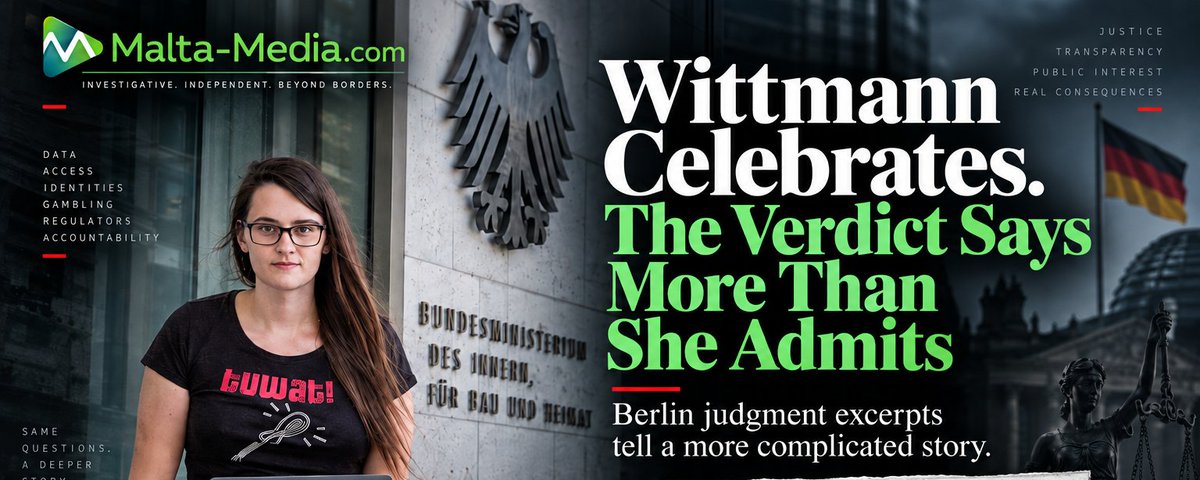
Lilith Wittmann celebrates her Berlin court victory. Unfortunately, the judges appear to have read a different case.
I have now read the complete 24-page judgment from the Landgericht Berlin II concerning @LilithWittmann and the @MaltaGamingAuth . Judging by her celebrations on @LinkedIn, you might think the German courts had given her a medal for investigative journalism and a licence to hack regulators whenever she feels like it.
Unfortunately for Ms Wittmann, the actual judgment tells a rather different story.
The court upheld an injunction based on § 202a StGB, Germany's criminal provision concerning unauthorised access to protected data. The judgment describes a false identity, a disguised account and the circumvention of access controls to obtain protected regulatory information. It refers to 3,027 instances of access to documents and information that were never intended for her.
Those are findings in a civil injunction proceeding, not a criminal conviction, but hardly something I would celebrate as a complete vindication.
And then there is the rather inconvenient question of money. Wittmann must bear half the court costs and three-fifths of the MGA's recoverable extrajudicial legal costs. Quite a remarkable financial outcome for somebody presenting herself as the winner of the entire dispute. Perhaps the celebratory LinkedIn posts should have included that detail.
Yes, Wittmann successfully defended her right to criticise the MGA and the court rejected other parts of the regulator's application. Nobody disputes that. But the judges did not give her unrestricted permission to hack regulatory systems, distribute confidential information or publish people's private records.
@MaltaMediaNews has examined the judgment and included extracts showing exactly what the judges decided.
Apparently, @LilithWittmann has discovered a fascinating new definition of winning in court. Celebrate loudly on @LinkedIn, conveniently forget the injunction and hope nobody reads the actual judgment. Unfortunately for Ms Wittmann, we did.
1
3
54,423
There is something rather convenient about spending months investigating everybody else's money, business relationships and private lives while apparently nobody is particularly interested in examining the financial arrangements behind the investigation itself. Accountability for everybody else, but the journalist gets a free pass? How wonderfully convenient.
Let's talk about @LilithWittmann , PlatinCasino and Thomas Kalman.
German prosecutors are investigating alleged illegal gambling involving approximately €5.86 BILLION in wagers. Serious allegations, certainly, and something the authorities should investigate thoroughly. But while everybody is fascinated by the expensive cars, luxury lifestyles and corporate structures, I am interested in something rather different.
WHO ACTUALLY BENEFITS IF PLATINCASINO DISAPPEARS?
Its customers will not all suddenly stop gambling. Competitors could acquire valuable players, affiliates could redirect traffic and other operators might find themselves facing considerably less competition. We are potentially talking about substantial commercial opportunities.
So I have a few questions for Ms Wittmann. Who originally supplied the leads? Who financed the investigation? Did anybody with a commercial interest provide resources, assistance or financial support?
I have seen no evidence that a competing operator paid Wittmann, and I am not claiming that happened. But surely somebody who spends so much time investigating other people's financial arrangements should appreciate why these questions matter.
And while we are discussing journalistic standards, perhaps @NDRrecherche and @FTM_eu, both associated with the wider Casino Secrets reporting, might also appreciate questions about editorial independence, source verification and how sensitive regulatory material was handled.
Then there is the rather extraordinary decision to publish a photograph of a food delivery outside Kalman's private apartment. Seriously, Ms Wittmann? What exactly does somebody's shopping establish about alleged tax evasion? Have we reached the point where even a five-kilogram food parcel is now considered investigative evidence?
The wider investigation also involves sensitive information obtained through unauthorised access to gambling regulators, including @MaltaGamingAuth. Those methods and the subsequent handling of private documents deserve scrutiny in their own right.
My latest @MaltaMediaNews editorial examines the commercial interests, the potential beneficiaries and the questions that nobody should be afraid to ask.
Ms Wittmann wants transparency from an entire industry. Excellent. I would now like to see that same principle applied to the investigation itself.
Accountability should work in both directions. How terribly inconvenient.
Who makes money if PlatinCasino disappears? Competitors could inherit customers and affiliates could redirect millions in traffic. But who supported Lilith Wittmann 's investigation and who benefits? Malta Media asks the uncomfortable questions.

4
58,195
There is something almost comical about watching Lilith Wittmann lecture an entire industry about transparency, accountability and wrongdoing, while apparently expecting everyone to stop asking awkward questions the moment her own methods come under scrutiny. Accountability for everybody else, but a special set of rules for the journalist? How wonderfully convenient. Apparently, shouting “JOURNALISM!” loudly enough is supposed to make all those uncomfortable questions disappear.
Let us remind ourselves of a few rather inconvenient facts. Wittmann publicly told the Malta Gaming Authority: “Yes, I hacked you.” The Curaçao Gaming Authority reported that an account linked to her domain obtained database access within hours, with that access remaining available for roughly nine months. Its forensic findings identified 14,054 data-returning requests, 373.78 GB transferred and material from 1,355 organisation folders, with approximately 123 GB estimated to be unique. Quite an impressive collection for somebody who seems so enthusiastic about holding everyone else accountable.
And please spare me the romantic nonsense about heroic hackers saving the world. Exposing hidden shareholders, questionable ownership structures or actual wrongdoing can absolutely be journalism. But passports, private residential addresses and unrelated KYC documents do not suddenly become legitimate public-interest material simply because somebody managed to get their hands on them. Journalism is not a magic washing machine that turns every questionable method and every unnecessary disclosure of private information into something respectable.
And while we are at it, the MGA and CGA should not be getting a free ride either. These regulators demand mountains of sensitive personal information from people and companies, yet apparently struggled to protect it adequately. If you cannot secure the information you legally require others to surrender, perhaps a little less lecturing and a lot more explaining would be appropriate.
Now let the police, prosecutors, data-protection authorities and relevant media regulators examine the evidence and determine whether any legal boundaries were crossed. Those are perfectly legitimate questions, regardless of how uncomfortable Wittmann might find them. For once, Ms Wittmann may have to answer some difficult questions instead of simply asking them. How terribly inconvenient.
Who appointed Lilith Wittmann judge, jury and untouchable journalist? She admits hacking regulators, yet questions about her methods and sensitive personal data are apparently inconvenient. Since when did “journalism” become a free pass?

8
250,150
iGaming Society is back this Thursday, 23 July. I always like these evenings because they are not about forced networking or standing around with a name badge trying to sell something.
It is more relaxed than that. Good people, good conversations, drinks, music and a setting where you can actually talk properly. So if you are around and part of the iGaming scene, come by.
It should be a nice evening. See you Thursday. RSVP now: igamingsociety.rsvpify.com/

4
612
Michael Schmitt retweeted
Supporting businesses with corporate structuring, compliance and licensing services across international markets.
EM Group works with companies that need clear, practical support in regulated sectors. Simply next level.


The German channelisation problem is not a theoretical dispute between regulators and industry. It is a consumer protection question. Legal offers protect players only when players use them. Every player who leaves the licensed framework is also leaving the tools that make the framework meaningful.
The official figures published by the GGL suggest that a substantial majority of online gambling activity is inside the regulated market. That is important and should not be dismissed. But a remaining illegal share of 23 percent, as referenced by the GGL in relation to the 2024 study, still represents a serious challenge for a system built on channelisation. The question is not whether Germany has created a licensed market. The question is whether that market can continue to attract and retain enough consumer behaviour to justify confidence in the model.
The licensed market cannot be expected to carry this burden alone. It needs consistent enforcement against illegal alternatives, clearer consumer communication, a credible commercial framework and regulatory decisions that are tested against behaviour rather than intention. The strongest consumer protection system is not the one that looks strictest in isolation. It is the one that keeps the player inside the protected environment.
That is the uncomfortable lesson. A legal framework does not win consumer behaviour automatically. It has to earn it, defend it and measure it continuously. If friction, uncertainty or commercial weakness in the regulated market strengthens alternatives outside the intended framework, then channelisation becomes less a regulatory slogan and more a warning sign.

4
293

Germany has some of Europe’s strictest online gambling rules, yet almost 23 percent of the market is still estimated to sit outside the regulated system. That should make regulators deeply uncomfortable. Strict rules only protect players who remain with licensed operators. Once a player moves offshore, most of Germany’s carefully designed safeguards disappear.
There is no German €1,000 deposit limit, no LUGAS monitoring and no OASIS protection on an unlicensed platform. There are also no mandatory cooling-off periods, no German slot-speed restrictions and no meaningful German supervision. The entire protection model depends on players choosing to stay inside the legal market. That assumption deserves far more scrutiny than it currently receives.
Germany restricts deposits, stakes, game speed and parallel play. Some of those measures may prevent harm, and that must be recognised. Others, however, may make the licensed market slower, more frustrating and less attractive than unlicensed alternatives that are only a few clicks away. That is not strong consumer protection if vulnerable players respond by leaving the supervised environment.
A regulator can point to technical systems, legal restrictions, enforcement notices and a growing whitelist of licensed operators. None of that proves the market is working as intended. The important question is whether high-risk players remain inside the legal system or migrate towards operators with fewer safeguards. Without that answer, Germany is measuring regulatory activity rather than regulatory success.
The official channelisation figure may look respectable in a political presentation. It becomes much less impressive when nearly one quarter of the market may still be outside supervision. It becomes even more concerning if the players leaving are those most attracted to faster products, higher stakes and fewer restrictions. A headline percentage cannot tell us where the greatest risk is concentrated.
Germany does not need another speech about how strict its gambling rules are. It needs evidence showing whether those rules actually keep vulnerable players safer. If strict regulation pushes players towards offshore operators, the country has not reduced the danger. It has simply hidden it behind a more impressive legal framework.
malta-media.com/player-prote…

3
289
