

@Blockworks_ @blockworksres | prev @Citi | views are my own
Joined May 2023
- Tweets2.8K
- Following6.4K
- Followers4.4K
- Likes18.7K




Racing toward zero fees isn’t automatically good for the network.
@Aptos raised its gas schedule 10x, yet the median transaction still cost around $0.0003 and despite this, daily activity doubled between February and September.
Although it is important to not crowd out onchain use cases, testing the Laffer Curve is also important to create value accural for token holders.


Alpenglow is showing up in the data.
Valid Blocks measured average finality of 252ms on @solana over 30 minutes today.

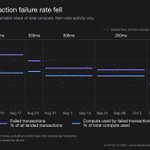
.@solana's failure rate fell alongside faster slots.
Comparing the 400ms and 200ms periods, the share of landed non-vote transactions that failed dropped from 44.5% to 30.6%.
Failures also consumed less of the total non-vote compute: 29.8% → 20.9%.
Esentially this means a bigger share of compute going to transactions that actually succeed.
Bullish

Yep, roughly the same landed non-vote TPS: 1,879 in the 400ms period versus 1,852 in the 200ms period.
The increase in total TPS is mainly consensus votes.


.@solana's failure rate fell alongside faster slots.
Comparing the 400ms and 200ms periods, the share of landed non-vote transactions that failed dropped from 44.5% to 30.6%.
Failures also consumed less of the total non-vote compute: 29.8% → 20.9%.
Esentially this means a bigger share of compute going to transactions that actually succeed.
Bullish
Sam Schubert retweeted

Wow @Collector_Crypt has now flipped @HyperliquidX in 24 hours revenue. This was not on my cards ngl. And this is before some of the other catalysts in Q4.
Send it

Simple parameter changes can materially improve a network’s tokenomics.
In March, @Aptos tokenholders voted to raise gas fees 10x and halve staking rewards. No new mechanism was needed as Aptos has burned every gas fee since launch. However, at the old prices that burn covered just 0.2% of issuance (now ~10%).
The repricing moved both sides at once. The burn went up while validator commission roughly halved along with issuance, and Token Holder Net Income went from around -ve $130K a week in January to positive by May.
Demand held as well. Daily transactions doubled to ~9M even at 10x the old fees, which is why the network now burns more in gas fees than it pays its operators.

Sam Schubert retweeted

We just sent the SEC our comment letter on Regulation Crypto Assets.
Our goal is to give every token one current, public record to make onchain compliance cheaper and faster.
Our asks:
1) Let projects file disclosures through Qualified Onchain Disclosure Agents
2) Let third parties file on behalf of projects
It's time we protect investors so we can protect this industry.
cdn.blockworks.com/s/assets/…


Sam Schubert retweeted

1/ Aptos tokenholders overhauled APT’s tokenomics through governance votes in under a month, and the network now generates more from gas fees, which it burns, than it pays its operators.
Token Holder Net Income (THNI), a Blockworks Research metric, turned positive in May and has held since, while Ethereum and Sui still run negative and Solana sits only marginally positive.

Turnover is one way to test product market fit for tokenized equity issuers.
@Backpack x @sunrise equity tokens generated $1.61B in DEX volume against $28.1M of average circulating value. That’s 57× turnover in 30 days, versus 0.39× for Ondo.
Different distribution models, so this isn’t a complete like for like. But it captures something supply alone misses as getting it actively traded is the real test.

StonkFun's coins are creating a sizeable fee opportunity for liquidity providers on competing venues. That makes retaining their trading important to how much of the value StonkFun ultimately captures.
Through Oct 11, Meteora generated $12.8M in gross LP fees from these coins versus $4.6M in @LaunchOnSF own pools, despite handling less than a third as much trading.
Almost all of that trading runs through @MeteoraAG's DLMM (Dynamic Liquidity Market Maker) pools. Rather than spreading liquidity across every price, as StonkFun's constant-product pools do, DLMM splits it into narrow price bins so LPs can concentrate capital around the current price, with fees that rise when volatility does. That deeper liquidity gives larger trades a better fill, so aggregators route there even at a higher average fee (2.1% vs 1.25%).
The other major difference is where the fees go. Meteora allocated ~191 bps per dollar traded to LPs versus 21 bps in StonkFun's pools, roughly 9x as much. StonkFun captures most of the fee for the platform, while Meteora leaves most with the liquidity providers supporting those trades.


A record month put @solana back at #1 for stablecoin transfers.
557M in September, up 33% from August and overtaking BNB Chain’s 543M.
That’s 18.6M stablecoin transfers a day.
Higher.

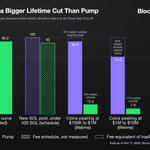
Stonkfun and Pump charge similar fees at launch, but StonkFun earns more per dollar traded as coins grow. The catch is that much of its biggest winners’ trading moves elsewhere, limiting how much revenue it captures from their success.
Pump owns PumpSwap, where its cut drops to 5 bps and creator fees taper as coins grow, bringing total pool fees down to 30 bps. That likely helps retain trading.
StonkFun’s Raydium pools keep charging 125 bps regardless of coin size. Its take falls because trading leaves: 71% of volume in its $10M+ winners happens elsewhere, mostly on Meteora.
Even with most of that trading elsewhere, StonkFun’s estimated gross fee take on $10M+ winners is ~29 bps versus ~5 bps for Pump, meaning it still earns roughly six times as much per dollar traded.


75% of SPCX volume in BWR-covered pools on @solana traded outside regular US market hours from Oct 8 to 14.
Tesla: 68%.
NVIDIA: 64%.
For SPCX alone, that was $55.7M outside those hours.
24/7 trading isn’t just a feature on a roadmap but now a core feature on crpyto trading.
