

Builder & PE advisor with a bent for anthro & philosophy. I study what people actually do, then build for it. Acquired AI founder. Building from Lisbon.
Lisbon & SF
Joined April 2009
- Tweets1.4K
- Following1.4K
- Followers1K
- Likes34.1K







Pinned Tweet
Anthropology trained me to switch lenses: ask better questions, hold several worldviews at once, and genuinely enjoy how differently people see things.
I've built products for 15 years. My last AI startup was acquired, and now I build AI that helps PE firms diligence and turn around companies. After hours I make art and hardware that visualizes what's happening in the world, in real time.
I'm looking for people who skip the small talk, go deep fast, and make things happen. If that's you, say hi.
5
7
667
Miroslav Lysyuk retweeted

This is a pretty key insight. Services businesses are always held back by their ability to deliver outcomes to customers.
That scaling essentially only could come from headcount, and no matter how much demand you saw, there was always a finite amount of talent you could get for the problem you were going after. Not to mention, the customer generally always wants the work done faster, at a lower price, or at a higher quality.
Agents entirely change the calculus here, because now we can scale output in a way that’s decoupled from the among of time that goes in. A single engineer can have the output of dozens of engineers before. A single designer can probably build out your entire design system and brand. And so on.
Well why isn’t this just all agents then? Because the key is to still have experts on the front end that actually can ensure the right outcomes are delivered from agents.
It’s likely that we’re going to see this in a wide variety of categories. You’ll see this in cyber security, advertising and marketing, legal, accounting, IT transformation, and a number of other historically people-only services industries.
It’s a great time if you’re starting one of these businesses, or if you have the capability to transform an existing one.

This is wildly impressive. We’ve progressed so far from 8 years ago, when the alternative worth paying for was pre-saved maps with cubes at the scale of real buildings to show on a map.

The crazier thing is that the right side uses less compute than what the left used to take.
Extreme compute efficiency optimization.
1
44
You know how I know we’re still early and possibly missing a new form factor?
The “sent from my iPhone” equivalent caveat for your agent isn’t a thing yet.
2
1
271


The most striking thing about this stunning feat is how gentle the landing looks from onboard cameras.
At some point, this is going to be consumer grade. You’ve already got the footage to visualize it.

4
316
Greg's AI-pilled company blueprint are steps 5 and 6 of a longer AI adoption maturity curve. Here's the whole thing.
Most companies are still at 2, using AI to generate text. Scientists too, per Anthropic's own data: they mostly use Claude to write.

ALT AI maturity curve: 8 steps from summarize to org-wide scale

Making the most AI pilled company is the whole game:
1. make a second brain. one folder of markdown files on how you think, write and decide (obsidian)
2. talk to it. voice notes all day (wispr), and an agent files every fact, story and decision
3. make a company brain. customers, calls, numbers, pricing, playbooks, past decisions and why you made them
4. record every call and meeting (granola). the transcripts go straight into the brain
5. keep a facts file. true things about you and the company that agents are allowed to say. this kills made-up claims
6. keep a voice file. your 50 best posts, 20 you hate, and the words you never use
7. put all of it in git (github) so every change has a history
8. write one instruction file at the top (CLAUDE.md or AGENTS.md). read these files before any task, never overwrite, always date
9. give agents memory across sessions so they stop starting from zero (claude-mem, mem0)
10. pipe every data source into one warehouse your agents can query (airbyte → clickhouse). ads, analytics, CRM, payments
11. feed it data nobody else has. it's the only part a competitor can't download
the skills
12. don't start from zero. install the good ones first (anthropics/skills, obra/superpowers, mattpocock/skills, addyosmani/agent-skills)
13. grab the marketing ones too (coreyhaines31/marketingskills, cody schneider's graphed skills for static ads and UGC, boringmarketing dot com skills)
14. map every workflow in the company and rank them by money made or saved
15. do each one once while talking out loud, and record it
16. have an agent turn the recording into a skill. when to use it, the steps, the checks, the mistakes to avoid
17. one skill per job. small and boring beats one giant prompt
18. connect your tools with MCPs so agents can act and not only advise (gmail, slack, stripe, linear, notion, posthog, supabase)
19. give agents a browser (browser-use, vercel agent-browser, claude in chrome)
20. give agents a computer of their own for the tools with no API (vercel agent-desktop, orgo)
21. give your best skills away in public. it's the new lead magnet
the agents
22. run an orchestrator that never turns off (grok bot, openclaw, hermes). it manages one agent per project, and each of those runs its own sub-agents
23. use coding agents for the building (claude code, codex, cursor, t3, antigravity)
24. wrap them in a harness so they plan, test and remember (ECC, superpowers)
25. manage the whole fleet in one place (paperclip). every agent gets a job, a budget and a log
26. put the skills on triggers (n8n, scheduled tasks). daily, weekly, on every new lead, on every cancellation
27. route your models (openrouter). the expensive one plans and checks (fable 5.2, gemini 4 carbon), the cheap ones do the volume
28. cut the token bill. shorter outputs, smaller tool results (caveman)
29. run a local model for the data that can't leave your machine (gemma 4)
30. track cost per job. if a job costs more than it earns, fix it or kill it
the factory
31. build the line. spec agent → builder agents in parallel (git worktrees) → test agent → reviewer agent → deploy (vercel, railway)
32. design goes through the same line (paper MCP), and a skill strips out anything that looks AI made (unslop)
33. every annoying task in the company becomes an internal tool by the end of the day
34. every customer request becomes a pull request before a human reads it (tstack for the PR workflow)
35. reviewer agents with a named bar. "would the best team in the world ship this?" reject until the answer is yes
36. keep 50 real cases with the right answer. rerun them every time a new model drops and switch to the winner
37. humans approve, own the outcome and talk to customers. that's the 10% you keep
the loop
38. every finished job writes back to the brain. what worked, what failed, what to stop doing
39. support tickets, analytics and social comments flow in every night
40. every friday an agent rewrites the playbooks from the week's results, and you approve the diff
41. every month, rank everything by profit per human hour. kill one thing and double one thing
the growth
42. research with agents before you spend a dollar (perplexity API, last30days skill)
43. outbound runs itself. find the leads, enrich, verify, send (apollo, million verifier, instantly, phantombuster)
44. send prospects finished work in place of a pitch
45. ads run on a loop. an agent writes the creative, publishes through the facebook ads API, kills the losers and scales the winners
46. agents make the creative too. images (nano banana), video (heygen, fal), voice (elevenlabs), music (lyria 3.5, suno)
47. turn every finished job into content. the story, the number, the prompt
48. every customer makes the brain smarter for the next one. that's your network effect
49. once it works, point it at a new niche. same agents, new context
The models are the same for everyone but your context is the only part that's yours.
Acquire as much of it as you can, as fast as you can.
Build loops like this.
This is the whole game, happy playing.

1
3
201
The hardest jump is 3: you ask for new ideas or complex analysis and realize models remix and reason shallowly. They don't invent, and they miss nuance. That's what pushes you into methods, then a brain, then a harness (@karpathy's LLM Wiki, @garrytan's GBrain), where the model matters less than the system around it.
The frontier is 8: org-wide, eval-gated systems that compound productivity and insight across whole teams, not just one person with a Claude subscription.
43
Asked Siri a question today. It listened for a full minute, then said nothing.
Apple’s AI experience is fundamentally broken.
Siri is how they’ll lose to whoever rebuilds the phone around a native agent. The richest irony is that it’s been obvious for over a decade.
1
3
152
Even to this day, I can't ask a question (for it to ChatGPT, their intelligence handicap) without it listening for a minute, and then just not responding, my question gone into the wind. Extremely infuriating basics.
1
19
Running is to humans as flying is to birds.
Very few feelings beat a strong stride and wind at your back. Peak human experience.
1
2
82
In 1906, John Philip Sousa warned that recorded music would kill real music.
Instead, music became ambient. It's in every café, car and pair of headphones, each person with their own playlist.
The backlash to cheap intelligence is just as overblown.
In 20 years, intelligence will be ambient too: built into streets, objects and to-do lists, working without being asked. And everyone will carry their own playlist of minds, tuned to their taste.
1
54
I’ve been vibe hacking hardware for over a year now. From 3D print to code, all via agent. But my ideas are still limited by off-the-shelf components and their constraints.
This is an early sign of what's next: hardware designed around your idea, not your idea bent around the available hardware. Sendcutsend for entire product categories.
Imagine asking for an eink display phone, battery maxxxed, don’t care about the camera, but I want solar charging. Braun aesthetic. Iridescent pink. $500 BOM. Two days later it’s at your door.

Fable 5.2 wrote its own specifications, selected the components, routed the four-layer circuit boards, designed enclosures for 3D printing, and programmed the software.
Each board was ready for manufacture in under a day. All three devices work without any modifications.

2
284
I have two to-dos that are just "figure out if I need to do this."
An agent could answer each in a minute. Instead, they sit on my list until I remember to go ask one.
We still don't have an ambient agent for one of the most basic problems there is: keeping track of what you need to get done.
That's how early we are.
1
69
Miroslav Lysyuk retweeted

Human tools used to be simple, the sort you could make without learning from previous generations.
Then about 600K years ago they started getting more complex, implying people were learning from previous generations

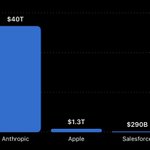
Anthropic’s s1 reported annual TAM is $40 TRILLION with something like 1-2% penetration. Insane.
For reference Apple is $1T, Salesforce $290B.
1
1
416
