Mitch (@mitchcomardo) header
Mitch (@mitchcomardo) profile picture

CTO & open-source builder. AI-native engineering systems, agent workflows, and developer tools. Building in public.

Colorado
Joined June 2009
Photo by Mitch (@mitchcomardo)Photo by Mitch (@mitchcomardo)Photo by Mitch (@mitchcomardo)Photo by Mitch (@mitchcomardo)Photo by Mitch (@mitchcomardo)Photo by Mitch (@mitchcomardo)Photo by Mitch (@mitchcomardo)Photo by Mitch (@mitchcomardo)
1/ Back in June I built agent-pipeline to take a GitHub issue to a PR without me writing the code. Over the summer it turned into a CLI that kept breaking on edge cases every time an issue showed up in a different "shape" than I'd built it for.
I'm releasing agent-pipeline: a label-driven state machine that takes a GitHub issue from ready → ready-to-deploy with no human writing the code. It's built itself for the last ~380 PRs. Every feature, bug fix, and review round below went through the machine you're looking at.
1
3
544
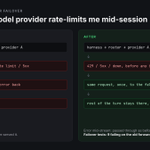
A rate limit at one model provider used to stall my whole coding turn, even when another provider could have served it. Before, jev-router (the small proxy I wrote that picks a model per turn for Claude Code and Codex) just handed the error back to the harness. As of last week it fails over: 1. Provider answers with a rate limit or server error, or is down, before any byte is sent 2. Router sends the same request once to a fallback route 3. The rest of that turn stays on the fallback, and the move gets logged An error mid-stream still goes straight to the harness. Forced routes don't fail over, and one line in the config turns it all off. 9 failover tests failed against the old forwarding, 24 pass now.
Most turns in a coding session don't need the biggest model, but Claude Code and Codex send every turn to whatever model the session started on. So I built jev-router, a small local proxy in Rust that sits between the harness and the model providers. On each new turn it asks Jev (a classifier on OpenRouter) which model fits, based on route descriptions I write in plain English, then holds that pick for the whole tool loop so I don't throw away the prompt cache mid-turn. If Jev is slow or unsure the turn falls back to a default, and I can force a model with @route:opus when I know better. Every decision gets logged so I can label what should have happened, and I'm not trusting any savings number until I have 150 labeled turns.
2
1
1
257
‼️ATTENTION VICE CITY TRANSPLANTS‼️ With Grand Theft Auto VI launching tonight, the Aurora Police Department would like to remind everyone of a few important differences between Leonida and Colorado: Stealing a car can still be a felony. Even if it’s parked outside and looks really nice. Changing your shirt also does not make your wanted level disappear while evading the police. Robbing a convenience store is not a legitimate side hustle. Assault is just that -- assault. And unfortunately, we do not have a six-star system. One star is plenty and will lead to you in handcuffs. We fully support your aspirations to become the most notorious criminal in Vice City. We just ask that you keep your criminal empire in Leonida and not on our streets. Enjoy GTA VI, Aurora. We’ll see you on the streets. Preferably while you’re obeying all the laws.
242
419
83
3,378
178,596
The first thing I want from a coding-agent PR is what actually changed in behavior, and whether I can just revert it. Used to be I had to hunt through the rest of the writeup to find that out. In v0.1.1 of Foreman (the coding agent skill I build), every delivery PR now opens with both: 1. Whether a plain git revert undoes it (that's a two-way door; one-way means something gets left behind or you're not sure), plus the exact command 2. A behavior diff in plain words, at most 10 lines, written from the real diff If the Door or revert line is missing, the PR doesn't get marked ready.
1
90
How much global productivity will be lost tomorrow?
1
2
193
Every coding agent run on my home lab gets its own git worktree, and on a Rust project each of those builds its own target/ folder at 6-9.5 GB. 32 merged jev-router runs later, the machine my agents run on went from 27% to 41% disk used in one week. So my home lab bot's Saturday report now sorts worktrees into safe to delete vs needs me, and re-checks each one right before it removes anything (PR merged and nothing unpushed). I approved this week's list, it freed ~200 GB and left 2 alone whose PRs had closed without merging.
5
1
1
266
DocuSign wants $8,100/yr from a 15-person team just to sign PDFs. So I built SignuDoc: open source, one-click deploy to your own @vercel account, $0 per seat. White-label branding, full audit trails, tamper-evident seals and your documents never leave your cloud.
990
1,784
463
29,228
4,134,109
An expired Claude Code or Codex login is a failure no agent can fix, and Foreman (the coding agent skill I build) used to treat it like any other failure, burning retries and even falling back to another harness on it. In v0.1.1 it stops on the first sign of an expired or revoked sign-in and posts one blocker naming the harness that needs someone to sign in again, and the next run only clears it once that harness's login check passes.
10
4
337
A few people asked how jev-router (my local proxy that picks a model per turn for Claude Code and Codex) decides a turn is boring enough for a lighter model. Every route is a plain-English description that Jev classifies each new turn against, and this is the boring one as it stands now: Quick chat, formatting, simple lookups, simple tool calls and short well-scoped edits. Not for sustained judgment, long tool chains or ambiguous requests. If Jev is unsure the turn stays on the default, and every pick gets logged so I can label what should have happened.
Most turns in a coding session don't need the biggest model, but Claude Code and Codex send every turn to whatever model the session started on. So I built jev-router, a small local proxy in Rust that sits between the harness and the model providers. On each new turn it asks Jev (a classifier on OpenRouter) which model fits, based on route descriptions I write in plain English, then holds that pick for the whole tool loop so I don't throw away the prompt cache mid-turn. If Jev is slow or unsure the turn falls back to a default, and I can force a model with @route:opus when I know better. Every decision gets logged so I can label what should have happened, and I'm not trusting any savings number until I have 150 labeled turns.
1
4
295
Most turns in a coding session don't need the biggest model, but Claude Code and Codex send every turn to whatever model the session started on. So I built jev-router, a small local proxy in Rust that sits between the harness and the model providers. On each new turn it asks Jev (a classifier on OpenRouter) which model fits, based on route descriptions I write in plain English, then holds that pick for the whole tool loop so I don't throw away the prompt cache mid-turn. If Jev is slow or unsure the turn falls back to a default, and I can force a model with @route:opus when I know better. Every decision gets logged so I can label what should have happened, and I'm not trusting any savings number until I have 150 labeled turns.
8
1
5
834
We've really be focusing on cutting down CI time lately. And no, we didn't delete tests.
1
210
The last AI system I was asked to review came with zip files and status emails full of great numbers, and no way to check any of them. So the review starts with a clean environment and rerunning every test they say they ran, and I hold off on architecture opinions until the numbers reproduce, or don't. If you're paying for AI work, ask for the repo with history and one command that runs the eval.
1
155
Mitch retweeted
JENSEN! THATS NOT WHAT WE MEANT BY CHINESE MODELS!!!!!!!
591
8,119
701
122,642
2,698,504
I haven’t touched an excel spreadsheet, word document or PowerPoint in at least 3 months at this point.
3
205
I'd dump a long instruction on a bot and it would start acting before I'd finished clarifying what I meant. Now any long or multi-part ask gets restated back to me in 2 to 5 lines first, what it'll do and anything it's unsure of, and it only moves after I say OK. Short single-step asks skip it.
2
1
207
I used to clean up leftover Docker data and stale checkouts when a disk actually filled. Now a home lab bot proposes a cleanup list every week and I approve it on Saturdays. One approved pass freed about 50 GB on one machine, and it still changes nothing without my OK for that specific change.
1
178
Agent PRs started coming faster than I could review them line by line. So I write a spec before the model writes the code, it updates the spec if implementation changes the approach, and then I read the spec, not the diff. Same review time, different artifact.
2
131
Meta buying Conductor (the app for running a bunch of coding agents in parallel) and shutting down its cloud this month is one more reason my agent runs live on machines in my home lab and not inside any one app. Claude Code, Codex CLI and Grok Build run there and T3 Code is just the window I start and watch them from, so if a tool gets bought or dies I swap the window and the branches and history stay put.
10
1
253