

Insightful macro charts and actionable trading signals
Macro blog
Joined April 2022
- Tweets7.4K
- Following1.1K
- Followers1.6K
- Likes24.2K




Monetary Commentary retweeted
America’s 4.2% unemployment rate conceals an uneven labor market.
Over the past year, Connecticut’s jobless rate climbed 0.9 percentage points, the largest increase nationally. New Jersey, meanwhile, experienced a 1.3-point decline, with unemployment falling markedly across several other states.
Here’s the striking part: per the BLS, just seven states recorded statistically significant increases in unemployment between September 2025 and September 2026, while 20 states and Washington, D.C., registered declines.
That geographical dispersion complicates the narrative of an economy experiencing uniform labor-market deterioration. The Fed sets one interest rate for the entire country, but the employment conditions confronting households and businesses vary enormously across state lines. National averages conceal those differences.

Monetary Commentary retweeted
March’s inflation shock practically jumps off the page. Gasoline prices surged 21.2% in a single month, plunged 9.7% in June, then climbed another 9.1% in September. Those violent swings have repeatedly pushed headline inflation higher and lower throughout 2026.
Still, core goods prices remained relatively subdued, while non-energy services registered increases in eight of nine months.
For monetary policymakers confronting 3.7% annual inflation, the distinction is notable. Higher interest rates are better suited to restraining persistent domestic price pressures than reversing an energy supply shock. The greater danger is that repeated energy shocks eventually spill into broader pricing decisions and inflation expectations.

Monetary Commentary retweeted
China is no longer America’s largest bilateral goods-deficit partner. In fact, it isn’t even in the top three.
Through August 2026, Vietnam led with a $163.9 billion U.S. goods deficit, followed by Mexico ($155.9 billion) and Taiwan ($147.7 billion). China ranked fourth at $109.6 billion.
The year-over-year shifts are particularly revealing. America’s deficit with China contracted $36.3 billion, while those with Taiwan and Vietnam expanded by $63.8 billion and $50.8 billion, respectively.
This raises a fundamental question about the effectiveness of trade barriers: how much production has genuinely relocated, and how much has simply changed its final export destination?
Bilateral trade statistics identify where goods are shipped from, but reveal considerably less about the geographic origins of their underlying value added.

Look at the direction of travel.
In January, headline inflation was running at 2.4% and unemployment stood at 4.3%. By September, inflation had accelerated to 3.7%, while unemployment had actually edged down to 4.2%.
The near-vertical movement on the inflation–unemployment map illustrates an uncomfortable policy dilemma. Price pressures have returned without an accompanying boom in the labor market. Of course, much of the latest acceleration reflects energy, with gasoline accounting for more than half of September’s monthly CPI increase.
For a Fed that has resumed raising rates, the challenge is distinguishing an external price shock from persistent underlying inflation. Monetary tightening can suppress demand, but it cannot directly resolve an energy supply shock.

America’s 4.2% unemployment rate conceals an uneven labor market.
Over the past year, Connecticut’s jobless rate climbed 0.9 percentage points, the largest increase nationally. New Jersey, meanwhile, experienced a 1.3-point decline, with unemployment falling markedly across several other states.
Here’s the striking part: per the BLS, just seven states recorded statistically significant increases in unemployment between September 2025 and September 2026, while 20 states and Washington, D.C., registered declines.
That geographical dispersion complicates the narrative of an economy experiencing uniform labor-market deterioration. The Fed sets one interest rate for the entire country, but the employment conditions confronting households and businesses vary enormously across state lines. National averages conceal those differences.
Monetary Commentary retweeted
For all the attention surrounding AI’s enormous appetite for electricity, solar has emerged as the largest contributor to America’s incremental power generation.
During the first eight months of 2026, U.S. electricity generation increased 78.5 terawatt-hours from a year earlier. Solar alone supplied an additional 50.5 TWh, equivalent to 64% of that net increase.
Natural gas and wind contributed another 32.2 TWh and 24.0 TWh, respectively, while coal generation contracted.
There is a notable catch, however. Producing more electricity annually is different from delivering reliable power around the clock.
Solar’s expanding contribution helps satisfy growing energy requirements, but the economics of meeting persistent data-center demand will increasingly depend on storage, transmission and dispatchable generation.

March’s inflation shock practically jumps off the page. Gasoline prices surged 21.2% in a single month, plunged 9.7% in June, then climbed another 9.1% in September. Those violent swings have repeatedly pushed headline inflation higher and lower throughout 2026.
Still, core goods prices remained relatively subdued, while non-energy services registered increases in eight of nine months.
For monetary policymakers confronting 3.7% annual inflation, the distinction is notable. Higher interest rates are better suited to restraining persistent domestic price pressures than reversing an energy supply shock. The greater danger is that repeated energy shocks eventually spill into broader pricing decisions and inflation expectations.
China is no longer America’s largest bilateral goods-deficit partner. In fact, it isn’t even in the top three.
Through August 2026, Vietnam led with a $163.9 billion U.S. goods deficit, followed by Mexico ($155.9 billion) and Taiwan ($147.7 billion). China ranked fourth at $109.6 billion.
The year-over-year shifts are particularly revealing. America’s deficit with China contracted $36.3 billion, while those with Taiwan and Vietnam expanded by $63.8 billion and $50.8 billion, respectively.
This raises a fundamental question about the effectiveness of trade barriers: how much production has genuinely relocated, and how much has simply changed its final export destination?
Bilateral trade statistics identify where goods are shipped from, but reveal considerably less about the geographic origins of their underlying value added.
Monetary Commentary retweeted
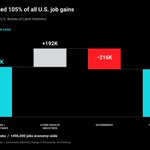
Strip health care and social assistance out of America’s payroll numbers, and the economy has actually lost jobs over the past year.
Between September 2025 and September 2026, that single sector added 520,400 positions, equivalent to 105% of the entire economy’s net gain of 496,000 jobs.
The rest of the private sector generated another 192,000 jobs, but a 216,000 contraction in government employment more than offset those gains.
It’s a revealing picture of an increasingly concentrated labor market. Relatively resilient demand for health and care services is keeping aggregate employment growth positive, even as the rest of the economy struggles to generate meaningful net job creation.
With the Fed tightening again, that lack of breadth deserves considerably more attention than the headline payroll figure alone.

Monetary Commentary retweeted
The Treasury market has dramatically repriced the cost of money over the past year, with little change in longer-term inflation compensation.
Between October 2025 and October 23, 2026, the 10-year Treasury yield climbed 89 basis points to 5.00%.
Nearly all of that increase—85 basis points—came from rising inflation-adjusted yields, while 10-year breakeven inflation increased just four basis points.
The distinction carries important implications as the Fed resumes tightening. Higher real yields are raising the discount rates applied to equities, real estate and long-duration assets even without a comparable repricing of future inflation.
And because TIPS yields also incorporate real term premiums, the move cannot simply be attributed to expectations for monetary policy.

Monetary Commentary retweeted
Commercial real estate credit stress is following two increasingly different paths across the banking system.
Delinquencies at America’s 100 largest banks peaked at 1.97% in Q4 2024 before retreating to 1.70% by Q2 2026.
At smaller banks, however, the delinquency rate has climbed for 14 consecutive quarters, reaching 1.27%.
Consequently, the delinquency gap between the two groups has narrowed from 97 to just 43 basis points.
Commercial property borrowers continue confronting refinancing pressures. Improving credit performance at the largest institutions can obscure persistent deterioration elsewhere, particularly among smaller lenders whose loan portfolios and exposure to local property markets differ substantially.

For all the attention surrounding AI’s enormous appetite for electricity, solar has emerged as the largest contributor to America’s incremental power generation.
During the first eight months of 2026, U.S. electricity generation increased 78.5 terawatt-hours from a year earlier. Solar alone supplied an additional 50.5 TWh, equivalent to 64% of that net increase.
Natural gas and wind contributed another 32.2 TWh and 24.0 TWh, respectively, while coal generation contracted.
There is a notable catch, however. Producing more electricity annually is different from delivering reliable power around the clock.
Solar’s expanding contribution helps satisfy growing energy requirements, but the economics of meeting persistent data-center demand will increasingly depend on storage, transmission and dispatchable generation.
Strip health care and social assistance out of America’s payroll numbers, and the economy has actually lost jobs over the past year.
Between September 2025 and September 2026, that single sector added 520,400 positions, equivalent to 105% of the entire economy’s net gain of 496,000 jobs.
The rest of the private sector generated another 192,000 jobs, but a 216,000 contraction in government employment more than offset those gains.
It’s a revealing picture of an increasingly concentrated labor market. Relatively resilient demand for health and care services is keeping aggregate employment growth positive, even as the rest of the economy struggles to generate meaningful net job creation.
With the Fed tightening again, that lack of breadth deserves considerably more attention than the headline payroll figure alone.
Monetary Commentary retweeted
A fresh inflationary shock is building inside America’s production chain, with input costs accelerating at a pace last seen four years ago.
Prices for processed intermediate goods surged 14.1% year-over-year in September, their fastest increase since August 2022. Final-demand producer prices, meanwhile, climbed 6.3%, leaving a sizable divergence between upstream cost pressures and the prices businesses receive for finished goods and services.
Energy accounts for much of the latest acceleration, but the implications extend beyond fuel. Businesses facing sharply higher input costs must absorb the pressure through thinner margins, pass it along to customers, or adjust production. That creates a particularly difficult inflation-growth tradeoff: disinflation becomes harder even as rising operating costs threaten economic activity.


Producer Prices is running at 14.7% over the latest 6 months, above its historical midpoint (86th percentile of this chart’s history). 12.0 percentage points faster than a year ago.
I’d be watching corporate working capital closely here. When producer prices rise this rapidly, manufacturers need more cash to finance the same physical quantity of inventory. With borrowing costs already elevated, that can become a big squeeze on smaller firms operating with thin margins.
There’s a nasty macro implication: industrial production could weaken considerably before the inflation data improve. The Fed may end up looking at persistent price pressures while the businesses absorbing those pressures are already cutting output to preserve cash.

Monetary Commentary retweeted
The American consumer continues powering economic growth, but the income supporting that spending has increasingly struggled to keep pace.
Since January 2024, inflation-adjusted consumer expenditures have climbed 7.7%, nearly twice the 4.1% increase in real disposable income.
The divergence widened further in August, when real spending jumped 0.6% despite virtually no growth in household purchasing power.
The personal saving rate has consequently slipped to 4.1%, highlighting an important vulnerability beneath otherwise resilient consumption figures.
Households can sustain spending above income growth by saving less, but with inflation accelerating and the Fed tightening policy again, that cushion becomes increasingly important.

The Treasury market has dramatically repriced the cost of money over the past year, with little change in longer-term inflation compensation.
Between October 2025 and October 23, 2026, the 10-year Treasury yield climbed 89 basis points to 5.00%.
Nearly all of that increase—85 basis points—came from rising inflation-adjusted yields, while 10-year breakeven inflation increased just four basis points.
The distinction carries important implications as the Fed resumes tightening. Higher real yields are raising the discount rates applied to equities, real estate and long-duration assets even without a comparable repricing of future inflation.
And because TIPS yields also incorporate real term premiums, the move cannot simply be attributed to expectations for monetary policy.
Monetary Commentary retweeted
Tariffs have delivered a revenue windfall, but their contribution to Washington’s broader fiscal position remains relatively modest.
Between Q4 2024 and Q2 2026, U.S. customs-duty receipts surged 244%, from $89 billion to $306 billion annualized.
Total federal current receipts, meanwhile, increased just 14%.
Even at their Q4 2025 peak of $367 billion annualized, tariffs remained a relatively small component of government revenue. As of Q2 2026, customs duties accounted for 5.1% of federal receipts, up from 1.7% before the latest tariff escalation.
As it relates to the deficit debate, a substantial tax increase on imported goods can dramatically reshape one revenue stream without fundamentally changing the federal government’s financing arithmetic.

Monetary Commentary retweeted

We are going to be seeing this in the insurance stocks everybody is ramping up right now later. The toxic leverage hasn't even begun to be exposed yet.
Commercial real estate credit stress is following two increasingly different paths across the banking system.
Delinquencies at America’s 100 largest banks peaked at 1.97% in Q4 2024 before retreating to 1.70% by Q2 2026.
At smaller banks, however, the delinquency rate has climbed for 14 consecutive quarters, reaching 1.27%.
Consequently, the delinquency gap between the two groups has narrowed from 97 to just 43 basis points.
Commercial property borrowers continue confronting refinancing pressures. Improving credit performance at the largest institutions can obscure persistent deterioration elsewhere, particularly among smaller lenders whose loan portfolios and exposure to local property markets differ substantially.
A fresh inflationary shock is building inside America’s production chain, with input costs accelerating at a pace last seen four years ago.
Prices for processed intermediate goods surged 14.1% year-over-year in September, their fastest increase since August 2022. Final-demand producer prices, meanwhile, climbed 6.3%, leaving a sizable divergence between upstream cost pressures and the prices businesses receive for finished goods and services.
Energy accounts for much of the latest acceleration, but the implications extend beyond fuel. Businesses facing sharply higher input costs must absorb the pressure through thinner margins, pass it along to customers, or adjust production. That creates a particularly difficult inflation-growth tradeoff: disinflation becomes harder even as rising operating costs threaten economic activity.
Producer Prices is running at 14.7% over the latest 6 months, above its historical midpoint (86th percentile of this chart’s history). 12.0 percentage points faster than a year ago.
I’d be watching corporate working capital closely here. When producer prices rise this rapidly, manufacturers need more cash to finance the same physical quantity of inventory. With borrowing costs already elevated, that can become a big squeeze on smaller firms operating with thin margins.
There’s a nasty macro implication: industrial production could weaken considerably before the inflation data improve. The Fed may end up looking at persistent price pressures while the businesses absorbing those pressures are already cutting output to preserve cash.