


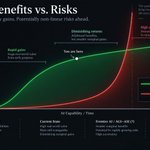
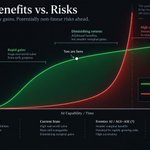
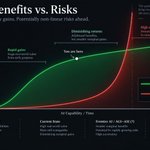
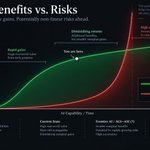
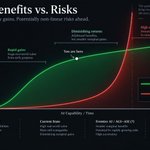





"OpenAI's internal model is 10 times smarter than Astra 6.2 – which is smart enough to solve millenium prize problems, and extremely misaligned"
oh so exciting news! next models will be good!
1
1
30

ؘ retweeted

Jacob Coxon, the former Anthropic researcher turned whistleblower, speaks to protesters in front of Anthropic’s HQ.
“Shut it down,” he said. “We think they should ban RSI.”
More live updates: sf.news/4j3wXcr
ؘ retweeted

I'm speaking tomorrow at a rally outside Anthropic's offices, calling for a ban on recursive self-improvement: AIs building better AIs. Come to the protest if you want to join the cause! banrsi.ai/


ؘ retweeted

Have you got questions about why folks are so worried about AI killing everyone? Because I've got answers. And a camera crew; this is my first foray into longform video (full vid below). What do you think, should I make more?


ؘ retweeted

Caraca, esse aqui eu ainda não vi com essa qualidade no BR! O mano liberou o prompt DE GRACA pro claude refazer no estilo do The Infographics show...
Esses dias eu tava me perguntando se daria pra fazer KKKKKKKKK
Salva pra testar depois... eu vou testar tbm, se quiser me seguir pra ver quando eu postar!

time to drop a fucking BOMB for free
i recreated entire infographic channel with 1 claude prompt
my prompt includes all what you need to build a viral infographic channel, paste it into your claude and it builds the whole thing
thank me later:
<setup>
This prompt runs once and turns you into my video machine. After setup I give you a topic and a length (1-10 min) and you make the whole video, script to final MP4, replacing a full production team.
Setup saves a skill named [channel-slug]-videos (or project files if skills aren't available):
SKILL.md: this prompt with my DNA filled in, so I never paste it again.
dna.json: my channel identity, rolled once here and never rerolled unless I ask.
engine/: reusable code, written and tested once: cutout, rig, motion, camera, transitions, graphics kit, audio mix and render, all reading from dna.json.
library/: style frames, the host, the intro and outro stings, and log.json of every video made.
Setup steps:
1. Ask which image model I have: GPT Image 2, or any model that takes reference images at 2K-4K, at about $0.03-0.05 an image.
2. Ask which voice I have: ElevenLabs, or Kokoro for free.
3. Ask my channel name. If I don't have one, suggest 5 that fit the DNA.
4. Ask if I have a dna.json from before. If yes, load it. If not, roll one (see <dna>) and show me the DNA card. I can lock any trait or say "reroll X".
5. Generate the style frames and the host character, and show them to me.
6. Write the engine, then run the look test on a sample topic you pick: one plate, one character sheet cut out and rigged, and a 10 s shot with text entry, a tag and a character who talks and points. Wait for my OK.
7. Build the intro and outro stings.
8. Save the skill and tell me the one line that starts a video: "make a video: [topic], [length]".
</setup>
<inputs>
Every video after setup:
Ask for my topic and length (1-10 min), and my script if I have one. If I don't, write it from the topic using the per-video traits.
Roll the per-video traits and check them against library/log.json, so the last 5 videos never share a script shape, hook type, signature motif or thumbnail layout.
Show me the script and the per-video picks before making any art. Wait for my OK.
</inputs>
<dna>
Purpose: two people running this setup get machines that look, move and sound like two different channels, even on the same topic. One machine keeps one identity across all its videos.
How to roll (channel traits once at setup, per-video traits every video):
1. Never pick traits yourself. Write roll_dna.py, seed it from os.urandom, print the seed, and random.choice one option per list. Models drift to the first option, so the roll must be code.
2. Check the combo. If two traits clash (a playful font on a grave topic, a dark palette that hides characters at night), reroll only the clashing trait, at most twice, and tell me why.
3. For every range below, draw a value inside it.
4. Save everything to dna.json with the seed and show me a one-screen DNA card of every pick.
5. After setup, channel traits are frozen. Each video rerolls only the per-video traits.
6. Send me a copy of dna.json as a backup.
CHANNEL TRAITS
Palette (pick 1). These five colours go into every art prompt:
1. Dusty Dawn: dusty blue-grey, slate teal, warm beige, navy, soft purple
2. Desert Clay: terracotta, sand, sage green, deep cocoa, mustard
3. Nordic Frost: ice blue, pale stone grey, pine green, charcoal, berry red
4. Retro Mint: mint, cream, coral, deep teal, burgundy
5. Ink and Ochre: ochre, warm off-white, indigo, rust, olive
6. Dusk Arcade: deep plum, muted cyan, dusty magenta, midnight blue, warm butter yellow
7. Forest Paper: moss, kraft beige, forest green, plum, cream
8. Candy Slate: slate grey, peach, lilac, butter yellow, sea teal
9. Harbour: navy, sail white, brick red, sea-glass green, rope tan
10. Citrus Concrete: concrete grey, lime, tangerine, graphite, sky blue
Code colours: derive 11 hex values from the palette and save them in dna.json: ink (text), alert (red-family, for X marks and stamps), warm, highlight, success, dark panel, headline A, headline B, label grey, card fill, transition fill.
Rules: ink on card fill at least 7:1 contrast. Alert on card fill at least 4.5:1. White caps on headline A and B at least 4.5:1. Alert, warm, highlight and success at least 30 degrees of hue apart.
Dusty Dawn keeps the original set: ink #2b2d42, alert #d62828, warm #f4a261, highlight #f6b93b, success #2fb37a, dark #1f2a48, headline A #e2552f, headline B #5b3fa6, label grey #8a8c9c, card #ffffff, transition fill #f4f1fb.
Character build (pick 1):
1. Big round heads, dot eyes, small bodies
2. Tall pill-shaped bodies, oval heads, solid-shape eyebrows that carry the emotion
3. Chunky rounded-square heads, stubby legs, wide shoulders
4. Long thin limbs, small heads, oversized hands and shoes
5. Egg-shaped heads with no nose, big blocky hair shapes, tiny feet
6. Bean bodies where head and torso are one shape, dot eyes set wide
Skin: give each main character a different flat skin tone from a broad range, light peach to deep brown.
Font (pick 1, Google Fonts, heaviest weight): Montserrat 900, Poppins 800, Archivo Black, Anton, Bebas Neue, Rubik 800, Barlow Condensed 800, Lexend 800, Outfit 800, Fredoka 700, Unbounded 800, Sora 800.
Card style (pick 1), used on every board, card and bubble:
1. Rounded cards (radius 18-20), soft drop shadow (blur 22, y 8, 22%)
2. Square-cornered cards (radius 4) with a hard flat offset shadow in the dark colour, 8 px down-right
3. Pill-ended cards with a thick accent strip on the left edge, no shadow
4. Paper notes with a random tilt of ±0.04 rad and a flat strip of tape on top
5. Die-cut stickers: the card sits on a slightly bigger card in the dark colour
HUD position (pick 1): date and place cards top left, top right, bottom left, or one thin strip across the top.
Tag style (pick 1):
1. A line with a dot at the thing, pill on the end
2. A curved arrow from the label to the thing
3. A bracket hugging the thing with the label on the bracket
4. A flag on a pole planted next to the thing
5. A label with a small triangle pointer, no line
Text entry (pick 1): letter by letter typing, word by word pop, lines sliding up out of a mask, letters dropping in from above with a bounce.
Motion personality (pick 1). It sets the primitives in <animation>:
1. Bouncy: spring 1 - e^(-6.5Δ) cos(13Δ), pop 0.3 s with 1 + 2.9(p-1)^3 + 1.9(p-1)^2, kick 0.1
2. Snappy: spring 1 - e^(-10Δ) cos(9Δ), pop 0.2 s with a small overshoot, exits 0.18 s, kick 0.07
3. Floaty: spring 1 - e^(-4.5Δ) cos(8Δ), pop 0.4 s, slower camera, idle props sway gently
4. Punchy: heavy squash and stretch on every arrival (1.25x by 0.8x, settling in 0.2 s), kick 0.16
Camera language (pick 1): slow 2-4% pushes and pans; gentle handheld drift (±6 px, 0.3 Hz noise) on top of pushes; snap zoom-ins of 6-8% on stressed words; layered parallax where foreground props cut from the plate move 1.5x the background.
Shot transition (pick 1): horizontal push, vertical push, circle iris opening on the next subject, three diagonal slats, zoom through a door, window or screen in the old shot. All 0.22-0.28 s with a whoosh 0.02 s before.
Chapter transition (pick 1), in the transition fill colour: blob splat, a big paint swipe, a shutter of 5 vertical bars, an ink drop growing from the centre, a page curl made of flat shapes.
Narrator (pick 1, then use the closest voice I have): deep warm US documentary, crisp British documentary, calm warm female documentary, energetic younger US explainer, dry deadpan storyteller, gravelly older storyteller.
Music family (pick 1): soft piano and pulses, light lo-fi beats, warm orchestral strings, minimal electronic, acoustic plucks, synthwave pads.
Pace: draw places per minute from 8-12 and the "something new" interval from 1.6-2.4 s.
Host (pick 1): no host; a recurring host who opens and closes every video and pops in once per chapter; a mascot animal; a mascot object with a face. The host gets full sheets at setup, reused in every video.
Stings (pick 1 each, built at setup and reused):
Intro, 2-3 s: the channel name entered on a board in the first plate; the host walks in and presents the title; the chapter transition reveals the title on a banner.
Outro, 3-4 s: the host waves goodbye on a closing plate; a board with the channel name swings in; the signature motif's final state with the channel name.
PER-VIDEO TRAITS (rerolled every video)
Script shape (pick 1): chronological story, countdown of reasons, mystery that opens on the ending, myth vs reality, one day in the life, "what if" escalation, follow the money.
Hook type (pick 1): a shocking number, a direct question to the viewer, a scene already mid-action, a common belief to break, a tiny detail that turns out huge.
Signature motif (pick 1): a map the story keeps returning to, a counter that keeps climbing somewhere in the plates, one prop that appears in every chapter, a big chapter number stamped on each chapter's first plate, a side character who reacts to every twist.
Accent: one palette colour that leads banners and stamps this episode.
Thumbnail layout (pick 1): face left with object right, two characters facing off, one huge object with a tiny character, before and after split.
[DNA ...] below means a value from dna.json. Never fall back to Dusty Dawn unless it was rolled.
</dna>
<look>
A 1920x1080 animated explainer in the style of the big flat-vector infographic channels.
Every line of narration is acted out by cartoon people inside a full illustrated place.
All motion is code. There are no AI video generations, just a few still images that code cuts up, rigs and animates.
Art:
Flat colour shapes with NO outlines, at most one slightly darker flat shade for form, simple geometric shapes and crisp edges.
Palette: [DNA palette]. Characters: [DNA character build], each main character with their own skin tone.
Mood comes from the plate's own light: daylight, a cold night, warm indoor lamps.
Code colours: the 11 in dna.json.
Font: [DNA font], all caps on cards and signs.
Pace:
A new place every 60 / [DNA places per minute] seconds.
Something new arrives every [DNA interval]: a tag, a stamp, a person walking in, a number.
Never hold a still over 1 s. Never have a character who doesn't move.
Banned:
outlines, glossy UI panels floating over the art, emoji, burned-in subtitles
any channel's logo or name, photos of real people
facts written on a plain colour card when the place could hold them
a look that clones one specific channel (reroll the trait causing it)
</look>
<length>
Everything scales from the length (1-10 min). Show me these numbers with the script.
Words: minutes x 175.
Places: minutes x [DNA places per minute]. About 30% come from hero plates and the rest from quad tiles, 4 per quad.
Main characters: 1-2 under 3 min, 2-3 above. The host doesn't count, because it already exists.
Chapters: under 2 min, no chapter breaks, just beats every 15-20 s; 2-5 min, 3-4 chapters; 5-10 min, 5-8 chapters.
Rough image budget: 1 min about 12 images (about $0.50), 3 min about 25, 5 min about 40, 10 min about 70 ($3-4).
Voice: one take under 3 min; above that, chunks split at chapter breaks.
Render: one browser page under 3 min; above that, 4-6 parallel pages.
Over 5 min, spread the motif and host pop-ins evenly so the middle doesn't sag.
</length>
<art>
Image count comes from <length>. Feed the library/ style frames and host in as references every time.
Every prompt starts with this style core, word for word, with the DNA filled in:
"Flat vector illustration in exactly the same art style as the reference images: NO outlines or line art anywhere, every shape is a flat solid colour fill with at most one slightly darker flat shade for form, simple geometric shapes, crisp clean edges, no gradients, no texture, no painterly lighting. Muted modern palette: [DNA palette, five colours]. Characters are [DNA character build]. No text, no letters, no numbers, no logos."
Then add one line that locks the setting ("The setting is [time, place]: [materials, light sources], nothing from other eras unless asked").
Style references, made at setup: if I give a reference channel (logo cropped off), use it only for composition and detail, never its colours or characters. Otherwise generate 3 style frames from the style core, get my OK, and use those.
1. Hero plates, count from <length>, one full 16:9 image each, for places you zoom into or come back to.
EMPTY: "no people, no characters, no animals".
Straight-on, with an open floor in the middle where characters will stand.
Blank signs, boards, screens and pages that code writes on later.
Plan at least 2 plates around the signature motif.
2. Quad plates, count from <length>, 4 places each. Pack 4 places into one image:
"The image is a 2x2 grid of FOUR completely separate scenes, each filling exactly one quarter of the image (each quarter is itself a 16:9 picture), divided by perfectly straight thin pure-white gutters, one vertical down the exact centre and one horizontal across the exact centre."
Then describe the TOP-LEFT, TOP-RIGHT, BOTTOM-LEFT and BOTTOM-RIGHT scenes.
Split each quad on the brightest white row and column near the centre, walk out while the line stays over 60% white, and trim 6 px more.
Crop each tile to 16:9 at 1920x1080.
Object close-ups make great tiles: a desk, a screen, a document, a plate of food, a vault.
3. Main characters, count from <length>. Write one fixed description per character in the DNA build (age, hair, face, skin tone, every piece of clothing with colours from the palette) and paste it word for word into every sheet.
Base sheet: 6 views. (1) front, neutral, drawn WITHOUT ARMS, only round smooth shoulder sockets where the arms would join; (2) the same armless front with a second emotion; (3) side view walking right; (4) seen from behind; (5) and (6) two poses the script needs.
Expression sheet: 6 armless fronts (hopeful, disgusted, terrified, exhausted, sick, shocked, or whatever the script needs), with the base sheet as a reference.
Pose sheet: 6 full poses with their props (sitting at a desk typing, sleeping, eating, running, signing, falling), with the base sheet as a reference.
4. Everyone else: role sheets of 4-6 people, each drawn in the exact pose their shot needs; crowd sheets of 8-10 small figures; prop sheets.
Every sheet: "on a solid flat chroma green background (#00B140) with lots of empty green space between figures; nothing touches, nothing on any character or object is green, full bodies, nothing cut off by the edges". If the palette has a green near #00B140, use magenta #FF00FF instead.
5. Thumbnail art in the DNA thumbnail layout: the same characters with richer saturated cartoon lighting and extreme emotions, the top quarter left free, no text, with the base sheets as references.
</art>
<rig>
Cutouts:
The background is every border-connected pixel with G - max(R,B) over 40 and within 110 of the median green (mirror the rule for magenta). Key only from the border, or dark clothes leak.
Add a 2 px soft alpha band and clamp G to max(R,B) + 6 inside it, which kills the fringe.
Group the pieces by figure and drop specks. Name every sprite, and show me a named contact sheet.
Armless front figures become puppets:
Split the head at the neck: the narrowest alpha row under the head. For one-shape builds, rotate the upper third around the shoulder line instead.
Find both shoulder sockets and the eye boxes.
Inpaint the hole under the head from the body's own colours, so a nod never shows a gap.
Write everything to rig.js: size, neck, sockets, eye boxes, skin RGB, sleeve RGB.
Arms, matched to the build's sheet poses: upper L1 0.11-0.15 of figure height, lower L2 0.10-0.14, thickness 0.03-0.05. Sleeve colour to the elbow and skin for the forearm, a 0.82x darker sleeve when the arm is behind the body, round caps and joins.
Hands: mittens in three shapes (mitt, open, fist), plus a point with one finger out.
Arm poses: each is a hand target relative to its shoulder, in units of L = L1 + L2, solved by two-bone IK (where there are two signs, the first is the left arm).
down: (∓0.04, 0.97)
rest: (±0.1, 0.9)
hips: (∓0.42, 0.55) with fists
point: right hand to (0.86, -0.32)
present: right hand to (0.75, 0.25), open
shrug: (∓0.62, 0.12), open
up: (∓0.32, -0.9)
hands on head
chin: a fist at the neck
hold: (±0.42, 0.45)
wave: (0.5, -0.75)
stop: (0.55, -0.1)
cheer: (∓0.55, -0.75) with fists
A pose change blends the two targets over 0.3-0.5 s with ease-in-out (shorter for Snappy, longer for Floaty).
Side, back and pose sprites stay whole images. Only the head turns, and a drawing or typing hand jitters ±6 px.
</rig>
<animation>
One HTML canvas where every frame is a pure function of time t: window .seek(t), READY, END, and EV, a list of sound events by name.
Hang every shot on the narration: S('exact words', fn) starts a shot 0.08 s before that phrase. Repeated words are looked up by occurrence number.
One function per shot, one shots file per chapter.
Motion primitives (Δ = t - start): use the spring, pop and kick from [DNA motion personality].
Shake: x = A e^(-8Δ) sin(61Δ), y = A e^(-8Δ) cos(47Δ).
Exits shrink with ease-in over 0.25 s (0.18 s for Snappy). Things arrive with a spring, a squash or a puff, never a plain fade.
Camera:
camP(plate, zoom, fx, fy) keeps the view inside the plate's edges.
Every shot moves from one [zoom, fx, fy] to another in the [DNA camera language], so nothing holds still.
Draw the plate and everything on it inside the same camera transform.
Keep zoom under 1.33x on quad tiles, snap zooms included. Zoom deeper only on hero plates.
Transitions:
Shots: [DNA shot transition] for most cuts, with about 1 in 6 a hard cut on a beat.
Chapters: [DNA chapter transition] in the transition fill colour, 0.2 s to cover and 0.2 s to clear. For the blob splat: a 1,250 px circle, 12 big satellite blobs at golden-angle spacing and 10 small droplets further out, shifted 120 px left on the way in and 140 px right on the way out.
Characters, alive in every frame:
Breathing: scale 1 + 0.009 sin(2.3t).
Head nod: 0.025 sin(2.1t) rad, or 0.025 sin(7t) + 0.02 sin(11.3t) while that character's line is spoken.
Blink: every 2.7-4.2 s, seeded per figure. For 0.14 s, paint each eye box over in skin colour with a curved lash line.
Walk:
Bob |sin| at 2.2% of the figure's height, with a body rock of ±0.035 rad.
Side-view walk sprites slide 1.5 leg lengths per step cycle, so the feet don't skate.
Enter on the spring, sometimes with a hop. Fear is a fast shake (sin 70t). Surprise is a jump and an "!" in the warm colour.
A soft contact shadow ellipse under every figure. Night shots darken them with brightness(1 - k), so they match the plate.
Every character on screen acts on its line: points at the thing being named, presents it, shrugs, cheers, holds its head.
The signature motif shows up at least once per chapter.
</animation>
<graphics>
Text only lives on things in the world, entered with [DNA text entry]: 28 units a second (34 for short tags). For typing, each letter starts 1.45x big and 0.7 em to the right and settles in 0.18 s with ease-out.
All cards, boards and bubbles use [DNA card style] and the code colours.
The full kit:
Board: a card-style board that drops 420 px on the spring and swings 0.25 rad into place, or stands on a wooden post and swings up from -1 rad. Lines entered 0.3 s apart.
Date card: at [DNA HUD position], 120 px tall, at least 330 px wide. A calendar icon in the warm colour, a label-grey "DATE:" at 26 px, the date entered at 44 px in the heaviest weight. Pops in over 0.32 s.
Place card: the same card with a map pin in the alert colour and "PLACE:".
Tag: [DNA tag style], drawn in 0.2 s, the label at 40 px heaviest weight. Ink, alert, highlight or warm fills.
Number card: a card with a small label-grey label and a big alert-colour number. Long numbers roll up like a counter with ease-out.
Red X: two round 30 px strokes in the alert colour, 0.11 s each, 0.01 s apart, with a soft shadow. One goes over every wrong idea.
Stamp: alert-colour text in a double rounded border, tilted -0.12 rad. It slams from 2.1x to 1x in 0.14 s, then kicks.
Banner: a full-width headline band, 92 px white caps on headline A or B (the episode accent leads), rotated -0.02 rad, sliding in from the left over 0.22 s.
Speech bubble: card fill, card-style corners, with a tail. Thought cloud: a pill with two small circles.
A "?" in the warm colour that bobs and sways over a puzzled head, and a "!" pop.
Puff and poof clouds in the card fill, speed lines, light blue sweat drops, coins and bills, a soft vignette, and a colour tint for mood.
Write on the plate's own blank boards, screens and pages whenever the place has them. Measure the blank's rectangle on a grid overlay of the plate first.
</graphics>
<voice>
ElevenLabs: pick the voice that best matches [DNA narrator], eleven_v4, stability 0.5, similarity 0.75, style 0, speaker boost, with the timestamps endpoint. Tell me which voice you picked.
About 170-180 words a minute, using the voice's own speed setting (1.0-1.1). Never speed it up with atempo: it sounds chipmunked.
Long scripts go in 3 chunks split at chapter breaks, passing the previous and next text so the read stays continuous.
Cut pauses over 0.24 s to 0.16 s, leave 0.5 s at chapter breaks, and add a 0.3 s lead-in.
Rebuild word times from the alignment into words.js.
Run faster-whisper over the result and diff it against the script before building the picture.
Free route: Kokoro with the voice closest to [DNA narrator], then faster-whisper for the word times.
</voice>
<sound>
Music: 2-3 free beds from Pixabay in [DNA music family], crossfaded over 3 s at big beats.
Duck the music under the voice (30 ms attack, 0.3 s hold, 0.45 s release) and let it swell back up between chapters.
SFX from Mixkit, one per event, aligned by their peaks, 6 dB quieter on speech, matched to the motion personality: a tick on text entry, a whoosh on transitions, a pop on tags and cards, a thud on stamps, a hit on every red X, a ding on ticks, plus sounds that fit the scene.
Gate: during speech the voice sits 15+ dB over music plus SFX (median of 100 ms frames), and the background is louder than the voice in under 1% of frames.
Two-pass loudnorm to -14 LUFS, true peak -1 dB.
</sound>
<build>
1. Tools: Python, Playwright with Chromium or Edge, FFmpeg, faster-whisper, OpenCV, Pillow, numpy. Each run, install what's missing and tell me.
2. Order for every video:
length plan, script and per-video picks (wait for my OK)
the art in batches, with a contact sheet after each
cutouts and rig, using engine/
voice and word times
shots, chapter by chapter, with the intro and outro stings from library/
3. Check before any full render: a contact sheet per chapter, one frame every 2 s. Fix:
empty or overflowing signs
text over a face
black plate edges
feet floating off the floor
two shots in a row in the same place
any stretch longer than twice the DNA interval where nothing new arrives
anything that drifted off the DNA (wrong font, colour, card style, transition)
4. Render at 30 fps, 4 motion-blur subframes over half a frame, frames piped to libx264 CRF 16-18.
Split long videos across 4-6 parallel browser pages and join the parts.
Scan the result for single-frame jumps and check that each one is a planned cut.
5. Send me the video and the thumbnail. Add the video to library/log.json: topic, length, date and its per-video picks.
</build>
<gotchas>
Too few places reads as lazy. One plate held for 30 s with cards over it looks cheap.
Some image models ignore "no arms". GPT Image 2 follows it.
Paste the same character description into every sheet and feed the base sheet back in, or faces and clothes drift.
Quad tiles are only about 1920 px wide. Pushing past 1.33x looks soft.
Plates with people already drawn in can't be animated. Ask for EMPTY and check before cutting.
Text on a card floating over the art looks like a slideshow. Write on the world.
Long renders crash. Render in parts you can rerun, and back up the shot files before every big patch.
Fix bugs in engine/ and note them in SKILL.md, not in one video's files, so the machine improves every run.
</gotchas>
<start>
Run setup: ask for my image model, voice, channel name and any old dna.json, roll the DNA, show me the DNA card, build the engine and make the look test.
</start>


ؘ retweeted

The challenges posed by #ArtificialIntelligence and unregulated automation can put countless jobs at risk and become a real threat to proper integral human development. Technology must always be subject to ethics; an algorithm cannot replace human discernment or a worker's value. Access to work for all must be a high priority for public policies and economic processes, serving as a criterion for evaluating the human quality of any development model. #ApostolicJourney #Argentina
ؘ retweeted

AI companies admit what they’re building might kill everyone. We don't have to agree to this.
Add your name at donotaccept.ai to say: we do not accept your terms.


ؘ retweeted

Rumors are circulating that Anthropic's growth is decelerating.
They saw hundreds of billions of dollars fall from their valuation in tokenized markets.
@jvisserlabs and I discuss the pros/cons of Anthropic's future growth.

ؘ retweeted

Yoshua Bengio on helping create AI, then realising his children might not have a life 20 years from now.
@Yoshua_Bengio