

Reader • Writer: @asiatimesonline, @bsindia, @CambridgeUP, @firstpost, @indianexpress, @scroll_in, etc. • Lawyer too though that's beside the point here…
India
Joined March 2008
- Tweets1.8K
- Following2
- Followers4.1K
- Likes568







Pinned Tweet
My mum's childhood memoirs were published recently: Whispering Pines by Korobi Saikia.
amzn.in/d/1Xmyg6C
One of the nicest things is that it seems to have led to her getting back in touch with old friends she's not spoken to for over fifty years now.


2
2,222
#CRPS / Complex Regional Pain Syndrome (earlier generally called RSD / Reflex Sympathetic Dystrophy)
Jan. 2026
Incredibly glad to see CRPS being spoken of after the recent celebrity disclosure of having developed it.
That said, have been a little disconcerted to see CRPS being referred to as "suicide disease" in numerous posts. Yes, rates of suicidal ideation are unusually high because the pain really is that bad. It's also not well understood and, even if one somehow accesses appropriate care, receiving effective pain management can be very difficult. Which means that, sometimes (and I hope I'm wrong here), the primary hope a patient has, AFAIK, is to pray for spontaneous remission.
There are multimodal treatments available, AFAIK, which include physical therapy and various analgesic options that facilitate functionality but not everyone can access them. (Not least because some of the available options are very expensive.)
I'm not a doctor and obviously have no medical training in this area but, even so, it seems to me that plastering the words "suicide disease" (a reductive label) all over SocMed both essentialises RSD and is sensationalist without necessarily contributing to raising awareness in any meaningful sense.
Also, I imagine that telling colleagues one has CRPS, if one chooses to, and the aftermath of disclosure would be a very different experience depending on whether or not one's colleagues were to immediately have the "suicide disease" tag pop up in their minds upon hearing "CRPS".
re the expense, individual requirements obviously differ but should one need spinal accessory nerve blocks, for example, they are usually guided by ultrasound these days, administered by a superspecialist, and can cost up to about 70 K INR a pop. AFAIK. Obviously, this isn't what everyone needs and you should speak to a doctor for details; I'm not one. My own, possibly flawed, understanding is that it is more common for patients to receive stellate ganglion blocks for CRPS; they cost up to about 50 K INR each.
That said, addressing CRPS definitely isn't just about buying a strip of Combiflam at the local chemist.
And, no, getting someone who actually knows what they're doing isn't about padding up the bill in such a case; the injection site is right next to the carotid if not anything else. No-one wants a mistake. Though reiterating yet again that I'm not a doctor and that this is just my understanding.
1
184
re AI training data, Indian law:
Thinking aloud. re training data & AI, our focus has thus far been on copyright. However, we've gone further than that in non-AI contexts.
e.g. hot news. Step 1: Determine the limits of 16, Copyright Act, to ensure that all non-copyright claims aren't precluded. Step 2: Turn to tort law and misappropriation. (Unjust enrichment in the contractual sense is kinda worthless here because privity, quasi contract arguments etc. don't quite seem to work. Restitutionary disgorgement... who knows?)
Given that we have form for attempting this (ie stepping beyond copyright) when it comes to dispute resolution, I'm wondering why we can't and whether we should apply a broader lens to scraping news as training data than merely copyright re policy. Commercial harvesting?
I'm also aware that there's quite a strong push towards "one licence/one payment" but I think that that fundamentally undermines copyright being understood as an author's right (which we pretend that it is). Instead, it requires us to accept copyright as primarily being an economic right, which, TBH, is exactly what it is. But, then again, ignoring human creativity, dignity, and the freedom to trade, I suspect, undermines Arts. 19 & 21 of the Constitution so that approach will always be open to challenge.
No firm opinions here, merely the suggestion that the 'obvious' and straightforward solution may not be ideal ie visit be a constitutional and jurisprudential minefield.
113
Nandita Saikia retweeted

I finally wrote a piece about sarees and the law...
through culture, commerce, and constitutionalism.
And Draupadi.
Here: copyright.lawmatters.in/2026…
(Pic.: commons.wikimedia.org/wiki/F…)

DPIIT released a working paper on generative AI and copyright yesterday. In many ways, it seems to be aligned with ideas which I'd discussed in a May 2025 essay (copyright.lawmatters.in/2025…) although its approach is practical rather than theoretical, and, although there is divergence, seems to carry ideas forward by discussing implementation mechanisms.
With regard to training data, a very quick skim through the document seems to indicate that it seems to favour a non-voluntary licence regime with royalty requirements kicking in upon commercialisation and a distribution setup envisaged. (One can only hope that lessons have been learnt from the exploration of that territory via the 2012 'Bollywood Amendments'.)
Anyway! Here's the DPIIT paper:
dpiit.gov.in/static/uploads/…
133
Sharing the occasional painting till Christmas, if things go to plan... (each one featured in the National Gallery advent calendar we're using this year).
Here's Tiger in a Tropical Storm or Surprised! by Henri Rousseau (1891). Prey outside the frame. French artist who, despite claims to the contrary, never left France. The greenery based on domestic plants coupled with exotics in botanical gardens. Derided by some for being 'childish' but the use of numerous shades rather contradicts the allegation. Now regarded as a pioneer of 'naïve' art.
Somehow, distinctly remember buying a large print of the painting at a Bombay gallery when I was quite young; the bright colours and dynamism appealed to me although I knew nothing of the artist at the time. (Now, I'm wondering how that print came to be in the gallery.)

93
An overview of personality rights law in India weaving together thoughts on law, technology, culture and enforcement mechanisms...
copyright.lawmatters.in/2025…

The Approach of Autumn
— @wisteriawonders
I wish I could have painted the four seasons with their changing colours, the bare beauty of winter moving on to the pink of spring, leafy green foliage on trees which, not too long ago, had looked ever so forlorn. And with the coming of the rains there were the unmissable red plums, luscious peaches and then pears, not easily visible for they seemed to be almost camouflaged by leafy green trees.
Thankfully, even if you are neither an artist nor a poet, your life isn't a shambolic mess; you just have to (euphemistically speaking) make do with a bit of borrowing from others’ talents.
Van Gogh’s ‘Autumn Landscape with Four Trees’ has always fascinated me. Although it may not exactly reflect what the mind's eye often goes back to, it at least captures the essence of my idea of autumn that I once enjoyed back home in Shillong.
Our backyard lay on the foothills of the Government Fruit Garden, those acres and acres of hills and dales landscaped by the British who had transformed the area into a majestic garden. Mind you, fruit processing, too, was a part of the activities that the garden immersed itself in.
Although I enjoyed the spectacular sights of the changing seasons, for me, autumn had a special appeal. The season of ‘mellow fruitfulness’ was for Shillongites the closing of the end of the wet and warmish summer months between June and August.
The russet beauty that September ushered in was something I always looked forward to. Gazing at the meadows brought in an inner sense of peace and quiet which I could enjoy in some sort of pensive and solitary mood. The sense of tranquility that this simple change of the colours that nature presented itself was nonpareil.
Even today, almost half a century away, I often ruminate on the colour palette that nature's bounty presents in such abundance each season, each year. The context may be different but the feelings that September evokes always reminds me of Wordsworth’s opening line “Earth has not anything to show more fair/ dull would he be of soul…” in his sonnet ‘Composed upon Westminster Bridge’.
Fortunately for those who have drunk of its beauty, the Fruit Garden still exists and has not gone the way of some of our childhood haunts (in the vicinity) which became victims of the fell blow of the changing priorities of a growing urban landscape in a land-starved hilly area.
The loss of the beautiful orchard in Ri Kynti bungalow and, even earlier than that heartwrenching loss, was the loss of the verdant twin hills on which AG quarters came up in the 60s. Why was all this heartache even there when neither of these places were my private property to moan and groan about?
As a child it's probably just any place we play in is a part of you as much as your toys are a part of you. And which little child would think of their play areas as anything but their very own playground to be held on to at whatever cost whether it be private property or not? Wherever the child played was an extension of their own playground at home.
The terraced hills, and the majestic meadows beyond which, oftentimes, we used as our echoing boards brings back not just visual memories but aural ones too. I remember the brook marking, for me, the end of the compound of my childhood home and the beginning of Fruit Garden flowing sometimes gracefully and, at other times, with an unmatched ferocity that one can expect only in Shillong with the downpour of torrential rains. I can only hope that it babbles on forever.

Nandita Saikia retweeted

It's 2025 and 21st century India is still grappling with the evils of dowry. Laws don’t protect, unless people are aware, empowered, and able to use them. And social media and internet have turned this into a dowry vs alimony debate??
Nandita Saikia retweeted

"Why doesn't she leave?"
Easy question to ask.
I always think of @nsaikia 's piece on this.
I read it way back - in 2013.
It has stayed with me.
Dug it out just now, and read it again.
Worth a read.
indianexpress.com/article/ne…

Finding a use for all those bits and bobs one collects over time...
Stringing together beads can be such fun!

1
102
My mum, @wisteriawonders, on collecting autographs, from Bhupen Hazarika to M F Hussain, from her time to mine...
wisteriawonders.blogspot.com…
1
104
My final infinity scarf with this yarn all but done. I'd intended to use it to knit with but it was so slippery that crochet was a better option.
Ran out of striped yarn I've been using halfway through so supplemented with a cherry pink. The greys and browns remind of wintery landscapes and the pink of the coming of spring. 🌸
Rather pleased with the colours, and looking forward to using the scarf once the weather turns.
(And, yes, crochet because I find it much more rewarding to relax by counting stitches than non-existent sheep... At least there's something to show for all the counting!) 🙂🧶

115
Weekend reading.
Not quite a retelling of Dickens' Great Expectations but a telling of Estella's life from her own perspective. Equal parts horrifying and unsurprising.
Estella's Revenge by Barbara Havelocke.


134
Nandita Saikia retweeted

"Jana Gana Mana" is the national anthem of India, originally composed in Bengali by poet Rabindranath Tagore, who was awarded the Nobel Prize in Literature in 1913.
Pictured: An English translation of Jana Gana Mana by Tagore

ALT Jana Gana Mana handwritten in English.
So many of our histories are closely tied to the history of colonialism, and the fight for independence.
To hear many histories tell the tale, one might well imagine that soldiers making their way to the Eastern front during World War II were, by and large, white men relying on nothing but scythes and grit. That's part of the story though it certainly wasn't just white men at the Eastern front. Other parts of the tale, too, are not spoken of much.
I had heard family lore of my maternal great-grandfather having refused a title from the British but it was only when my mother dredged up old childhood memories a few years ago that I learnt more of his interactions with the British. He had helped them during the war, amongst other things providing them with apparatus to cut through jungles on the Eastern front (the same apparatus he'd used to cut through jungles to set up tea estates) on the understanding that they'd leave after the war. They didn't leave, and he turned his attention to focus on the freedom struggle.
A few years later, he gave his daughter's hand in marriage to a civil servant who had previously been imprisoned by the British for his role in the freedom struggle. The couple were to become my maternal grandparents.
Patriotism comes in many forms and it often runs in the blood.
#IndependenceDay
(Pic: A page of the agreements pertaining to Abhoyjan, the first tea estate my great-grandfather set up in 1928.)

Nandita Saikia retweeted


I’m a dog parent and love dogs. My golden retriever Duke is family. ❤️
But I fully support the Supreme Court’s decision to remove stray dogs from Delhi-NCR’s streets, in fact it should be implemented in Maharashtra too. Stray dogs in India aren’t just an “inconvenience”, they’re a menace.
We’ve normalised dog-bite cases, rabies deaths, and aggressive packs chasing kids, cyclists, and delivery guys.
You don’t see this in any other country. Go to Singapore, Japan, Europe, US where dogs are pets and not free-roaming hazards.
Don't get me wrong, I love dogs but I also love seeing kids play in the park without fear, delivery agents ride without being chased, and pedestrians walk without dodging packs.
This decision will anger many. But it might finally make Indian cities safer for humans and for the dogs themselves.

Reading Enid Blyton
— @wisteriawonders
Enid Blyton was born on this day in 1897 in a suburb of London. The year she was born also witnessed the great earthquake that shook Shillong and many other parts of Assam causing extensive damage to life and property. Shillong, then the capital of undivided Assam slowly came back to life rebuilding shattered homes and offices. By the time we were enjoying our early childhood there in the 1960s, it had already established itself as an educational hub.
The State Central Library was set up. And, for most of my contemporaries, it was the library from which we borrowed our leisure time reading material, at least during our years in school, till we were considered grown-up enough to use the reference section upstairs.
You may be wondering why on earth I’m writing about seemingly disparate happenings in a post on Shillong. Well, one caused extensive damage, bringing in misery to a quiet little town. The Governor's residence, the church opposite the library, and Ferndale (then privately owned by a Miss Nightingale), were all damaged.
The State Central Library was our go to destination on most weekends either on a Saturday afternoon or a Sunday morning during our childhood years in those hills which now seem so distant. Trudging through the half a dozen short-cuts we would make our way towards The Children's Corner, the well-stocked room filled with reading material for kids. The welcoming ambiance, a well-lit room with its immaculately polished wooden floors and reasonably good sitting arrangements, ensured that we spent considerable time there, browsing through books, reading the ones which were not lent out and bringing back our next cache of reading material for the following week. Bliss it was to spend our time in the library!
Our happy hours were not made of Happy Meals at McDonald’s but of the hours we spent reading the books we had borrowed, at home or sometimes in the classroom hiding a storybook within a textbook!
How many of us must have got addicted to the English classics through abridged versions, to Louisa May Alcott, and not least to Enid Blyton! I must admit that yours truly was one such addict.
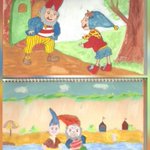
The Famous Five, Secret Seven, St. Clare’s, and Malory Towers series were some of the books I devoured. For reasons unknown, I missed out on Noddy during my childhood. However, I more than made up for it when I spent hours on end reading Noddy books to my son, Bikram, decades later. He had cataract as a child and although he underwent cataract surgeries, the surgeries did not leave his eyesight in good shape at all, so I wound read to him till my voice cracked, day after day.
By then we were living in Pune where he had been born (and where his surgeries had been performed too). My daughter had bought some Noddy books second hand from Jai Bookstall on FC road, and a few inexpensive editions from Modern Bookstall then on East Street. Together, they made for many pleasurable hours. I didn't read the books mechanically but with my head, heart (and hand), and tremendously enjoyed them along with many other books that I read aloud to him.
Discussions with friends from various parts of India about books by Enid Blyton, had me conclude that the books were like a storm that had hit many towns and cities across the country. The interest in Blyton's books was a phenomenon not limited by distances of space or time, her books were as popular in the 1960s as they were in the 80s and 90s when my children were growing up.
These books enriched our lives with make believe scenarios, actual midnight parties, treasure hunts, and so on and so forth.
Life without Enid Blyton would definitely have been less colourful, less adventurous. Noddy, Mr.Goon, Fatty and the others did spice up our lives, didn't they? And who could forget Lacrosse which all those boarding school girls seem to excel in…
(Pic: Pictures my son painted with a little help from my daughter)

Not sure what's caused the latest round of self-proclaimed animal lovers to fret (loudly) about how important stray dogs are and how much they love them.
What I do know though is that dealing with stray dogs is about a lot more than dumping last night's left over dinner by the roadside, and claiming to love dogs. *snort* (There are plenty around who don't seem to do much beyond that.)
I've lived with rescued stray dogs.
They're not always peaceable. They're not always immediately safe to be around.
Sure, they need food. Sometimes, company. Always, medical attention. And that tends to take money, quite a bit of it.
I'd be much more interested in listening to what stray dog 'lovers' have to say if more of them actually took responsibility for *any* of the animals they claim to love. The number of them who actually do so, however, seems to be vanishingly small.
And, in the meanwhile, they — the people — seem to have a horrible tendency of putting the health and safety of everyone in the vicinity of stray dogs on the line.
Not necessarily those in their own vicinity: some stray dog 'lovers' seem to get into their cars, drive quite a while, then dump food on to footpaths... and leave. In almost perfect safety themselves. Never mind other human beings.
We need to do better. For dogs, and for other human beings.