
Joined May 2009
- Tweets37
- Following50
- Followers408
- Likes52

Pinned Tweet
Our work understanding the impact of GenAI on education is out in PNAS today! We confirm what many educators already suspected -- without appropriate guardrails, GenAI can harm student learning. We urgently need better safeguards to prevent these harms.

Out in @PNASNews today!! We ran a field experiment with ~1000 high school students & found:
✅ Unsurprisingly, GenAI boosts performance
⚠️ But it hurts learning -- students perform worse on a follow-up exam
🛡️ Careful guardrails can prevent this harm
pnas.org/doi/10.1073/pnas.24…

Osbert Bastani retweeted

🌟 Excited to share that our paper, RoboReason, has been accepted to EMNLP 2026!
🤖 We study how well Vision-Language Models (VLMs) perform on spatiotemporal ordering tasks that use real-world robotics images.
Our key findings:
🔹 Large VLMs often underperform previously reported results when evaluated on spatiotemporal ordering tasks using real-world robotics images.
🔹 Overlaying specialized computer vision model outputs and increasing reasoning effort generally help improve large VLM performance.
🔹 Finetuning smaller models using GRPO and SFT on examples generated by specialized computer vision models often helps them achieve comparable results to much larger VLMs.
📍 Presenting in Budapest with @utk7arsh at @emnlpmeeting, tomorrow!
🗓️ Poster Session C | 9:00–10:30 AM
#EMNLP2026 #VLMs #LLMs #Robotics #AI
Osbert Bastani retweeted

😊 Excited to share our work accepted to #ICML2026 🇰🇷 as a Spotlight paper
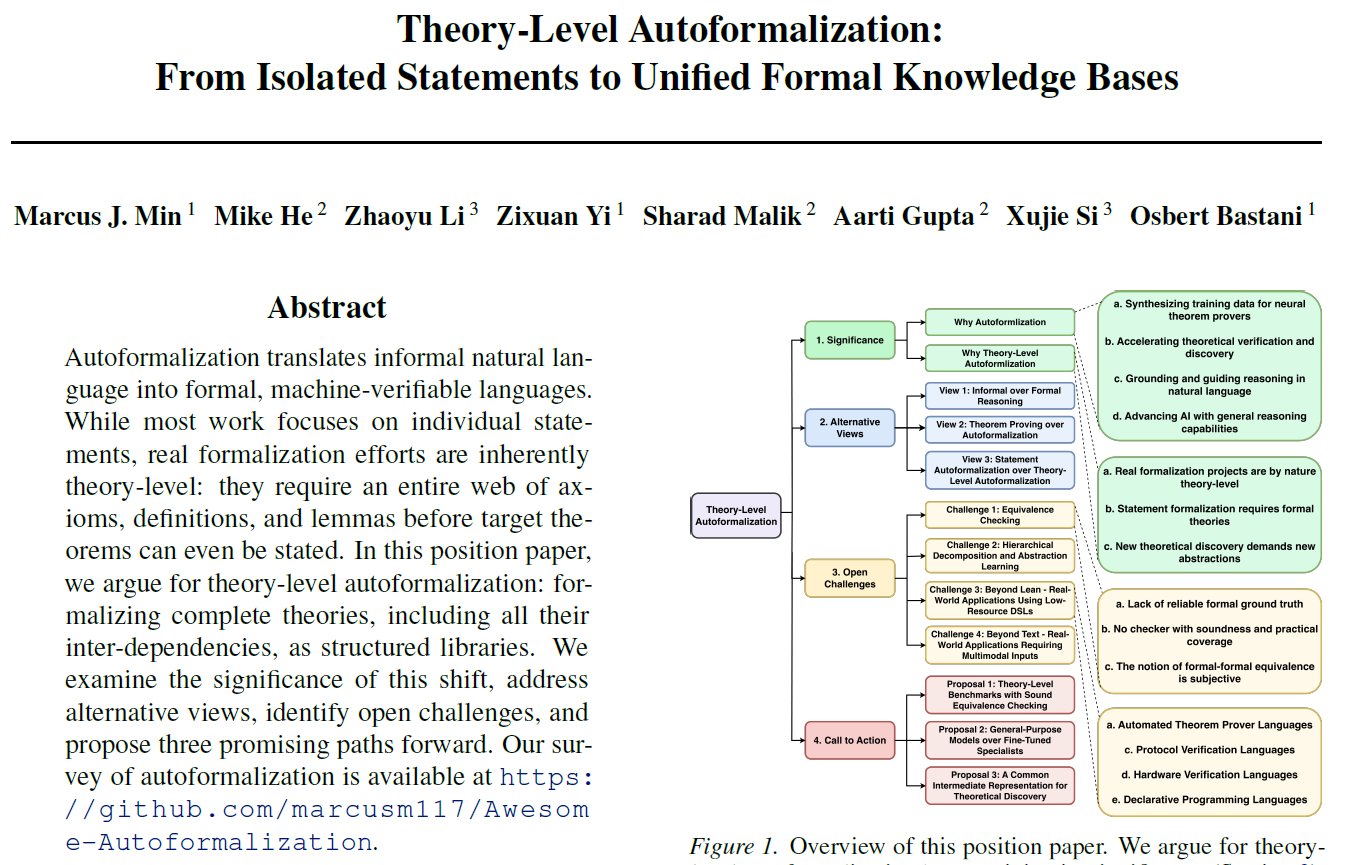
Theory-Level Autoformalization: From Isolated Statements to Unified Formal Knowledge Bases
Paper: papers.ssrn.com/sol3/papers.…
Survey: github.com/marcusm117/Awesom…
#AI4Math #Autoformalization 🧵[1/8]
Osbert Bastani retweeted
Work done with my amazing collaborators @alex_shypula and @obastani!
Paper: arxiv.org/abs/2501.18916
Code: github.com/sagnikanupam/llmp…
Website: sagnikanupam.com/papers/llmp…
Substack: largemodels.substack.com/p/d…
X Article: xitter.cf/sagnikanupam/status/20…


Osbert Bastani retweeted

Places to look for ambitious, creative, rigorous health AI:
Sierra Leone, Thailand, Rwanda.
A short comment in @Nature nature.com/articles/d41586-0…
Don't miss the main course: amazing new paper by @AngelTHChung
@obastani @hamsabastani

Osbert Bastani retweeted

Our years-long collaboration with Sierra Leone is out in @Nature today! We improve allocation of essential medicines in Sierra Leone's Free Healthcare Initiative by an estimated 19% for ~2 million pregnant women and young children. To achieve this, we deployed a computationally tractable "decision-aware" forecasting + stochastic optimization pipeline at scale -- a topic of considerable recent interest in the OR/CS communities.
This project has been an incredibly long and challenging path to fruition, made possibly only by @AngelTHChung's tireless efforts, @obastani's brilliance and the support of our coauthors in the Sierra Leone administration. None of us worked on this primarily to write a research paper, so this was an extra happy outcome.
This work was generously supported by @WhartonAIAI, @Wharton Mack Institute for Innovation Management & Global Initiatives.

Osbert Bastani retweeted
🥳 Excited to share our paper accepted to #ICLR2026 🇧🇷
Divide and Abstract (DNA): Autoformalization via Decomposition and Abstraction Learning
Paper: openreview.net/forum?id=Njga…
Code: github.com/marcusm117/DNA
#AI4Math #Autoformalization #TheoremProving

Osbert Bastani retweeted
🚨🚨 Excited to share our first *positive* results on AI in education!
Most AI tutor work focuses on making the chatbot better. We suggest another lever: deciding what students should practice next to improve learning.
We combine an LLM tutor with reinforcement learning to personalize problem sequencing using signals from student-chatbot interactions and solution attempts.
We tested this in a 5-month randomized field experiment in a Python course across 10 high schools in Taipei. All students had the same course material and the same AI tutor. The only difference was adaptive vs. fixed problem sequencing.
Result: across 770 students, adaptive sequencing improved performance on an in-person final exam taken without AI assistance by 0.15 SD, with larger effects for beginners. Our evidence suggests the gains came from stronger engagement and more productive AI use.

Osbert Bastani retweeted
UPDATE: here is the version a lot of people asked for. We fit our model of sigmoid(base capabilities) * sigmoid(reasoning) as well as the exponential curve on all models except the "unseen 3" (Gemini 3 pro, Claude Opus 4.5, and GPT 5.2) on the v1.1 dataset. This is an apples-to-apples comparison, and we believe both models are still plausible hypotheses. I hesitate to make any claims from 3 OOS points.
Part of the issue is that there were very few reasoning models in the original dataset, and so the inflection point of the sigmoid(reasoning) term is noisy.
Again, our point is to offer a competing hypothesis to raw exponential growth -- what we may be seeing is stacked S-curves of key innovations. If this is true, progress may begin to plateau without new innovations. All this is stated clearly in our paper, but we will make it clearer in an update.

I wanted to make a few clarifications, which we believe were clear in our paper but not in my original post (re-analyzing @METR_Evals data).
Our contribution is to posit progress as a multiplicative product of sigmoids around different innovations. Given the METR data, we split it into improvements in base capabilities (data/model size) and reasoning.
We show that this product provides a similar *in-sample* fit to the small datasets we observe as exponential growth. However, the implications are very different! Under our model, we would need continued innovations (akin to reasoning) to see continued exponential progress.
This isn’t to say we rule out exponential progress, or that our product of sigmoids is the right model. It is simply to say there are few points and multiple possible underlying models with very different implications.
Our product sigmoid fit actually fits very well when holding out GPT 5.2 and/or Gemini 3 pro. We do look worse when additionally holding out Claude Opus 4.5, but still plausible. Our goal isn’t to quibble about OOS metrics on a handful of data points, but to point out that existing forecasts are fragile, and don’t model the succession of different innovations. (There are a couple of other fits floating around X, but they don’t seem to be using our proposed product sigmoid so I can’t say what’s going on there…)
I apologize for my un-nuanced earlier post – we hope people will read the paper!
Osbert Bastani retweeted
Joint work with @HaosenGe & @obastani, supported by @WhartonAIAI.
Paper: arxiv.org/abs/2602.04836
Code: github.com/obastani/AI_Forec…

Osbert Bastani retweeted
Excited to share our findings on AI in education, particularly newer RCTs with @SPoulidis, @AngelTHChung, & @obastani ! tl;dr - while giving students unfettered AI access can be detrimental, targeted interventions that train students to critically engage with AI can be beneficial

Join us Wednesday at noon in AGH 414 when @hamsabastani will discuss Unpacking the Unintended
Consequences of AI in Education!

Excited to share some impressive work led by my students on RL for LLMs! We show that off-policy learning substantially improves computational efficiency while simultaneously simplifying system design. This idea is well-known in robotics (e.g., IMPALA) but underexplored for LLMs

Excited to share BrowserArena, an arena for evaluating the capabilities of LLM agents at browser use tasks! Effective benchmarking of LLMs is broadly important in an age where there is so much hype about every new GenAI technology.
Introducing an evaluation platform for web agents– BrowserArena! Combining the awesome @arena platform with @browser_use, we rank LLMs side-by-side to compare their ability to solve web navigation tasks!
Users vote for models using GIFs and text outputs to judge task performance.
Osbert Bastani retweeted
Conformal prediction sets are a useful way to capture uncertainty for LLMs & deep learning models. But they're data-hungry! We propose a semi-bandit algo to learn these sets online. Check out our @icmlconf paper: arxiv.org/abs/2405.13268
Work led by @HaosenGe & with @obastani
Our paper "Generative AI Can Harm Learning" was cited in the 2025 Economic Report of the President -- first paper I've written that someone outside of academia has read! Or at least the abstract 😂
Excited to see our paper "Generative AI Can Harm Learning" cited in Ch 7 of the 2025 Economic Report of the President: whitehouse.gov/cea/written-m…
Paper: papers.ssrn.com/sol3/papers.…, co-authored with @obastani @Alpsungu @HaosenGe Ozge & Rei
We ran a randomized controlled trial on 1000+ students at a large high school and found that GenAI can harm their learning if not used carefully, details below!
Excited to share our work on using generative AI tutors in the classroom - we ran a RCT on 1000+ students at a large high school in collaboration with math teachers. We find that students use GenAI as a "crutch," harming their learning: papers.ssrn.com/sol3/papers.…
Osbert Bastani retweeted
Excited to share our work on using generative AI tutors in the classroom - we ran a RCT on 1000+ students at a large high school in collaboration with math teachers. We find that students use GenAI as a "crutch," harming their learning: papers.ssrn.com/sol3/papers.…
Osbert Bastani retweeted

Excited to share our #ICML2023 paper ✨LIV✨!
Extending VIP, LIV is at once a pre-training, fine-tuning, and (zero-shot!) multi-modal reward method for (real-world!) language-conditioned robotic control.
Project: penn-pal-lab.github.io/LIV
Code & Model: github.com/penn-pal-lab/LIV
🧵:
Osbert Bastani retweeted
The exploration-exploitation tradeoff in #RL raises concerns about exploration -- who does it impact and how much? In a recent #AISTATS paper, we show how to effectively "spread out" exploration across episodes (individuals) w/ only a small cost to regret: arxiv.org/abs/2110.13060
Osbert Bastani retweeted
I worked with @Meta last year on using multi-armed bandits to dynamically improve their content moderation. Excited that the short paper is finally up! arxiv.org/abs/2211.06516
Was fun working on this with @vas1089, @obastani, Deeksha, Parikshit, Caner & many others at Meta CDS