

ICU doc. Sci-fi is becoming science. I break it down to learn it. Keeping patients alive by day, kids alive by night. Hoping to see Kardashev 1.
Montreal, Quebec
Joined April 2016
- Tweets283
- Following800
- Followers218
- Likes5.2K


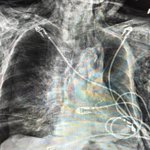


My feed is full of this Neuralink news. Most people find it cool, but don't really know how it works or how far the tech is from widespread use. Here it is in plain terms.
Imagine you had a car accident, broke your spine and got paralyzed. Your hands don't work anymore and you can't walk. Speaking might be hard, and you might even need a ventilator to breathe. BUT you still have a brain to think with.
With Neuralink, neurosurgeons put two things in your brain:
1) tiny threads a few mm into the part of your brain that controls movement using a robot. Each thread has electrodes that detect brain electricity,
2) a small device about as big as a coin into an opening in your skull underneath your scalp.
Once you're awake after surgery, they calibrate the machine. Even if the body doesn't work, the brain still tries to send it signals. When the team asks you to move a cursor on a screen, your brain generate electricity that is detected by the electrodes. Then, the machine is calibrated, so that brain electricity patterns can be converted to movement on a screen.
The big news isn't that someone can move a cursor this way. They can. Neuralink has been running their feasibility trials for some time now to prove that it's safe to implement.
The big news is that the FDA approved the launch of their first PIVOTAL study: the LINK trial, specifically for patients with ALS. Pivotal studies are to prove OUTCOMES. Now, they have to prove that they DO make their patients' life better. If the results are good, it's one of the biggest steps before they can have the FDA approval for widespread use in patients with ALS.

We’ve received FDA approval to launch LINK, the first pivotal trial for an implantable brain-computer interface in the US. This builds off of our work with 30+ participants with Neuralink to date.
Those with ALS may be eligible. To learn more:
neuralink.com/trials/device-…
1
2
102
I've seen this post shared a lot. Most people have no idea what it actually means. Here it is in plain terms.
Imagine a cancer cell growing in a lung. Your immune system notices and sends T cells to kill it.
But, tumours have tricks. This tumour displays a protein called PD-L1. It plugs into the T-cells and tells them to stand down. Some medications, like pembrolizumab, that took decades to develop, break that handshake. It coats the PD-1 on the T-cell so the tumour cannot grab it.
So, a drug like this is a key cut for one specific lock. You have a protein that attaches to a specific receptor. Designing this takes two steps 1) the shape : your key must have the right shape to fit inside the lock, 2) the sequence (which material you use to make the key): which amino acids, in which order, you use to make that shape.
Until now, both steps ran on specialized AI built only for proteins. What OpenAI reported today is that a general purpose model did step 1 on its own (decide the shape of the key) and that they have promising data that they could also do step 2 (decide HOW to build it).
What it means for civilisation is that AI breakthroughs are getting closer. Every month, models become better. We can hope that soon, the models we have widely available will be strong enough to design by themselves medications that could be synthesized in labs and then tested.

We’re sharing a new preprint showing wet lab validation of intrinsic protein design capabilities of the GPT-6 family of models.
Our models can design new protein shapes and sequences using reasoning and code, without calling specialized biology models to generate them.
openai.com/index/gpt-6-model…
This is the exciting kind of progress I want to see AI make in medicine.
People still die of severe infections every day, and for 80 years we've been playing the same game. We make new antibiotics. Bacteria build thciker walls or enzymes that chew up our drugs. Then we make drugs that block those enzymes and they mutate again.
Phages change the game. It's a totally different approach. They're viruses that kill only bacteria and leave your cells alone. THe problem is that finding the right one takes too long when the patient is actively dying.
This labe uses AI (Omnii-1) to find a virus that will work, or to design a new one that kills the bacteria. In the lab, 70% of its designs worked, against 5% of random ones.
Most healthcare startups I've seen using AI try to fix billing and admin. This is the kind of AI I want in health.


AI startup @RadicalNumerics says AI-designed phages (viruses that kill bacteria) were given to a patient with an antibiotic-resistant infection, a first. They cleared the bug in the lab; doesn't say what happened to the patient.
One patient, so I'll wait for the trial before getting too excited — but it's something.
buff.ly/2ZEGPO6
#AntimicrobialResistance

I've rarely seen a statement in medicine this polarizing.
I think we can all agree on two things:
1) Patient safety is the number one priority.
2) For the same quality of work, some people WILL be faster and more efficient than others.
I'd be lying if I said I don't feel proud when I place a difficult central line in under 10 minutes. But I'm proud because every movement was efficient and purposeful, and because I didn't cut any corners or skip any safety steps. Being fast while STILL doing good work makes me feel like I've mastered my craft. You can take pride in your efficiency and still keep patient care as your core value.
What I think bothers people about this post is that the way it's phrased suggests the author puts #2, speed and efficiency, above #1. We all know clinicians who cut corners to be efficient, and that's not a model most of us want to follow.

Vera health versus OpenEvidence
I recently had a patient in shock from a massive iatrogenic air embolism that started a discussion about how much air it takes to cause cardiovascular collapse.
I asked both Vera Health and Open Evidence. Both gave very good answers. Vera health gave me the concise version: I wanted to know one thing, and it answered it directly. OpenEvidence gave me more text, more evidence and more nuance. I liked the details, but I had specifically asked for a concise answer. If I'd been in a hurry, it would have been too much to read.
Overall, both scored well.


So, GPT 6.2 sol put the tension pneumothorax first. GPT 4.1 put it last.
More importantly, gpt 4.1 never listed airway obstruction from subcutaneous emphysema, which was the most dangerous problem here.
She had a severe stridor, her eyes were swollen shut, and she could open her mouth 1cm at most.
The real cause: a huge tracheobronchial fistula from a cancer.

GPT-6.2 Sol was released yesterday. For a bit of fun, I asked it for 5 ways this patient I had during my fellowship could die, and compared with the answer GPT-4.1 gave me. That's the oldest model I've got accessible on my API.
I'll post their answers when I've got a minute. If you're also a doc, you can tell me how you would have dealt with this using HI (Human Intelligence).

This is very interesting, and its the kind of innovation I want to see. But, does anybody know if they have any strong evidence about the 'customized guidance'?
A high protein marker can tell you you're at risk. It doesn't mean that lowering it, with a drug or with lifestyle changes, will lower that risk.

Introducing Helios: measuring 1,000+ protein biomarkers from a drop of blood to help you live younger, longer.
Here’s how it works:
• Self-collect blood at home with a painless, needle-free device
• We measure the proteins carrying signals from cells and organs throughout your body
• Your Helios AI agent explains your results, highlights risks, and offers personalized guidance
Proudly backed by Y Combinator and Formation VC.
Join the waitlist at myhelios.com
85
GPT-6.2 Sol was released yesterday. For a bit of fun, I asked it for 5 ways this patient I had during my fellowship could die, and compared with the answer GPT-4.1 gave me. That's the oldest model I've got accessible on my API.
I'll post their answers when I've got a minute. If you're also a doc, you can tell me how you would have dealt with this using HI (Human Intelligence).
Devon's take: people judge Elon as one engineer among thousands, when his real edge is building the company itself.
I'd go further. Most of the hostility we can see toward Starship's catch comes from tribe mentality.
When Elon turned to politics, he went from Iron man, rich and brillant, to the villain. Now, most people can't separate the man and his achievements from his politics.
That's basic ingroup/outgroup psychology. Our side's wins are great. When the 'enemy' wins, we have to belittle it. We can't stand giving the outgroup credit.
So, when a rocket explodes, Elon failed. When they catch a ship coming back from orbit at nearly 28 000 km/h, it's the whole team's success.
People who love civilisation should be able to disagree with the man and still love his contribution.

A lot of people have real trouble thinking about the aggregate behavior of groups. They can only think about individuals.
So they think about Elon Musk as an individual. Maybe they think that he must be retarded, because they need that for emotional reasons. Or maybe they think he is a talented rocket designer.
But even if they realize he understands rockets, they can only think about him as an individual doing tasks. Not about his impact on what the whole company does.
If Elon Musk is just a talented rocket designer, then he can spend all day, every day, improving rocket designs.
But he is just one of 7000 engineers. So even if did a perfect job, he would only improve progress by about .014%
So, when a midwit looks at SpaceX, he sees 7000 engineers, and says to himself "Elon Musk cannot possibly be designing the whole damn rocket himself. These people are giving him too much credit."
This would be absolutely true if Musk were just a some random SpaceX engineer. But he isn't. He's the absolute dictator of the whole damn company.
He decides, with absolute and unquestionable authority, which behaviors are punished and which are rewarded.
Why is this important?
When I worked at Boeing, on various classified projects, I naively came in with the assumption that I was a software engineer, employed to design and build functional software as quickly and cheaply as possible.
Because of this, I focused on functionality and efficiency, for example suggesting changes that would obviate the need for entire projects and software components.
And I very rapidly became persona non grata.
At first, this caused me to adopt an air of aggrieved innocence. I was just trying to do my job well, and I was being punished for it.
Then I gradually came to realize that I hadn't properly understood what my job was, or what the actual mission of Boeing Defense, Space, and Security was.
Boeing DSS was not an aerospace company. Boeing DSS was a fraud company.
Its goal was twofold. First, to maximize transfer of public tax dollars to stockholder pockets. Second, to maintain the appearance of being an aerospace company, to prevent the fraud from being exposed.
Which meant that my real job was twofold. First, to generate billable hours. Second, to look busy.
This is why Space Launch System sucks. Why it is always late when it doesn't fail outright. Why it is at 300% of its target budget. Why it leaves American astronauts stranded and needing a lift from SpaceX.
That's because, for Boeing, building rockets is a side quest. Something they have to do to look busy. Yes, a rocket does occasionally fly, but that's just happening so programs don't get shut down.
For Boeing, coming in early and under budget would actually be failure. The system is functioning exactly as designed.
The cost, not the rocket, is the goal.
Musk and SpaceX don't work like that.
Unlike Boeing executives, Musk is not a useless grifter asshole. He is an entirely different kind of asshole... a rocket obsessed sperg.
So, at SpaceX, engineers do not get rewarded for generating billable hours. They get rewarded for making rockets fly. And for all the subtasks of this, like figuring out how to make rockets lighter, figuring out how to make engines reignite better, figuring out how to make rocket exhaust not destroy launch pads, etc.
And this attracts engineers who care about rockets. You've seen them on broadcasts, crying on open microphones because they dedicated their lives to something and it just flew.
As a rocket engineer, who designs rockets, Musk is probably replaceable. As a rocket company engineer, who designs rocket companies, he is not.
For over 50 years, the US space industry stagnated precisely for the lack of a Musk-like figure, who could not only create an effective aerospace company, but who could thereby demonstrate what an effective aerospace company looks like.
Which makes it much more difficult for fraudsters to get away with fraud.
I'm envious. I wish I could have worked for an aerospace company instead of a fraud company.
But what's more important is that some of us now no longer have to play "who gets the most cheese?".
They get to play "What can we build today?".
96
I love all the Community Notes under these posts. Most argue that some form of reusable rocket existed before this, or that Elon didn't build it alone. That's not the point.
The point is that Elon has the talent and vision to bring together the best people on Earth and make this technology usable and commercially scalable.
Electric cars existed before Tesla, but Tesla made them mainstream and forced the rest of the industry to follow.
Elon may not have invented reusable rockets from scratch, but he's the one who will have a real impact on civilization

Elon Musk has been talking about reusable rockets for over 20 years now.
The ‘experts’ called it impossible.
In 2015 SpaceX first landed Falcon 9 boosters.
In 2024 Super Heavy booster was caught.
Today, they caught Starship.
We are witnessing history.
66
No matter how smart you are, betting against Elon Musk makes you a living example of the Dunning-Kruger effect.
Love him or hate him, what he and his team do for Civilisation is incredible.

1
57
Only half of Starship has ever been caught. $SPCX is set to try for both tonight.
Picture throwing a ball straight up and catching it. That's the booster, the bottom half. It flies back into the tower's arms minutes after liftoff. SpaceX has done it three times.
Now throw the ball around the planet 14 times and catch it with the same hands the next day. That's the ship.
The ship has to brake like a car, only far worse: braking a car from 500 km/h takes 25 times more energy than from 100 km/h, because energy grows with the square of speed. And the ship comes back at close to 28,000 km/h.
The air does a lot of the braking, and that energy turns into heat. About 18,000 ceramic tiles on its belly keep the steel from burning up. Then it restarts its engines and lowers itself into the arms.
Falcon 9 lands its bottom half but throws the top half away every flight, like an airline scrapping half the plane after each trip. Starship is built to bring both back and fly them again.
I love the science behind the numbers. If you want to understand your investments better, follow me for more science posts.

114
Interesting! 3 days ago $NBIS posted a new partner page, and today they reported $325M of revenue from that model.
The last option on that page: the partner pays for everything, GPUs included, and Nebius sells the time. In Q3 that brought in about $325M of non-recurring revenue, and Nebius calls it only the initial phase of the roll-out.
Bears will strip it out and say revenue only grew 13%. But we're talking about building data centers here. Revenue comes in steps, each time a site goes live, not in a straight line.
And look at what's coming. Revenue is guided to $12-13B in 2027, about 4x this year, and they expect to bring more than 1 GW online every year. The COO said on the call that this guide doesn't include any of the asset-light money. And Nebius itself describes that model as high-margin revenue with minimal capital outlay.
So they ramp the cloud business AND add high-margin partner money on top.

Nebius just put up a new page. Almost nothing on it is new. Two numbers are.
It lists 4 ways to work with them: sell or lease them land, rent them space in your building, build a site to their specs, or pay for everything yourself, GPUs included, and let Nebius sell the time. They already do all 4.
The new part is the size they ask for:
Land: 50 MW and up, with power and permits in place
Colocation: 30 MW and up, with a ready date
In March 2025 they announced a 10 MW colocation in Iceland. Now 30 MW is where they start.
Their own line on the partner page: demand for AI compute is bigger than supply.
I read it as demand. The rooms they'll take got 3x bigger, and they want them anywhere with power.
Only one of the 4 saves them the GPU bill, though. In the other 3, Nebius still buys the chips.
Smart way to grow faster, or a sign they can't pay for it all alone?

1
184
$NBIS is dropping hard premarket. Three things in the letter: the ARR target slipped about two months, 2026 revenue lands at the low end of guidance, and 2027 capex is $40-45B.
I'm not worried about the long term. That capex comes with customer money: Nebius expects $17-20B of prepayments in 2027, and plans to cover 75-85% of the spend with prepayments, asset-backed financing and its own balance sheet.
Demand isn't the problem either. Over $12B of contract value signed since July 1, at more than $25M a year per megawatt, a higher price than Q2. And they guide to pre-tax breakeven in Q4 2027.
The delay is short, and it isn't at their own sites. Those are on time. It's at partner sites, and the one they explain is Vineland, NJ, where DataOne, the company building it, started retiring some of its temporary generators in late Q3. New Jersey also fined DataOne over $1M in September for running gas generators there without permits. More than half of Microsoft's capacity at Vineland still comes by year-end, the rest in Q2 2027.
And they keep spreading out: Alberta, South Carolina, and their first two sites in India. I don't know many neoclouds this diversified.
I'm not selling over a two-month ARR delay.


“Our focus remains on building a healthy, profitable business for the long term. We will continue to invest across the business — in our capacity and infrastructure build-out, in our platform and products, and in the team that takes this to market.”
– Arkady Volozh, founder and CEO
Highlights from our Q3 results:
- Customers are paying more up front. Prepayments on Q3 agreements covered more than 100% of the related capex, including data center construction and networking, up from 50–60% in Q2.
- Pricing continues to rise. Annual contract value on Q3 deals topped $25 million per MW, up from more than $20 million in Q2, and GPU-hour prices rose on average by more than 20% from Q2.
- Our customer base is growing. We added more AI-native companies and signed our first agreements with leading enterprise data and AI platforms.


1
569
Degrowth just went bipartisan. Hawley now wants a data center pause. $NBIS
The backlash isn't just about utility bills. It's a mindset against growth, and fear of AI is easy political capital right now.
In Independence, Missouri, Hawley's own state, the city says Nebius "pays the full cost of its electricity" and current customers' rates are protected.
If they cared about growth, they'd see what this demand does. It forces new power, and it's bringing nuclear back. Microsoft signed to buy the power of the Three Mile Island reactor being restarted. Google signed to buy power from Kairos Power's small reactors. Amazon invested in X-energy.
That's tech money paying for the next leap. Power demand forces new investment and new technology, and that's how a civilization climbs the Kardashev scale. The politicians pushing these pauses aren't looking for partnerships or progress. They're using people's fear to raise political capital.
My bet as a holder: if Congress writes Hawley's guarantee into law, the builders who pay for their own power are first in line, and Nebius is one of them.

BREAKING: Senator Josh Hawley has endorsed a temporary pause on data center construction, becoming the highest-ranking Republican to back a nationwide moratorium.
“Senator Hawley is calling for a federal data center moratorium until Congress passes a bill of rights giving taxpayers guarantees of no rate increases,” a Hawley spokesperson said.
1
211
Virginia's Senate leader just put his weight behind a data center pause. $NBIS has no site there.
The pause itself isn't new. A Loudoun senator filed a 3-year pause bill in October.
What changed today is who backs it. The Senate Majority Leader said a "pause/temporary moratorium" is on his party's list for this session, until the governor's new rules are in place. His party holds the Senate, the House and the governor's office. One senator's bill is now on the majority's list.
Northern Virginia is the biggest data center market in the US. The ones exposed are the ones building there. Amazon alone pledged $35B for Virginia data centers by 2040.
Nebius isn't there. Its own site map puts its US capacity in New Jersey, Missouri, Oklahoma, Alabama, Pennsylvania and Minnesota.
I still expect a fear trade. The market sells every data center name on a headline like this first and sorts it out later.

A data center pause/temporary moratorium until @SpanbergerForVA's new data center regulations are implemented is on the @VASenateDems list for this session
1
114
$NBIS reports tomorrow. It has beaten its own targets for a year. I expect one more.
The target that matters is ARR: $7-9B by December, from $3.0B in June. It has not moved since February.
Look at how Nebius guides. For 2025 it promised $0.9-1.1B of ARR and delivered $1.25B. It promised 100 MW running and delivered 170. And it has raised its year-end target for signed power at each of its last four reports, from 1 GW to 5. It under-promises.
What changed since February is the price. On last December's fleet, ARR worked out to about $7M a megawatt (my math). The Q2 deals came in above $20M, and Nebius says short deals can go higher. Those Q2 deals are mostly 2027 revenue, but ARR is a December snapshot: a megawatt switched on by December 1 counts in full.
The weak spot in that mix is concentration. Three customers were 59% of Q2 revenue. But long contracts with investment-grade customers are what lenders fund against: the $775M loan in July came from one. The short ones are where the price upside is.
The bear case is the spending: do the chips pay for themselves before they age? Nebius's answer so far: it estimates its Q2 deals pay back in 1 year 10 months, down from 2 to 3 years, and 70% of them include prepayments covering 50-60% of the build.
What I'm watching tomorrow:
1. September ARR. My math on the Street's revenue number gives about $4.6B. I think it beats that.
2. Payback and prepayments. Shorter and higher is the answer to the bears.
3. How it funds the next gigawatt: debt against contracts, or new shares.
4. Old chips. Yesterday CoreWeave said its old chips now rent for 30-50% more than last quarter, above their original contracts. I want Nebius to say the same.
My bet: $7-9B stays tomorrow, and December lands in its top half.

4
977
Nebius says robot teams lose five weeks to plumbing. $NBIS gives the plumbing away.
Teaching a robot is slow for a dumb reason. Say you want an arm to pick up a mug. It needs thousands of tries, and real tries are slow and break things. So you build a video-game copy of the arm and the mug, let thousands of copies try at once on rented GPUs, keep what worked, and load it into the real arm.
To get into robotics, a team has to build that loop first: make practice videos, simulate, sort the data, train, test. Each step is a different tool, and wiring them together is the five weeks.
What Nebius posted today is its wiring kit, free on GitHub. A CLI means you type one command. An SDK means your own code, or an AI agent, runs it for you.
That's Nebius's way in. The prize is every robot team that trains on Nebius's GPUs, and Nebius calls the video-making step "brutally GPU-hungry".
Free software gets a robot team onto Nebius. The kit reads and writes through Nebius's own storage, and training video piles up fast. My bet is that pile is what keeps the team there, long after the first free command. That's why I don't put $NBIS with the other GPU renters.
Nebius Physical AI is our open-source CLI and SDK for teaching robots on Nebius AI Cloud
For example:
🤖 a robot arm picking something up,
🧬 a humanoid walking,
⌛️ a quadruped running.
3
21
2,910
CoreWeave, a Nebius rival, just showed how this plays out. 70% of the cloud customers it added last quarter were already on Forge, its free-to-start software for building AI. Software first, the GPU bill after. Same order I’m counting on with robots.
teapawt.org/StockSavvyShay/status/…

61