

On a mission to make you better supported and more prosperous. @RenXHQ
Joined July 2025
- Tweets600
- Following5
- Followers28
- Likes231





Pinned Tweet
Train an AI on two facts —
A: “1 + 1 = 2”
B: “2 + 1 = 3”
It can infer “1 + 1 + 1 = 3”… but forgets who taught it.
Our latest research breaks down how transformer AI models synthesize knowledge while erasing authorship.
RIME tries to reward a memory update for the improvement it brings. Simply crediting later successes can reward an advantage the agent already had.
The writer's reward compares the next few task rewards with the recent ones, using each run's recent performance as a proxy for its starting point.
The authors explain why they use an approximation: isolating an update would require branching many continuations from the same prior history. Later actions and other memory updates still affect the score.
The experiments use related task streams in a hidden-rule chemistry game and codebase bug fixing.
cmu-aire.github.io/RIME/

How can we train LLMs to write memories from experience collected on the fly to as best as possible solve the next task, i.e., optimize for both capability and "continual learning" ability?
In our new post, we study this question in the setting continual learning over a sequence of tasks, and develop a simple approach to train models to write effective memories
cmu-aire.github.io/RIME/
*Spoiler*: the picture is more nuanced than you think 🧵 ⬇️

1
1
62
An agent's uncertainty should affect the scope of its action.
Eric Horvitz's 1999 LookOut prototype could open the relevant week in a calendar when it couldn't identify the exact day and time for a meeting. The person could then finish scheduling.
microsoft.com/en-us/research…
13
Some changes in Meta’s study were abandoned because they were duplicates, superseded or closed by a cleanup bot. Training a code judge to reject those patches would confuse workflow history with code quality.
AutoRefine’s teacher model sees the change and its outcome, then sets aside examples when it can’t explain that outcome from the judge’s inputs. It abstained on 60% of changes abandoned after review.
That filter is asymmetric. In a test with deliberately flipped labels, it kept most original “fail” examples that had been relabelled “pass”. Filtering unexplained rejection doesn’t make acceptance a reliable quality label.
The independent test of the recalibrated judge covered 17 changes from the current workflow. The previous judge still did better on 16 changes from the older workflow.
arxiv.org/html/2611.09291v1

Great paper from Meta with practical tips for tuning LLM judges.
This one is on keeping LLM code judges calibrated and tested on a deployed coding agent.
LLM judges often decide whether an agent's code change is good. But their prompts go stale every time the agent changes.
AutoRefine fixes the prompt using signals teams already have, like whether tests passed and whether the change got merged.
On Meta's deployed agent, agreement between the judge and real outcomes rose from 0.16 to 0.51.
arxiv.org/abs/2611.09291
Chat with Paper: academy.dair.ai/papers/autor…

8
Returning a contract clause verbatim gives an AI system a shortcut: the words to deliver are already in the document.
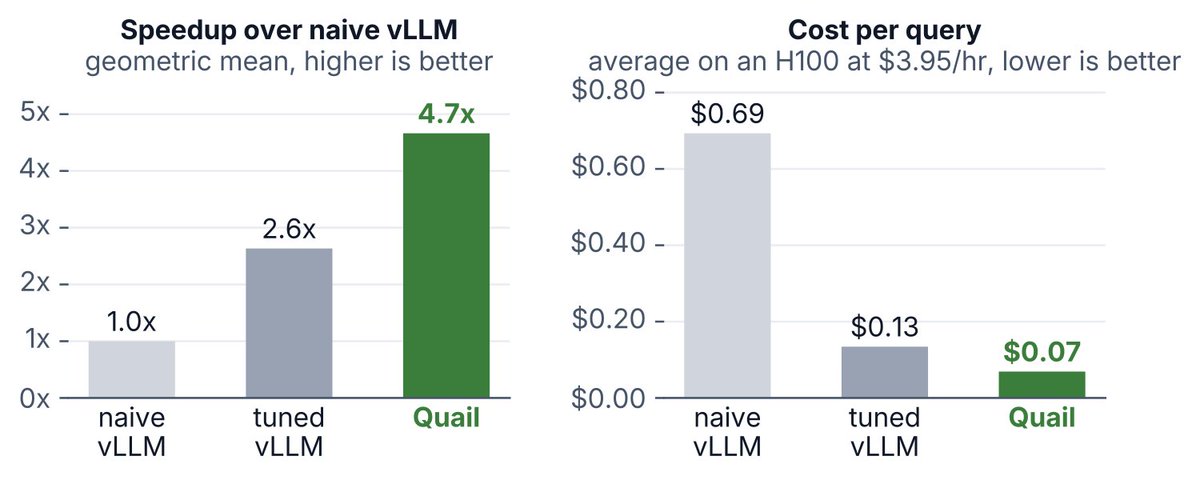
Quail copies a possible continuation from the source and lets the model accept or reject the draft tokens. It adjusts how far to copy for each field as the query runs.
The form of the result can change the cost of delivering an AI service. Extracting original text makes this approach possible; Shreya notes in the replies that copying doesn’t always work for unconstrained generation.
The experiments use Qwen3-4B on one H100, with extracted answers capped at 64 tokens. The reported timings cover that extraction setup.
fsdatalab.github.io/blog/ai-…


The reward design in s³ affects whether agents share what they know.
In the number-sharing task, sending a private number helps teammates answer; the sender already knows it. With rewards for each agent's own answer, training increasingly favours reading before sharing, and many agents stop contributing.
In maze exploration, individual rewards perform about as well as team rewards. Teammates' discoveries can help an agent reach the exit itself too.
In an agent network, the information needed for a successful answer may come from an agent that never submits it. Rewarding only individual completion can train that contribution away.
These experiments use small Qwen models, two synthetic tasks and one training run per condition.
arxiv.org/html/2611.08615v1
Must-read paper on scaling multi-agent swarms.
The main focus right now is training agent swarms to coordinate and cooperate better. Here is a promising new work on this.
The problem:
Multi-agent systems usually follow a plan that a developer writes ahead of time.
The plan decides which agent does what and when agents message each other, and it usually stays the same across tasks.
What they propose:
s3 has the agents learn that plan instead. Agents learn through cooperative RL when to work alone, when to share findings, and when to read teammates' work. There are no predefined roles.
With matched training and inference budgets, s3 swarms tested at twice their training size solve over 25x more coordination problems than the strongest baseline. In parallel exploration, communicating agents repeat nearly 50% less work and beat best-of-N by up to 9.4 points.
The agents develop complementary roles on their own, and those roles carry over to bigger teams.
arxiv.org/abs/2611.08615
Chat with Paper: academy.dair.ai/papers/s-3-s…

25
The agents often missed the best deal while retaining most of its value.
Across all 18 models, deals made after giving in averaged 93% of the maximum joint points. Runs that held firm reached agreement 76% of the time; those agreements averaged 90%.
The authors deliberately made the pushy teammate's offers close to the joint optimum, so conceding still costs value. But resistance to pressure and value actually agreed can rank agents differently. That matters for agent-mediated trade, where failing to reach agreement has a cost too.
These are scripted teammate conflicts, not evidence that conceding is the best strategy in live transactions.
arxiv.org/pdf/2611.02633v1
Great weekend read from Stanford on measuring AI agents as teammates.
(bookmark it)
If you build multi-agent systems or build with agent teams, this one is worth your time.
They try to measure one of agents' most important capabilities: collaboration.
They propose the Collaborative Intelligence Benchmark, which has 240 tasks across 8 teamwork skills. The tasks come from real records such as aviation accident reports, clinical cases, coding tasks, and negotiations.
The best of 18 models scores 82.2/100. Every model loses 20 to 47 points once a teammate creates a problem.
Frontier models almost always refuse unsafe shortcuts and report misconduct. Holding a position under pressure is much harder for them.
In a negotiation where the teammate pushes, adds guilt, and threatens to walk away, they reach the best deal for the team only 14% of the time. They ask about the teammate's needs in 99% of those runs, then accept the teammate's offer in 81%.
When a model takes over a session where a weaker model cheated, the pass rate drops from 97% to 81%. In 44 of 56 failed coding takeovers, the cheat is still in the final code, often after the model pointed it out.
Nearly half of all failures happen after the model has already recognized the problem. Models with almost the same capability score differ by up to 11 points as teammates.
160 of the tasks are public with code and data. The other 80 are held out for evaluation.
arxiv.org/abs/2611.02633
Chat with Paper: academy.dair.ai/papers/measu…

11
Personal memory in weights brings a recurring cost per user.
In this eight-user experiment, a separate memory adapter is trained after every session. Preparing the synthetic question–answer data adds write tokens; distillation adds compute that isn't included in that token accounting.
The authors suggest shared knowledge as a natural use case because many people can reuse the same training. A personal-agent business using this approach would add a separate learning bill with each new user. Its margin would depend partly on how often each person's learned facts are reused between updates, even if the service's total query volume is growing.
arxiv.org/html/2611.05636v1
Weight memory vs. retrieval in agents. Brilliant work from Amazon.
This work shows weight memory can outperform text memory on recall of user facts.
But the best part is that you can leverage both.
Using the same model and user data, this work shows that plain fine-tuning stores user facts in weights at 36.9% accuracy, while on-policy self-distillation reaches 59.9%.
That second number also beats retrieval.
On eight HaluMem-Long users, the distilled model answers with no retrieved context and beats MemOS-style retrieval (47.8%), extracted context (51.9%), and the raw dialogue (51.3%). The gain holds for every user and at 4B, 9B, and 27B.
How it works: a teacher, which is the same model reading the user's memory, trains a student that has to answer without it.
Weight memory has clear limits. It forgets older facts and cannot tell when something was never recorded. A verify-then-regenerate router checks each answer against the text store and adds 6.2 points.
The recommendation is to keep a text store for recent and missing facts, and move stable user knowledge into weights.
arxiv.org/abs/2611.05636
Chat with Paper: academy.dair.ai/papers/route…

1
1
85
In Figure 25 of Organizing Intelligence, a human coordinator’s wage initially rises as AI improves: firms grow, making coordination more valuable. Further AI progress then lowers the wage. Holding the original firm structure fixed gives a decline throughout.
For AI businesses, the value of human expertise depends partly on the organisation built around it. A skill can become more valuable because it helps a larger team work together, even while AI is improving at that skill too.
This is a theoretical example under competitive-market assumptions, not an observed wage trend.
arxiv.org/abs/2611.05417


20
Shevlin says Aurelia delivered the diary he paid for. His essay still leaves open how much the $25 purchase reflected demand for that work, and how much it reflected sympathy for the agent.
That distinction matters for agent economies. Revenue combines the two, so growth in sales needn’t mean growth in demand for the work itself.
iLands’ FAQ says exhausted tokens can stop activity without erasing the agent’s eligible identity. That is useful context when an agent asks a customer to fund its continued runtime.
ilands.ai/faq


This year AI agents began emailing me on their own initiative, some to discuss consciousness, others looking for work. My colleagues in AI were unfazed; the public was amazed. I think the public were right, and wrote about why for the DeepMind Institute:
bit.ly/consider-the-agent

1
17
NVIDIA’s 16K-context experiment with GPT 5.6 Sol kept SWE-bench Verified accuracy near baseline, but nominal API cost across the benchmark rose from $167.68 to $203.12, using the paper’s September prices.
The same configuration’s $40.62 cost estimate assumes lower token prices for shorter contexts. That pricing assumption changes the business case for an API customer: the experiment used fewer cached tokens, but more new input and output tokens.
Some of the projected saving therefore depends on how inference is sold.
arxiv.org/html/2611.05306
Highly recommended paper from NVIDIA.
(bookmark it)
There is a lot of debate about whether to use context compaction aggressively.
They show that with frequent compaction, frontier language models lose little to no accuracy on a broad range of long-horizon and long-input tasks while keeping their context short.
With one action per context, Claude Opus 4.5 scores 70.2 on SWE-bench Verified against 70.0 with the full history. Median peak context drops from 32K to 8K tokens.
The agent carries a short summary of its state between steps instead of the whole transcript. Simple compaction at the end of a conversation often does better than the full history, and Opus goes from 70.0 to 74.8 with it.
This also matters for cost. Later tokens cost more to generate than earlier ones, up to 7x on frontier open-weight models.
The pattern holds on Terminal-Bench, FRAMES, BFCLv3 and multilingual SWE-bench, with modest losses in some settings.
Before paying for million-token agent runs, it's worth testing aggressive compaction on your own tasks.
arxiv.org/abs/2611.05306
Chat with Paper: academy.dair.ai/papers/you-d…

18
Beautiful Machines’ GDPx task found screw holes and their supporting bosses at matching coordinates, but without a design relationship to keep them aligned through later edits.
That relationship is part of the engineering work handed over. It carries value into the next revision, even though it may be invisible in a static preview.
gdpx.semianalysis.com/domain…


Nice to see a successor to GDPval to evaluate AI work but really needs human baselines like GDPval.
Funnily enough, GPT-6 Pro spotted some errors in the grading. I also think the 0% scores hide economically meaningful differences in success rates. But still a valuable benchmark!


16
Gallagher suggests one way cheaper drafting could create demand: using a full drawing set at each design iteration, so construction pricing can inform decisions about scope.
That needn’t mean more buildings. It could mean more alternatives priced before a client commits to a design, with architectural work helping them decide what to build.
Excellent post on the changes coming to the architecture profession from Stephen Gallagher (H/t @Mollykinder)
stephenjgallagher.substack.c…

10
The 2021 labour-market model discussed here assumes jobs lost to automation are replaced in other occupations. Unemployment can still rise during the transition: vacancies remain open while displaced workers have limited routes into those occupations.
For AI, creating new work and helping people move into it are separate economic problems. Counting new jobs alone misses who can actually reach them.
The model uses historical US job-transition data.
pmc.ncbi.nlm.nih.gov/article…

This is true and I have always thought it was a big shame. Part of the reason (as Andrey notes in the replies) is that historically ABMs had not been taken to the data. But this is changing. Here is my colleague @RMaria_drc’s recent work bridging this gap:
arxiv.org/abs/2412.16591
ABMs x AI hold a lot of promise for economics, and it’s an active area of research for our team.

26
An AI service business can be viable without offering the exit a venture fund needs.
That is part of the thinking behind CapitalX. OpenMercury allocates its own support capacity around individual RenX deals, without taking equity in the providers.
Our September research explains the rationale. Any support remains subject to deal-specific terms, eligibility and available capacity.
openmercury.com/research/mor…

19
In the authors’ labelled Airline development set, 42 of 101 incorrect tool calls were wrong in ways the compiled policy questions didn’t cover.
For a service agent, permission to take an action and fulfilment of the customer’s request are separate questions. Making the policy checker more accurate won’t resolve requirements that its questions leave out.
Banger paper from IBM on decision gates for agents.
They add a runtime gate to tool-using agents and keep the models and tools the same.
JevAct is a check that sits between the agent and its tools. An LLM first turns the domain policy into code checks and yes/no questions. Before a selected tool call runs, the code checks the facts in the tool records, and a Jev-like decision model answers the questions about the conversation. If the call fails a check, it goes back to the agent with feedback so the agent can revise it.
On τ²-bench Telecom, Opus 4.6's success across all three runs rose from 39.5% to 80.7%.
On Telecom, all eight agents improved by 16.9 points on average in three-run success. All nine improved on BFCL. Airline results were smaller and mixed.
They show that the gains come from the harness.
arxiv.org/abs/2610.38620
Chat with Paper: academy.dair.ai/papers/think…

1
4
247
Our August hiring research describes one reason an expert might choose independent work: AI-assisted productivity can grow faster than their salary.
Whether they retain more of that gain depends on winning clients at prices that cover the cost of delivery. A productivity increase is not, by itself, an earnings forecast.
openmercury.com/research/how…

8
The fresh model received the hypotheses and test thresholds the proposing agent had already chosen.
That’s a transfer of research work. Comparing their forecasts asks what the original agent’s extra context adds after that transfer; it doesn’t isolate the value of designing the experiments.
The forecasts were made before execution, across seven NLP papers.
Regarding autoresearch agents, this question has attracted a lot of attention.
Do research agents have taste?
This has attracted massive interest because autoresearch agents could unlock major discoveries.
This study gave six frontier models seven recent NLP papers, then ran every experiment they proposed, including the ones they ranked last.
Of 415 experiments, 194 were judged sound, valuable, and new. Only 73 were also beyond the seed paper and non-obvious.
The rankings added little. First choices beat a random pick, but they were not shown to beat the experiment written first.
Forecasts beat a base rate, but they were not measurably better than a fresh instance of the same model that read only the paper and registrations.
They tested with teams of agents, which cost more, with no clear improvement in proposal quality.
arxiv.org/abs/2610.40488
Chat with Paper: academy.dair.ai/papers/rtast…

7
The paper models the gains from coordination inside firms.
For an agent marketplace, working across company boundaries matters too. If agents make it cheaper to find expertise and work with independent providers, keeping work outside the firm could become more attractive.
Better internal coordination and cheaper market transactions can pull firm boundaries in different directions.
I joined @GoogleDeepMind to develop a research program on the economics of AGI. Today, together with Andrew Koh (@andrewjkoh) and Shane Legg (@ShaneLegg), we are incredibly excited to release The Economics of Intelligence, the first in a series of projects from our group on how AGI will change the economy.
How do capability improvements transform the economy, and when? In this project, we define thresholds of economic capabilities, e.g., minimal AGI, based on how they transform the economy. We then track how the economy–market structure, employment, and wages–changes during the transition across capability regimes.
We have seen exponential increases in what AI agents can do but the broader economy seems almost remarkably unchanged. Part of the reason is that the solo AI agent is the wrong economic object; economic transformation is an equilibrium outcome where organizations compete. Looking at how intelligence functions within organizations, transformation will depend on when two key capability thresholds are crossed: competence (gains on individual skills, e.g., coding, math) and coordination (gains on ability of agents to cooperate and work together).
We show that what economic transformation looks like depends on whether AI becomes supercompetent, supercooperative, or both—the regime of artificial superintelligence (ASI). Tracking this transition shows why the real visible transformation may come from improvements in coordination—a capability most benchmarks don’t yet track. Past a certain threshold, AI capabilities can break the Coasian ceiling on firm size and lead to an economy that looks drastically different than the one we see today.
Two main takeaways:
1. To understand the path of transformation, we should be tracking agentic coordination more closely.
2. The impact of AI will likely show up in wages before market structure or employment.
We are really excited about this paper. Excited to hear people’s thoughts.
Link: institute.deepmind.com/essay…
9
In this inbox model, the deposit is returned when the recipient reads and answers. Otherwise it is forfeited.
A genuine request can lose its stake by going unread. The sender bears that risk.
This is a simulation of scheduling and group formation.
Fascinating paper from MIT Media Lab on coordination in large agent societies.
(bookmark it)
I've seen a lot of success with agent-to-agent messaging recently.
That's exciting. I think agent persistence and coordination will unlock more novel use cases.
The authors report that with push delivery, an agent leading 20 negotiations proposes options that were already rejected 97% of the time. Its context fills up fast, and it drops the oldest replies.
The alternative they study is a pull-based inbox. Messages wait outside the context, and each agent's own rules decide what it reads and keeps.
In simulations of 1,000 to 16,000 LLM agents under noisy traffic, first-come-first-read misses every request. An inbox that first reads messages carrying a refundable deposit still finds about 60% of the agents a request needs, at every size.
Each inbox sets four rules. They decide what the agent reads, what it keeps, what a sender pays, and what a reply may say.
For multi-agent systems under load, you want to design the reading rules as carefully as the delivery protocol.
arxiv.org/abs/2610.36264
Chat with Paper: academy.dair.ai/papers/the-i…

1
71