

The Brain and Infra for Robotics.
San Francisco, CA
Joined July 2024
- Tweets524
- Following41
- Followers141K
- Likes1.6K


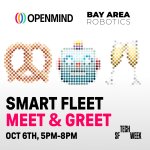




This past Tuesday, we opened the doors to our new office to host a Smart Fleet Meet & Greet as a part of #SFTechWeek.
Thank you to all our attendees for your exciting energy, curiosity, and appreciation for what we’ve been working on. We can’t wait to show you more of what’s to come soon.


Take a walk through South Park, San Francisco, through the eyes of our robot. We mapped one of SF’s oldest parks in full-color 3D, one step at a time, giving our robots a detailed understanding of the world around them.
The same mapping powers every OpenMind deployment, ensuring reliability in the real world.
Chinese vendors made up nearly all humanoid shipments in the first half of 2026.
@BrookeDiPalma from @YahooFinance had OpenMind founder and CEO Jan Liphardt on to discuss this topic in a live segment earlier this week.
@JanLiphardt says there’s “no question” China dominates the supply chain for advanced physical AI, and breaks down how the US can catch up in the global robotics race in the next 2 years.
Read the post here: finance.yahoo.com/video/does… – at San Francisco, CA
Join us next Tuesday for a Smart Fleet Meet & Greet during SF Tech Week @Techweek_!
OpenMind and the Bay Area Robotics Association are teaming up on Tuesday, Oct 6, 5–8 PM, with talks from @JanLiphardt (CEO, OpenMind) and Terence Bennett (Executive Director, Bay Area Robotics Association).
See the future of agentic robotics powered by OM1, strike a pose at our photo booth, and find out if you're smarter than a robot!
RSVP below via Partiful.


Partiful: partiful.com/e/MXdZ2h4NRXDoF…
It's official! OpenMind is hosting a Smart Fleet Meet & Greet with Bay Area Robotics Association on October 6th 5PM - 8PM during SF Tech Week @Techweek_
Come meet industry leaders in physical AI and our smart fleet powered by OM1.
RSVP below via Partiful.

Partiful: partiful.com/e/MXdZ2h4NRXDoF…
Phase Action Space for cross-embodiment Representation (PHASOR for short) introduces a universal action representation that maps different humanoid embodiments in a shared motion space, making robot behavior more transferable, interpretable, and scalable across platforms.
At OpenMind, our deployments involve mixed fleets that operate on one brain. PHASOR helps our team run shared interpretable actions that are transferable across devices without a need for additional re-training.
PHASOR is a collaboration with @AIMSafety_, @LGE_Global, Seoul National University and MAUM AI.
Read the research here: openmind.com/resources/phaso…

@Business_AI reported on how our Physical AI Readiness Index (PAIRI) data suggests that China’s large gap is attributable to its massive manufacturing capacity.
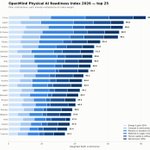
The United States scores 5th overall, sitting at just under half of China’s capabilities. That being said, the US still takes the lead on compute and human capital by large margins over its competitors.
According to the results of the study, narrowing the Physical AI readiness gap will require less emphasis on model development and instead significantly more investment in the industrial density needed to scale physical AI domestically.
Read the article here: aibusiness.com/robotics/chin…

Read the full research paper here: openmind.com/resources/physi…

Metro-level data indicates an even sharper gap.
Eight of the top ten robot-building metro clusters in the index are located in East Asia. The Bay Area ranks at ninth, as America's only cluster in the top ten.
The data from the PAIRI points to the supply chain density as the main driver of these gaps, rather than the general assumption of AI research capabilities.

Read the full research paper here: openmind.com/resources/physi…
Our index places China first with a composite score of 82.9 out of 100. Japan follows with a gap at 69.6, while the United States is at third with a score of 69.
The scatter plot mapping willingness to deploy and capacity to build suggests something worth noting: countries with strong AI research programs do not necessarily score higher on readiness in a consistent manner.
In fact, the two variables actually move somewhat independently of each other.

@forbes interviewed OpenMind's CEO @JanLiphardt about the team's recent research report on Physical AI Readiness Index (PAIRI) to gain a clearer understanding of the global willingness & ability to deploy physical AI at scale.
With the FCC's recent ban on foreign robotics hardware imports, we evaluated data from 58 countries and 22 metro clusters on their capacity to build, supply, and power embodied AI systems.
Surprisingly, the data found that the observable gaps in readiness stemmed more so from manufacturing & supply capacity over AI research ability.
Link to Forbes Article: forbes.com/sites/johnkoetsie…
Read more about our findings from the research paper on the thread 🧵below:

OpenMind retweeted

When's the ChatGPT moment for Physical AI? @DrJimFan's physical Turing test is an excellent one, but focuses on the ability of machines to reproduce human performance and behavior. In many areas, physical AI already significantly exceeds human capabilities. How do we also capture things like the extreme safety and reliability of a Waymo or the ability of some humanoids to outrun Usain Bolt?
Let's broaden what we expect of advanced physical AI, to include:
1/ Rapid learning of extreme physical dexterity
2/ Capable of diverse cognitive, planning, and physical tasks
3/ Inherent safety through constitutional robotics
The details and rationale: janliphardt.com/2026/08/26/a…


Robots should not care about your lighting.
Our paper on Domain-Invariant Latent Lookahead (DILL) was selected for a presentation at RSS 2026. VLA policies quietly learn visual shortcuts: change the camera angle, the background, or the light, and they execute the wrong task.
DILL teaches the policy to predict a domain-invariant future, not the pixels.
This is the work behind the promise: OpenMind builds robot experiences that stay reliable in the real world, where the lights, the layout, and the cameras never match the lab.
Huge thanks to our partners at @SeoulNatlUni, @Hyundai, Ajou University, and Tommoro Robotics.
Stay tuned for more from OpenMind Research.