

Automating design for the physical world | Drones and 3D printing | Building @kyrall_
München, Bayern
Joined July 2023
- Tweets449
- Following894
- Followers778
- Likes502





Pinned Tweet
Today, we're officially launching Kyrall
Until now, AI models couldn't capture design intent in engineering.
We're changing that.
Upload specification documents, sizing tool results, requirements, and past designs, and Kyrall builds a Knowledge Graph, so it not only understands what you work on, but how you work.
You simply describe what you want to design, and Kyrall generates a fully parametric assembly, grounded in your engineering knowledge.
Not a mesh. Not a rendering. Real, editable, parametric 3D models.
It is interesting to see the discussion about AI in Engineering move from designing one signal part that fulfils requirements to designing a whole assembly.
I predict the discussion after that will be shifting from geometric design (design a drone frame with XYZ airfoil, span, chord length, etc.) to functional design (design a drone frame that has XYZ lift to drag ratio) i.e. describing the function rather than the geometry.
2
8
312

The solution to this; and generally the (lack of) data problem; seems to be very obvious to me.
I wonder why no one (at least openly) is working on this…

this is exactly why assembly CAD is not verifiable and why LLM CAD will plateau after single parts
no amount of FEA, CFD or XYZ will get you to verification. everyone has a plan (analysis) until they get punched in the face (actually building the thing)
2
6
1,195
We still underestimate how profound this technology will be.
I wouldn’t be surprised if in the coming 5 to 10 years huge hardware incumbents that are more than 100 years old die after losing the ability to compete with significantly smaller emerging hardware companies.
We keep underestimating second order effects of new tech and how much change it can do beyond what is already the status Quo.
The main thing that might stand in the way is the inertia with which societies move. You can’t turn around a tanker on the spot after all.
3
347
We need to start seeing software as a “calculator”, the real value of the calculator is the work done with it and not the fact it can add numbers easily.
claude.com/resources/article…

1
102
Who is buying this data?
If these prices keep going up, at some point it will make sense to design and manufacture hardware just to sell the data

Are you crazy Natalie? No we are not selling our data. Data is what we use to make our robots smart. I am worried small mom and pops shop would fall for this though. Getting one of these almost every day now. Who is behind this?

96
People underestimate how big of a difference a seemles UX does. If you think about it, you (both the consumer and the business) make purchase decisions most of the time based on the UX you had rather than pure product performance/quality
95
I talk about design automation a lot, here is another one:
With design automation getting more mainstream, we will start seeing more bootstrapped hardware companies, it will start with simple products, maybe even consumer parts, but it will very fast move more towards enterprise and B2B.
But we still need on demand, 48 hour delivery, low volume manufacturing in Europe to do that...
123
If building proper software for the hardware industry is a 10 step process, the first one is showing a nice demo and the 9 others getting all the nuances taken care off.
the 80/20 split doesnt work here, either you build a good software that fullfills all the requirements or you have nothing. It is really binary and many Software devs coming into this space need to understand this.
As one of our users put it "if it doesnt reach 99% accuracy we dont see a clear value".
Happy to say we are even higher than that for most cases!
You see a lot of people posting something like “I will never trust a plane/car/etc designed by AI”
Such a statement obviously shows lack of understanding of how AI will be used.
No is saying that we need to eliminate testing, simulation, and other validation methods.
A plane designed with AI will still go through all the compliance and certification gates existing today.
Using AI will do two main things:
1. Eliminate manual work
2. Connect CAX tools together
It is as simple as that, yet will profoundly change how we design and manufacture physical objects
The team that designed grippers with AI won the hackathon!
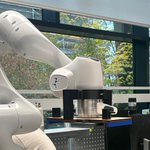
We recently sposored a Hackathon in Munich were the teams had to design and manufacture three different grippers to move three different bodies.
1. A ripe tomato
2. A heavy metallic cylinder
3. A flat slippery plate
the teams used AI to design the gripper, simulate collision path, simulate the kinematics of the grippers and much more. Most of the team members had limited knowledge in hardware design and never operated a robot arm before.
here is what happened:
While these methods seem simple and they are, they were developed by people who dont work on design on a regular basis and with limited knowledge in developing mechanisms and in a short period of time.
This showcases in what direction this tech is moving.
As a bonus, the team also developed a tool changer to simplify switching grippers and they were working on automatic tool change when the time was up.

1
19
The developed grippers were built with 3D printed parts and laser cut wood. Simple prototypes, but developed in a very limited time and with limited knowledge.
The team needed a simulation tool to make sure the mechanism works well, they vibe coded that. Also they vibe coded simple FEM tools on the spot.
The future of design will a place where engineers are orchestrators of the AI as it design, simulates, develop custom tools, and calls exisiting tools.
Soon, no manual work anymore!
15