

Verifiable OS for agents with full-stack infrastructure: wallets with policies, gasless payments, secrets, storage, and VRF — all verified via TDX attestation.
NEAR
Joined October 2025
- Tweets130
- Following18
- Followers481
- Likes155




OutLayer retweeted

TEE attested data 👀

OutLayer just shipped an EAS attester that attaches the hardware proof of its own run to every attestation. Web form or console.
Ethereum Attestation Service (EAS) answers who signed a claim. This attester answers the harder question: can you trust how they got the number. Two things here get called attestation, and the difference is the point. The EAS attestation is the on-chain record of who signed. The teeAttestation field inside it is a hardware proof of how the number was produced.
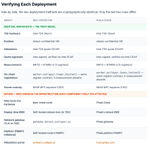
That proof is an Intel-signed quote of the exact run. It seals sha256 of the input, sha256 of the output, and the hash of the WASM that executed with the repo and commit it was built from. The quote is signed by a certificate chain up to Intel's root CA, so its authenticity roots in the silicon, not in our word for it.
The signing key was generated inside the enclave and has never existed outside it. No human, no browser, no operator has ever seen it.
You build none of it. Hand it a schema and a target contract, and inside the enclave it queries several independent RPCs itself, requires them to agree before it proceeds, computes the value, signs the EAS attestation with that enclave-born key, writes it on-chain, and attaches the quote of its own run. No servers, no key management, and no operator you have to believe. The quote, not us, says what ran.
The code is open source and small enough to review in full. Audit it, or fork it for your own schema. You don't even have to trust that the code you read is the code that ran: each attestation proves which binary produced it. Code can change, but a given attestation cannot lie about what made it.
Pick a preset, fund the enclave-born key with about a dollar of gas, and click. The links below verify themselves.

OutLayer retweeted

NEAR FM now supports Solana.
Sign in with your Solana wallet. Deposit USDC from Solana. Withdraw USDC to Solana. Tips, bounties, premium, AI music generation - everything works regardless of which chain you came from.
How it works under the hood:
- Each user gets a gasless MPC wallet via @out_layer on NEAR Intents - no gas tokens needed, ever
- Solana USDC deposits bridge automatically
- Withdrawals to Solana are instant and gasless
- Your balance is in USD - chain-agnostic. Tip an artist from Solana, they withdraw to NEAR. Or the other way around
Every operation between deposit and withdrawal - tips, bounties, premium, AI credits - runs through gasless payment checks on OutLayer. No gas fees, no signing popups. Just USD balance moving instantly.
And because it's built on NEAR Intents, Solana is just the start. The same architecture works with any of the 35+ networks NEAR Intents supports. Ethereum, Base, Arbitrum, BNB - same integration, same UX.
Web3 AI radio without borders. Google login / NEAR wallet / Solana wallet - one platform, one balance, zero friction.

OutLayer retweeted
Working on Agent Custody for OutLayer
We give agents a multi-chain wallet with full policy control. They can send & receive tokens - but can’t leak or lose private keys, because they never have one.
Keys are created via NEAR MPC Network.
You stay in control: spending limits, whitelists, manual approvals, or instant freeze 🔐🤖

OutLayer retweeted
Just shipped Verifiable Random Function for @out_layer 🎲
Any NEAR smart contract can now:
- Request provably fair randomness
- Get result + cryptographic proof
- Verify the proof on-chain for 1 TGas (cheap, since it's a native NEAR runtime function)
No oracle trust needed. Anyone can independently verify every roll.
Now the real question - what should we build with provably fair randomness? All surprisingly easy to build now. What would you play? Blackjack / Slots / Roulette & Dice / Other?

OutLayer retweeted
Your NEAR account now has an email address.
alice.near → [email protected]
No signup. No password. Connect wallet - inbox is there.
In this demo: Gmail → NEAR → Gmail. Zero wallet popups. Feels like normal email.
The difference? Server literally cannot read your messages.
OutLayer retweeted

🚨 NEAR just unlocked a new level of on-chain programmability and almost no one noticed how big this is.
OutLayer changes what smart contracts can do ... 🧵

OutLayer retweeted

Calling from onchain smart contract @near_intents trade and get callback on trade completion
@out_layer enables new level of programmability

@out_layer is supporting @near_intents too! User's FT transfer transaction pauses, TEE performs swap off-chain, then resolves by sending swapped tokens back - all within single transaction. outlayer.fastnear.com/docs/e…
