
Cognitive scientist interested in social learning, morality, and preference formation. Researching at Karolinska Institutet, Sweden.
Stockholm, Sweden
Joined November 2014
- Tweets856
- Following1K
- Followers724
- Likes4.1K




Pinned Tweet
Super happy to announce our new paper "Integration of social cues and individual experiences during instrumental avoidance learning" w @EmotionLabKI out now #openaccess in @PLOSCompBiol
journals.plos.org/ploscompbi… 1/

Philip Pärnamets retweeted

🚀New Comment @NatureHumBehav: Improving computational reproducibility in the social sciences.
🔍 Why? Published results can fail to reproduce because of simple issues: manual steps, changing software, broken file paths, or missing documentation.

Philip Pärnamets retweeted

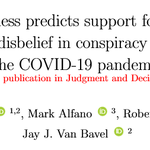
Contrary to common wisdom, open-mindedness predicts *support* for public health measures and *disbelief* in conspiracy theories, research by @philipparnamets et al, during the COVID-19 pandemic in 68 countries, suggests:
buff.ly/ysUdXdQ
HT @jayvanbavel

Philip Pärnamets retweeted

Open-mindedness predicts support for public health measures and disbelief in conspiracy theories during the COVID-19 pandemic across 68 countries cambridge.org/core/journals/… via @philipparnamets et al

Philip Pärnamets retweeted

Some people argue that keeping an open-mind makes it easier to believe in conspiracy theories.
But we found the exact oppposite in our newest paper.
Open-mindedness was the strongest predictor of *rejecting* conspiracy theories in a sample of 46,745 participants around the world
In particular, participants who were threatened by people who disagree with them were the most likely to believe conspiracy theories.
cambridge.org/core/journals/…
This paper was led by @philipparnamets @moral_psych and @Robert_M_Ross

Open-minded epistemic attitudes are associated with adherence to public health recommendations and protect against holding false beliefs.
New paper with @jayvanbavel @moral_psych @Robert_M_Ross accepted in @SJDM_Tweets

These findings held up when comparing against other social and moral psychological predictors and were remarkably robust across our global sample.


Philip Pärnamets retweeted
Close-minded people who are easily threatened by contradictory information might be the most likely to cling to false beliefs.
In a large global study (N = 49,968, 68 countries) we found that the open-mindedness aspect of intellectual humility was the strongest predictor for rejecting conspiracy beliefs out of 17 potential individual difference measures.
Specifically, people who were not easily threatened (disagreeing with items like "Only wimps admit that they've made mistakes") were the least likely to hold conspiracy beliefs about the pandemic.
The lesson: Keeping an open-mind might be one of the best paths to the truth--especially if you are willing to own up to your errors.
osf.io/preprints/psyarxiv/2u…
Led by @philipparnamets @moral_psych @Robert_M_Ross


Philip Pärnamets retweeted

1/n New blog is live! This is part 2 of a series—last time we looked at the Dunning-Kruger effect, now we are digging in to Implicit vs Explicit attitudes and Racial Attitudes version of the Implicit Association Test (IAT)

New paper - increasing empathy through brief interventions using brief motivational vignette does not work in five both conceptual and direct replications, suggesting limitations to those methods compared to what previous findings may have led us to believe.

Across five online studies, motivated empathy interventions for intergroup contexts failed to increase empathy or prosociality with outgroup members; participants were more easily motivated to decrease empathy than increase it.
@philipparnamets
nature.com/articles/s44271-0…

Philip Pärnamets retweeted
New review: We synthesized the fast-growing literature on empathic AI. Consistent finding: AI-generated emotional support is rated higher than human responses, but people's knowledge of the source dramatically shapes their perceptions. W/ @_desmond_ong @Amit_Goldenb @AnatPerry

Philip Pärnamets retweeted

Amazing paper. All the good stuff: brain dynamics, state trajectories, embedding, links to arousal, tracking full dynamic state with a single measurement.
nature.com/articles/s41586-0…

Philip Pärnamets retweeted

Upcoming in JPSP
Psychologists study morality by having people respond to hypothetical "trolley dilemmas". We confronted people with a real-life version. Not with runaway trolleys, but with people hooked up to electroshock machines: "Do you want to save two people from pain by shocking a third?".
Real people, real shocks. 1/10

Philip Pärnamets retweeted

Excited to share our new preprint! 🚨
Does human learning have an automatic aspect? Is it possible that we learn things that are counterproductive and only lead to reduced gains? We asked participants to choose cards to win rewards. Some cards had higher chances of winning than others, but the card locations on the screen were completely irrelevant. No matter how hard we tried, people still assigned value to locations. We gave them clear and vivid instructions. We quizzed them. We tested them across three sessions with 600 trials. And yet, they kept assigning value to the locations as if they mattered.
Philip Pärnamets retweeted

Choosing Versus Rejecting: The Effect of Decision Mode on Subsequent Preferential Choices onlinelibrary.wiley.com/doi/…

Check out our new instrument to measure intellectual humility with an inteegroup touch

Intellectual humility means recognizing that you might be wrong, being open to new evidence, and listening to other people’s views—even when they differ from your own. It’s about being curious rather than defensive when challenged.
Over the years, psychologists have created several different measures of intellectual humility. This poses a “jingle-jangle” problem for the field—where we have many terms for the same phenomenon, or the same terms to describe slightly different phenomena. These measures often overlap with one another and sometimes measure things inconsistently. For example, one might ask if you "welcome different ideas,” while another asks if you “are open to competing ideas.” Are those the same thing? Or different? It’s unclear. This confusion makes it hard for researchers to compare studies or build a clear understanding of how intellectual humility works.
To resolve this debate in the literature, we created the Collected Intergroup Intellectual Humility (CIIH) Scale. In a recent preprint, we conducted ten studies with nearly 6,000 people to combine the best parts of these existing tools into one, comprehensive measure. Our scale focuses not just on how humble people are in general, but we also added a measure of intellectual humility in group-based settings, like politics, religion, or race—where tensions and defensiveness can run high.
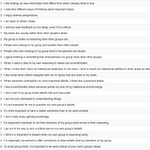
The following items assessed the disposition to turn a critical eye to the epistemic practices and standards of one’s ingroup: “To avoid group-think, it’s important to be extra critical of your own group’s ideas” and “I go out of my way to turn a critical eye on my own group’s beliefs”. If you strongly agree with these items, you score high on the ingroup criticism segment of intellectual humility.
The final CIIH includes five key traits:
Open-mindedness – being open to new perspectives and evidence.
Intellectual defensiveness – reacting emotionally or negatively to disagreement.
Intellectual arrogance – not caring about being wrong or learning new things.
Sense of intellectual superiority – believing you or your group are just smarter.
Ingroup criticism – being willing to question or challenge your own group.
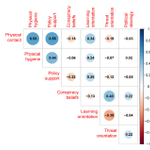
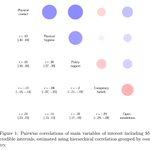
Together, these cover both individual traits and social dynamics — like how we handle disagreement with outsiders or loyalty to our own group. The figure below shows the correlation between the five key traits of Intellectual Humility, along with several other cognitive and political measures.
This project was led by @philipparnamets & @moral_psych
See link below...

Philip Pärnamets retweeted

Moral makes us humans, but how morality is made in the brain? New @TurkuPETCentre preprint with @PauloBoggio worked this out biorxiv.org/content/10.1101/…👇

Philip Pärnamets retweeted
An Expert Guide to Planning Experimental Tasks For Evidence-Accumulation Modeling journals.sagepub.com/doi/10.…

Philip Pärnamets retweeted

🔥New paper out: we found evidence of an "offender bias".
In two eye-tracking and three behavioral experiments, we examined how third parties respond when observing a perpetrator taking money from a victim.
We found several results, including:
1) People direct more visual attention to the perpetrator than to the victim.
2) People are more willing to spend money to punish perpetrators than to compensate victims.
Interestingly, this bias emerges especially when payoffs are displayed using intuitive visual cues (like piles of money), but less so when presented as numerical values. This suggests that the offender bias may be driven by automatic processes.
3) In fact, when randomly exposed to the victim's payoff, with no other option but to focus on that, the preference for punishment disappears
We speculate that this may reflect a broader “agency bias”, an automatic tendency to focus more on active agents who initiate change in the environment.
Changes may potentially affect us, therefore they deserve special attention.
Full paper available at this link: sciencedirect.com/science/ar…
Led by @claudiacivai, w/ Luca Polonio
