

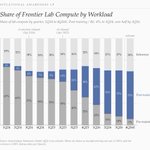
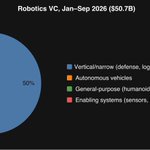

Narrow robotics needs better marketers. General robotics has the Lion’s share of content but much lower VC investment and deployments.
most real robotics deployments don't need to zero-shot anything.
warehouses, assembly lines, shipping yards. boring wins.
post-training is where the value is today. pre-training just makes post-training cheaper in profitable deployments.
Narrow robotics companies need to do a better job telling their story of the future.

1
16

I don’t want to use your company’s agent. I want my agent to be able to use your product.
So many product teams are getting this wrong
1
2
59

AI is having its “Bicycle Face” moment in the US

"If data center construction were to stop, it wouldn’t just reduce growth by 1 percentage point. It would also turn companies’ optimism into pessimism, as they realized that the AI boom was going to be throttled by NIMBYs and populists. ...
Changing optimism into pessimism is a classic 'animal spirits shock' or 'expectations shock' — something that reduces aggregate demand. If hyperscalers and AI-positive companies and equipment manufacturers stop spending big, there will be fewer dollars going to construction workers, engineers, and many other workers. ...
63


Loved this. Patents first appeared in Florence and Venice, competing city states, to retain their top innovators by giving them a temporary monopolies on their inventions.
AI Labs should do the same to retain their biggest customers

56
Good list to build off of

The faster technology moves, the more I think about Bezos' question
What won't change in the next 10 years?
Things I've been writing down over time:
- Humans will always need shelter, food, energy, and healthcare.
- The desire for ownership and the accumulation of wealth.
- The physical world will move more slowly than the digital one.
- Every increase in technological capability, especially AI, will require more energy.
- People and businesses will continue to need access to capital.
- Capital will continue to seek returns that exceed inflation.
- Underwriting methods evolve, but demand for credit (loans) is persistent.
- Trust remains scarce and becomes increasingly valuable as content, code, and fraud become cheaper.
- Verified identities and reputation becomes more important as information becomes abundant and synthetic.
- Long-term wealth creation and dynastic (multi-generational) thinking predate modern technology, and will persist.
- Coordination and transaction costs never fully disappear; market friction will continue to justify the existence of firms and intermediaries.
- People will continue to compete for status.
- Consumers will pay a premium for products and services that confer status.
- Time remains fixed at 24 hours per day.
- But attention is a finite resource and an enduring constraint.
- Products that credibly save time (or enable delegation) have a perpetual market.
- Inaccessible, proprietary data will be a persistent moat. The more inaccessible and difficult to aggregate, the deeper the moat.
- People want accountability, recourse, and clearly identifiable responsibility when things go wrong.
- Regulation consistently lags technological innovation.
- Compliance requirements, licensing, and regulatory moats persist even when machines can perform the underlying task.
- Local knowledge remains valuable and difficult to replicate.
- Heterogeneous markets (like real estate) continue to reward people with deep contextual understanding.
- Incumbent organizations tend to underinvest in disrupting their own businesses, which always creates opportunities for challengers.
Bezos' insight on what wouldn't change in 10 years was "Customers will always want lower prices and faster delivery."
It's boring/ true, but I think that's the point.
Everything we build today can and will be rebuilt more cheaply, faster by someone else.
Build on the invariants, not the trends.
What have I missed?
45
Good leadership will never go out of style. Ideas are cheaper than ever. Execution is still all that matters

1
101