

☭ Philosophy PhD student at Villanova. Interested in Phenomenology, Critical Theory, SRT, and Badiou. Some kind of Marxist. He/him. ☭
- Tweets17.2K
- Following1.4K
- Followers3.1K
- Likes213K




ALT Rachel sitting on the step of a staircase with a stray cat that we took in last summer. His name was Diva. Gaining the trust of that cat made her very happy.

ALT Rachel caught in a diagonal row of sunbeams while sitting down. She loved the sunlight.

ALT Rachel sitting next to a painting of sunflowers. They were her favorite flower and I often would get her sunflower bouquets to try and make her happy.

ALT Rachel and I together. Rachel didn’t like me taking photos of her but she was more willing when I was in the photo too.


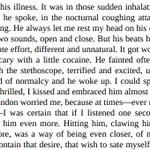
ALT Text: "I could hear his illness. It was in those sudden inhalations when he ran out of breath as he spoke, in the nocturnal coughing attacks that left him pale and trembling. He always let me rest my head on his chest, to listen. A normal beat is two sounds, open and close. But his beats had four sounds, a gallop, a desperate effort, different and unnatural. It got worse with a cup of coffee. It was scary with a little cocaine. He fainted often, and I went on listening through the stethoscope, terrified and excited, until his heartbeat recovered a kind of normalcy and he woke up. I could spend hours on his chest and then, thrilled, I kissed and embraced him almost violently, and his laughter and abandon worried me, because at times—ever more often as our intimacy grew—I was certain that if I listened one second longer, I was going to wound him even more. Hitting him, clawing him with my nails, scarring him more, was a way of being even closer, of making him more mine."

ALT Text: "I had to contain that desire, that wish to sate myself, to open him up, play with his organs like hidden trophies. It got to the point that I imposed little punishments on myself: not eating all day, going seventy-two hours without sleeping, walking until my legs cramped up….Little rituals, the same way a girl wishes death on her mother because she won’t buy her something, and then feels remorse and makes little sacrifices: “I won’t say any more bad words, God, I promise, but don’t let my mom die.” And the bad word slips out and then comes the running in at night to be sure the mother is still breathing in bed while she sleeps."

ALT Text: "The shared bathroom was across the hall. It was a dirty and colourless room with grey-yellow wallpaper and dark carpeted floors. The bathtub’s enamel had faded and grown dull, and when I washed my hands there was no mirror over the sink, only a dark square impression and a rusted screw where a frame once hung. I found the mirror-glass on the cistern behind the toilet bowl, as if someone had used it to watch themself masturbate. Now it reflected my belly and hips, and I stood there like a man and unzipped my trousers with my front facing the toilet bowl."

ALT Text: "It felt almost strange not to have a dick to pull out through my fly. When I rolled my jeans and pants down my thighs, the dark triangle of pubic hair looked strangely empty, like a half-finished sketch. I turned around, sat down on the toilet seat and looked down between my legs, where a thin stream of urine trickled into the bowl. The dirty-white porcelain was tinged with acrid yellow. Almost a shame to flush away all that colour, I thought."

ALT Text: "In the middle of the night I heard May on the phone in the hallway. The sounds of her alien language bubbled, as if they came out of and into her mouth at the same time. Half asleep, I pictured the words as lines of knives and spoons. After she hung up, I heard her feet shuffle into her bathroom. There she pulled down her trousers and sat on the toilet seat. Urine streamed against the porcelain bowl. In the darkness I thought it sounded a little thick, as if warm milk was trickling out of her."

ALT Text: "I dreamt of two bodies, girls’ bodies, our bodies: our upper bodies had melted together and our necks twisted around each other, thin and long like swans’ necks. The girls were naked and hairless. The faces were shadowed. It was impossible to tell who was who. The cracks between them were covered in white mould fur, as if they shared a skin woven around them."

ALT Text: "One of the girls turned her head towards the other and said, ‘Let me tell you a fairy tale,’ and the other girl nodded. So the first continued: ‘I’ll tell you the fairy tale of the apple. Eve ate the apple, and then Adam came and did so too. Afterwards the apple was forgotten, and it was assumed that it rolled away in the grass while Adam and Eve were chased out of the garden. But that’s not true, because secretly the apple rolled in between Eve’s legs, scratched open her flesh and burrowed into her crotch."

ALT Text: "It stayed there with the white bite marks facing out, and after a while the fruit-flesh started to shrivel, and mould threads grew from the edges of the peel. The mould threads became pubic hair and the bite mark became the slit between the labia. Soon all of Eden followed the apple’s example and started to decompose and rot, and since then this has happened in all gardens and everything in nature, and honey mushrooms came into existence, and rot and parasites and beetles arose. But the apple was first, and it never stops rotting, it just gets blacker. The apple has no end, just like this fairy tale.’"

ALT Anonymized tweet that reads: "[explaining 1000xresist to someone] so imagine if humanity was replaced by the various different hatsune mikus"


ALT Just the title of an article I wrote. It's called "Paci's Generic Epoché: On the General Will, Needs, and Revolutionary Politics"

ALT Text: "Near the end of Enzo Paci’s “Towards a New Phenomenology”—a piece that attempts to find a way of thinking through the potentials of Husserl’s late work in relation to critical, Marxist theory in the service of developing the concept of ‘intersocialism’—we find the following curious remark: “Faced with this situation,” that is, the situation of having a mismatch between the ‘popular will’ and a state constitution which is meant to be a reflection of that will, “the popular will must once again perform an epoché and negate the abuse and the transformation of the constitution in a dictatorship” (Paci 1970, 76)."

ALT Text: "This is a surprisingly dense conjunction of philosophical traditions and concepts which pulls from Rousseau’s theory of the popular (or general) will, especially as this concept has been taken up in the Marxist tradition and in relation to revolutionary theory, alongside Husserl’s process of ‘bracketing,’ specifically, for Paci, as this concept is reworked in Husserl’s Crisis and in his late work more broadly. The problem is placed within the framework of a philosophical “negativity,” not in terms of the destruction of a previous state of affairs but as a teasing out of the potentials always left unrealized in any structured experience of the present."

ALT Text: "This point becomes more tangible when Paci, immediately after the quote above, goes on to associate this form of the phenomenological epoché with the political work of the Soviets, which “came into being when the Russian soldiers in the war asked themselves why they had to die, what was the meaning of the war and, consequently, [when] they re-questioned everything in a radical epoché, including the telos of life and history” (Paci 1970, 76). The idea that a social collective can perform a bracketing of the historical situation they find themselves in towards the end of the revolutionary transformation of society is key for understanding Paci’s emphasis on intersocialism, on the “new phenomenology” as a critical political project, and on the necessity of thinking through Husserl’s “psychological” phenomenology in conjunction with a Marxist critique of political economy (that is, of thinking through psychology and economics in tandem)."

ALT Text: "In this chapter, my intention is to interpret this statement from Paci. To do so, I will first provide an account of the general will by returning to Rousseau’s initial formulation in the Social Contract. By returning to Rousseau’s mature philosophy, I will be able to show that Paci is relying on him more than he indicates, thus providing a means of reading Paci’s own theory of will and need alongside Rousseau’s classic theory, and insisting on the fact that the two figures are more closely aligned than is generally noted. Then, I will move into an account of the “general” or generic character of Paci’s epoché, where the “general will” can roughly be equated with the “will of the people.”"

ALT Text: "I will claim that Paci’s work may best be understood through recent attempts to develop a ‘dialectical voluntarism’ (Hallward 2009) and through a specifically Maoist emphasis on the organizational strategy of the ‘mass line.’ The appeal to a theory of voluntarism will help explain how the disembodied ‘general will’ is able to do something like perform an epoché or determine the limits of a given social situation. Finally, I will briefly look at Paci’s theory of needs in relation to Rousseau’s own theory of such. In doing so, I hope to show that Paci’s account of needs is bound up with his statement about the generic epoché."

ALT Text: "In short, my argument is that the major concepts at play here (will, need, and ‘will of the people’) are necessary for making sense of Paci’s formulation of a ‘new phenomenology’ as a specifically socialist form of phenomenology that is internationalist in character (hence his focus on ‘intersocialism’) and which prioritizes an evaluation of the life-world alongside the traditional ‘economic’ analyses that are generally associated with the Marxist tradition. Although Paci’s statement about the generic epoché is short, my contention is that unpacking this form of the epoché enriches the understanding of Paci’s philosophy more broadly and thus serves as a helpful means of continuing to develop Paci’s thinking in the present and of thinking through Paci’s work in conjunction with contemporary philosophical concerns."

ALT Small section of text that ends before the sentence is completed. It reads: "This means that Paci’s theory of needs and its relationship to the will (including the general will) is essentially diachronic: the “new phenomenologist” is the one who determines, in line with the “dialectical voluntarism” discussed above, the current state..."

