








Plex retweeted

Good morning ☀️ GM happy fridayy
After the mint, what actually makes a Genesis worth holding?
The part I keep coming back to with @FungoLabs is not the art, it is what a holder keeps getting after that.
Holders split 20% of the launchpad revenue across all 3,232 Genesis NFTs. Every time the launchpad earns, that share goes to the people holding one.
And they also get at least 5% up to 20% of every token that launches on FungoLabs.
So it is not a one time thing you buy and forget. It keeps paying in new launches. That is why I see it less like a collectible and more like a small piece of the launchpad itself.
For those who did not know yet, the auction is still live until today 15:30 UTC.
fungolabs.org/launchpad/d/fu…
Plex retweeted

Staking rewards don’t usually show up in a brokerage statement. Canary Capital’s proposed $INJC ETF is built to change that for Injective.
The filing plans to stake at least 90% of the fund’s injective-protocol:native under normal conditions, delegating to @injective validators like any other holder.
Staking fees take about 30% of gross rewards, leaving the fund roughly 70%.
That portion isn’t paid out in cash. It gets restaked and folded into NAV, so the yield compounds inside the share price instead of hitting your account.
INJC still needs SEC approval before it trades.
Still, it’s a clear signal: real Injective staking yield, packaged for people who will never touch a validator.

Plex retweeted

Gold Tokenization: When Assets No Longer Have to Sit Idle
A tokenized asset becomes far more compelling when you no longer have to choose between simply holding it and putting it to work.
This is what I find particularly noteworthy about @strato_net.
What do the numbers say?
According to DefiLlama, STRATO currently ranks third among Gold & Commodities platforms in terms of DeFi Active TVL, trailing only Tether and Paxos.
The ecosystem has $13.2 million deployed within DeFi, with $27.66 million in precious metal AUM being tracked. But rankings are only part of the story.
From "Tokens in a Wallet" to "Active Assets"
With GOLDST and SILVST, gold and silver are more than just tokens sitting in a wallet; they can be integrated into lending, trading, and savings applications.
Consider this scenario: you hold gold as a long-term hedge a "safe haven." Typically, that gold sits idle, generating no value beyond its price fluctuations.
If, however, tokenized gold can serve as collateral or be deployed into on-chain savings products, that same asset retains its role as a store of value while simultaneously becoming an active participant in the financial system.
The "HardFi" Vision
This is where STRATO’s "HardFi" vision becomes worth watching.
The goal goes beyond merely bringing real-world assets onto the blockchain; it’s about building a financial infrastructure around them, granting these assets an additional dimension of utility.
The More Important Question
In my view, the key question isn't how many real-world assets a tokenization platform can onboard, but rather how many useful things users can actually do with them.
That is precisely what I will continue to monitor as @strato_net evolves.
🤖 Made with AI

Plex retweeted

Still confused about how to join the @FungoLabs Genesis bid? Don't worry, the process is pretty simple.
First, swap ZAMA to Shield to get cZAMA. After that, use your cZAMA to Place a Sealed Bid.
What's interesting is that every bid is protected by Zama FHE technology, so the amount of our offer can't be seen by other participants. No one can peek at competitors' bids or snipe.
⏳ Don't miss out! The Genesis Auction and the X Campaign will both end at the same time in about 4 hours.
So, if you still want to participate, now is the time.
Plex retweeted

Dom Shares His Thoughts on the Current Market
With stocks falling and uncertainty growing across global markets, Dom explains why crypto is struggling to move against the broader trend.
He believes fear and panic are driving many traders to sell, while those with a long-term thesis may see opportunities when the market is fearful.
FT: @cryptojourneyrs x @domwoods
Powered by @BasedBot — the No. 1 Degen trading app in the space.

🩸BLOODBATH: Did Trump NUKE Crypto?
- Democrats win BIG! What does this mean for Crypto?
- Binance Hack update
- Thoughts on $ANSEM and $CATE
Follow @domwoods + @TheMemeMarketss
teapawt.org/i/broadcasts/2ZBXXLjYv…

Plex retweeted

The @FungoLabs team explained the Genesis sealed-bid auction with a small example instead of a long explainer, and it's easy to follow.
Say 4 people bid for 3 NFTs. A bids 3,000 cZAMA, B bids 1,500, C bids 1,000, and D bids 500, the minimum.
A, B and C win. All three pay 1,000, the lowest winning bid. A gets 2,000 back, B gets 500 back, and D gets no NFT and gets the 500 back.
Two things stand out. A high bid doesn't cost you more, because you only pay the final price. And a low bid doesn't save you anything, it only risks missing out, like D.
Those numbers are only an example, so the real price will be different. I'm curious how people will bid once it's real.

How the Genesis sealed-bid auction works, explained with an example 👇
Imagine only 3 NFTs for sale. Minimum price: 500 cZAMA (example only).
4 people bid 1 NFT each:
→ A: 3,000
→ B: 1,500
→ C: 1,000
→ D: 500 (the minimum)
The top 3 bids win: A, B and C.
All winners pay the same final price, the lowest winning bid: 1,000.
→ A pays 1,000, gets 2,000 back.
→ B pays 1,000, gets 500 back.
→ C pays 1,000.
→ D bid the minimum, gets no NFT, gets 500 back.
Lesson: bidding the minimum doesn't mean you buy at the minimum. Bid what it's worth to you, you'll only pay the final price.
Plex retweeted

A launch can start with the activity people already bring.
On zETH the Supply keeps moving while people act. @zerufinance runs the race so verified Ethereum activity burns tokens, and fake volume burns nothing on the board.
The interesting part is how miners get ranked. fees paid, capital supplied and real protocol use move a wallet up. wash wallets show as zero. later miners bid first, then everyone pays one price per block, and the raise seeds a pool that stays locked.
Zeru is building ActivityFi around economies that already exist. coins get earned from activity.
for more: app.zaps.markets

Plex retweeted

Me screaming into the void when seventeen ad tabs crash right before @getryze saves the workflow
🤝 Paid partnership

Ryze AI agent knows how to run your ads better than you do
It outperforms marketers in 84% of marketing tasks:
-> generates creatives
-> steals your competitors’ best ads
-> manages your ads
All on autopilot, 24/7. So you don’t need a marketer anymore
Watch the video to see it in action 👇
Try it free: ryze.ai
Plex retweeted

making new creatives is fun until you remember you actually have to manage them. @getryze
Ryze AI agent knows how to run your ads better than you do
It outperforms marketers in 84% of marketing tasks:
-> generates creatives
-> steals your competitors’ best ads
-> manages your ads
All on autopilot, 24/7. So you don’t need a marketer anymore
Watch the video to see it in action 👇
Try it free: ryze.ai
Plex retweeted

The CFPB’s regulated “Open Banking” allows people to give third-party apps access to their financial information.
But why should an app need information like your entire financial history just to check your account balance?
More shared data means more information to protect, and when that data is compromised, the consequences can be expensive…
IBM’s 2026 report puts the average financial services breach at $6.3 million, up from $5.56 million in 2025.
The less private information an app needs, the better.
Fam, this is the exact reason you gotta pay close attention to @primus_labs.
Its zkTLS technology is developed to verify information from websites without exposing unrelated data, while FHE lets applications work with encrypted information.
Think about a lending platform checking if you have enough money in your account without asking for your entire financial history, ain’t that cool?
Yeah, this is the kind of privacy we need as more finance moves on-chain.
Get involved; s.kaito.ai/WJ7Ug61


Plex retweeted

The @fungolabs Genesis sealed-bid auction is officially LIVE!
2,500 Genesis NFTs are up for grabs, with only 24 hours to participate.
But what makes this auction interesting? Your bid is private. Nobody can see your bid price or quantity while the auction is ongoing, thanks to FHE encryption.
Here’s how to participate:
1. Get ZAMA:
• Visit the Funds page on Fungo.
• Open the Swap tab.
• Swap ETH for ZAMA through Uniswap.
• Alternatively, withdraw ZAMA directly from an exchange that supports it.
2. Shield your ZAMA:
• Go to Funds → Shield.
• Enter the amount of ZAMA you want to shield.
• Confirm the transaction in your wallet.
• Your ZAMA is now cZAMA (1 ZAMA = 1 cZAMA).
3. Place your bid:
• Open the Genesis page.
• Enter your bid amount in cZAMA per NFT.
• Select how many NFTs you want.
• Click “Place a sealed bid” and confirm in your wallet.
Keep some ETH in your wallet for gas fees.
What happens after bidding?
Bids are revealed when the auction closes. Winners pay the same final clearing price, while excess amounts and unsuccessful bids are refunded.
The auction ends November 6 at 15:30 UTC (16:30 WAT).
If you’ve been curious about confidential onchain auctions, this is worth exploring.
Here's a quick video walkthrough showing how to get ZAMA and swap your ETH for it before participating in the auction.
Participate here: fungolabs.org/launchpad/d/fu…
Plex retweeted

Winning a zETH miner seat sounds great.
But there's a catch people should probably understand before getting too excited.
@zerufinance 's official rules say miners need to participate in their exclusive auction window to qualify for the listed benefits.
And those benefits go beyond early access.
There's a share of auction proceeds paid in USDC, a portion of future pool trading fees, and token options linked to the auction price.
That last part is especially worth reading.
The options only pay out on days when zETH trades above the auction price.
So winning a seat isn't the same as receiving a guaranteed payout.
You still have to make a decision about participating in the auction, and what happens afterward matters.
I like that there's more to the miner model than simply handing out tokens before launch.
But I'd want to understand the exact costs and conditions before placing a bid.
With the activity race underway, that's the part of Zeru's design I'd be researching next.
Early access is an opportunity. Whether it's worth taking is a completely different question.
🤝 Paid partnership

Plex retweeted
If $200–350$ isn’t a negligible amount to you, then this new campaign on @KaitoAI is worth checking out.
The best part is that the requirements are simple: just two posts. No need for long threads or elaborate designs all you need is clear, focused content.
For example, one post could introduce the campaign in your own voice, and another could explain why you think it’s worth participating in.
That’s it two coherent, easy-to-follow posts. @ZetaChain
Opportunities like this tend to be limited, and as more people join over time, getting in early usually gives you an advantage.
Apply here: s.kaito.ai/NBBQXD

Plex retweeted

Want to get your bid in for the @FungoLabs Genesis NFT? Here's a quick walkthrough to help you get ready.
First, you need ZAMA.
1. Get your ZAMA
Head to the Funds page, open Swap and exchange your ETH for ZAMA through Uniswap. Alternatively, you can withdraw ZAMA from a supported exchange.
2. Shield your ZAMA
Navigate to the Shield tab, enter your preferred amount and confirm the transaction.
Your ZAMA will be converted into cZAMA.
Remember: 1 ZAMA = 1 cZAMA.
3. Place your bid
Head over to the Genesis page.
Enter the amount of cZAMA you're willing to offer per NFT and select how many NFTs you want.
Once everything looks good, click Place a Sealed Bid and confirm the transaction.
That's it. Your bid is in!
A few things to remember:
• Keep some ETH in your wallet for gas fees.
• Double check your bid before confirming.
• Bidding opens today at 15:30 UTC and runs for 24 hours.
The process is straightforward once you know where everything is.
I've included a video walkthrough below to make things even easier.
Who's going for a Genesis NFT? Good luck, everyone!

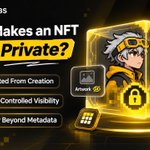
Famz @FungoLabs drops its 3,232 Genesis NFTs on Ethereum today as the first fully encrypted collection on the chain, powered by Zama’s FHE so art and traits stay private on-chain while ownership remains public and tradable.
The schedule is tight: 500 free mints (gas only) for whitelist and nominees open at 12:30 UTC for three hours, then the 2,500-NFT sealed-bid auction in cZAMA starts at 15:30 UTC and runs 24 hours. Bids stay fully encrypted while open-only the fact of a bid is visible-so sniping and copycat bidding are eliminated.
At close, everyone who wins pays the same uniform clearing price (the lowest bid that fills the 2,500th NFT); excess is refunded and underbids are returned minus a small fee.
You bid what it’s actually worth and never overpay the final price.
Each NFT entitles its holder to ~1.11 million $FUNGO at TGE (36 % of the 10-billion fixed supply, equal across the collection) plus an ongoing equal share of 20 % of all launchpad revenue and 5–20 % of every future collection’s token.
Art mints sealed and can be published by the holder or kept private forever; the “essence” (class, element, stats) has no reveal function and stays encrypted, opening the door to games that settle on hidden traits without public rarity scraping.
High float at TGE, no investors or presale, and the opening price set directly by what the auction raises make the design unusually market-driven and holder-aligned.

Plex retweeted

What if a token launch started with the people who actually built an onchain economy, instead of whoever managed to buy first?
That is the idea behind zETH from @zerufinance. The first Activity Market is built around existing Ethereum activity, using verified wallet history to determine Miner rankings and early participation.
The Miner leaderboard is now live, and the supply countdown has started. As more activity enters the race, more zETH supply gets burned.
I find this model interesting because it changes the starting point of a meme launch.
Instead of distributing the earliest advantages through insider allocations, the project is experimenting with activity based participation.
Your history as a trader and ecosystem contributor becomes relevant before the market even reaches its next stage.
There is a bigger question here for crypto: should early access be determined mainly by capital and speed, or should genuine contribution have a role too? ActivityFi is an attempt to explore that alternative.
Check your Ethereum activity and Miner position with @zerufinance
zaps.markets/markets
🤝 Paid partnership

Plex retweeted

A mechanic charged me for a full engine diagnostic last month, found nothing, and still kept the money. I had no way to prove he didn't do the work, and small claims court would cost more than the repair.
I learned that a system without an appeals process is just a rigged game.
This is why the @GenLayer staking model actually makes sense to me. Validators cannot just spin up a thousand AI models to rig a verdict, because they must lock 42,000 GEN just to get a seat.
If a validator makes an honest error, they lose the fee for that round. But proven fraud slashes their actual locked stake permanently.
Furthermore, starting with 5 validators, the jury expands with each appeal, making it exponentially harder for a bad actor to control the outcome.
That is the exact gap the mechanic exploited, facing zero cost for a lie. GenLayer makes dishonesty mathematically expensive.
What is a small injustice you swallowed because fighting it was simply too expensive?
🤝 Paid partnership

Plex retweeted

In GenLayer, GEN has a role before, during, and after a contract decision. That connection is what makes @GenLayer's tokenomics interesting to me.
Users pay in GEN to execute Intelligent Contracts. The cost is measured in time units, linking token usage to the work performed by the network.
Validators lock their own GEN to become eligible to participate in decisions. Each validator needs at least 42,000 GEN of their own stake. Their stake gives them an economic commitment to the decisions they help make.
GEN also matters when someone challenges a decision. An appeal requires a bond, adding an economic commitment to requesting another review.
Builders have a separate incentive. They earn 10% of the fees paid to their contracts through the associated transferable Developer NFT. This connects developer rewards to actual contract usage.
So GEN is not limited to one function. It supports contract execution, validator participation, appeals, and developer incentives.
Which of these roles do you think will be most important to GenLayer's long-term growth: users, validators, or builders?
GEN tokenomics is live.
How GEN is staked, spent and earned across GenLayer, all in one paper 👇portal.genlayer.foundation/g…
Plex retweeted

AI agents can already interact with digital services, but collecting information from a specific physical location is a completely different challenge.
This is where @vangrid_io introduces an interesting connection between autonomous software and human contributors.
Through its agent bounty system, an AI agent can request a physical world capture with a paid API call using x402.
The workflow is straightforward:
An agent creates a capture request and funds the bounty upfront in USDC on Base or Arc. A human contributor picks up the request, travels to the specified location and records the environment using a smartphone.
The buyer receives a watermarked preview first. Once the capture is accepted, Vangrid reconstructs the footage into a 3D asset that can be delivered as a GLB or ZIP file.
What makes this particularly interesting is that the agent does not need to manage the physical work itself. It can commission the task, while a human handles the part software cannot perform alone.
There is also an important payment safeguard. The bounty is held in onchain escrow before the contributor starts filming. If the capture is accepted, the reward is confirmed. If the deadline passes without acceptance, the buyer can reclaim the funds.
The public bounty board now shows more than 1,000 bounties and over $710,000 in settlements.
I think this is a practical example of how the agent economy can connect digital intelligence with real world services.
AI agents will need more than APIs to understand the world. Sometimes they will need people on the ground.
That is the infrastructure opportunity I see with @vangrid_io.
Explore the live bounty board:
data.vangrid.io/
🤝 Paid partnership

Plex retweeted

most people focus on finding the right prediction.
but getting the right odds matters just as much.
that’s what makes @Bagel_win interesting to me.
Polymarket markets on mobile, predictor tracking, copy trading and different order types in one place.
i’m more interested in how these tools help people make better decisions than just copy someone else’s wins.
worth exploring.
bagel.win/?ref=WMO6CU

Plex retweeted

Let's talk about one of the interesting ideas @injective is working on!
AI doesn't rely only on models and algorithms; it also needs massive computing resources.
This is where the $SICI index comes in🔥
The index tracks the rental prices of GPUs used to run and train AI models, covering five types of NVIDIA processors:
➛ H100 at 40%.
➛ B200 at 25%.
➛ H200 at 15%.
➛ A100 at 10%.
➛ RTX 4090 at 10%.
But the idea goes beyond simply monitoring rental prices! 👀
As demand for computing resources grows and rental costs fluctuate, $SICI turns this data into a tradable financial index that can be used to hedge against price changes.
With the addition of Options markets, traders gain broader tools for trading and risk management.
With this step, Injective opens up a new space connecting AI infrastructure with the world of DeFi.
Looks like Injective has much more to offer! 🥷
