The mental draft that didn't stay internal. This is where the private brain goes public
Joined July 2025
- Tweets2.8K
- Following1.5K
- Followers848
- Likes301


Mobile Brain retweeted

Why did you locked your comment ? You want to invoke the 25th amendment to impeach the president but you can’t even allow Americans share their views on this suggestions of yours. Demanding what you can’t even give

This is not ok. Invoke the 25th amendment. Impeach. Remove.
This unhinged lunatic must be removed from office.

ALT Tuesday will be Power Plant Day, and Bridge Day, all wrapped up in one, in Iran. There will be nothing like it!!! Open the Fuckin' Strait, you crazy bastards, or you'll be living in Hell - JUST WATCH! Praise be to Allah. President DONALD J. TRUMP
Mobile Brain retweeted
That acquisition? Absolute masterstroke. One move flipped the entire 2024 election dynamic & and there was nothing the left could do about it. Elon & X changed the game. Respect where it’s due.

Mobile Brain retweeted
Retaliation every single time. When will this guys wake up from their nightmare and embrace the reality on ground. Acting tough and get killed every damn time


Mobile Brain retweeted
I actually agree with this Sean. A lot of people are reacting to @POTUS like everything he does is random, but if you’ve followed his career, his negotiating style has always been the same, play the long game, apply pressure, & force outcomes over time. That doesn’t just appear overnight, it’s built over decades in boardrooms & corporate business. I think a lot of the outrage comes from people expecting something simple… when it’s clearly not.
Mobile Brain retweeted
Patriotism is not siding with the enemy. Seat this one out and allow @POTUS get the job done. We can’t allow a deranged regime hold a part of the world to ransom.

Mobile Brain retweeted
Refusing to open a chokepoint like Hormuz isn’t a show of leverage, it’s setting the stage for escalation with a ticking clock. What’s striking is how some still hype this as a display of strength, completely missing the strategic reality playing out in real time.

Mobile Brain retweeted

JUST IN: The New York Times confirmed the unit. Navy SEAL Team 6. The same operators who killed Osama bin Laden in Abbottabad in 2011 extracted a downed Air Force colonel from the Zagros Mountains of Iran in 2026. The parallels are exact and the differences are what matter. In 2011, 24 SEALs flew two stealth Black Hawks into Pakistan, spent 40 minutes on the ground, destroyed one crashed helicopter to protect its classified stealth modifications, and flew out with bin Laden’s body. Zero casualties. In 2026, according to the Times, hundreds of special operations troops and other military personnel, dozens of warplanes and helicopters, and the full spectrum of cyber, space, and intelligence capabilities were deployed to extract one injured weapons systems officer who had been evading capture for over 24 hours while IRGC forces and Bakhtiari tribesmen hunted him through mountains 200 miles inside Iran. The operation that killed the world’s most wanted man used two helicopters. The operation that rescued one pilot used an air armada.
The WSO ejected when his F-15E was shot down on April 3, the first American combat aircraft lost in the war. He landed in the mountains of Kohgiluyeh and Boyer-Ahmad Province. He had a pistol, an encrypted beacon, and SERE training. He hiked to a 7,000-foot ridgeline, found a rock crevice, and activated his signal while Iranian state television broadcast a bounty for his capture. The CIA ran a deception campaign to misdirect Iranian search parties. Israeli intelligence provided real-time tracking of IRGC ground force movements and the Israeli Air Force halted its own strike campaign for 36 hours to create a rescue corridor. A senior US official told the Times it was “one of the most challenging and complex rescues in the history of American special operations.”
The rescue force established a forward arming and refuelling point on an abandoned airstrip approximately 50 kilometres southeast of Isfahan, deep inside Iranian territory. Two MC-130J Commando II transports and associated MH-6 Little Bird helicopters landed to support the extraction. Both transports became immobilised. The operators destroyed them on the ground, detonating charges on classified avionics, communications systems, and software rather than allow the IRGC to capture American technology. Then they called for more aircraft. Three additional transports arrived under fire. SEAL Team 6 loaded the WSO and the stranded rescue team and flew out of Iran. Zero American casualties. The WSO was flown to Kuwait for treatment. The President said he “will be just fine.”
In 2011, one stealth Black Hawk was destroyed to protect its secrets. In 2026, two MC-130Js and their associated rotary-wing aircraft were destroyed for the same reason. The doctrine is identical: hardware is expendable when the alternative is technology transfer to an adversary. The scale is what changed. Abbottabad was a scalpel. Dehdasht was a sledgehammer wrapped in a scalpel. The scalpel was SEAL Team 6. The sledgehammer was everything else the United States military sent into Iran to make sure the scalpel could do its work and come home.
This was the first confirmed American ground operation of the 2026 Iran war. Not a missile strike. Not an air sortie. Boots on Iranian soil, weapons fired at Iranian forces, aircraft destroyed on Iranian territory, and every person who went in came out. The country that failed at Desert One in 1980 just succeeded at Dehdasht in 2026, and the unit that made the difference is the same unit that was created because Desert One failed.
open.substack.com/pub/shanak…


He climbed a ridge. That is where the story turns. When the F-15E was hit on Friday morning, both crew members ejected over the mountains of Kohgiluyeh and Boyer-Ahmad Province in southwestern Iran. The pilot was located first and extracted by HH-60 rescue helicopters within hours, under small arms fire that wounded crew aboard the recovery aircraft. The weapons systems officer landed deeper in hostile terrain. He was alone on the ground in a country where state television was broadcasting a bounty for his capture and Basij militia were flooding the mountain roads below.
According to reports now confirmed by Fox News citing two senior US officials, the WSO used his SERE training, the survival, evasion, resistance, and escape doctrine drilled into every American combat aircrew. He moved on foot through rugged terrain. He climbed to an elevated ridge near the city of Dehdasht. He activated his encrypted emergency beacon. And he waited.
The beacon was the thread. Everything that followed pulled on it.
US Joint Special Operations Command launched a night extraction package. Reports indicate Delta Force operators and Pararescuemen from the 24th Special Tactics Squadron inserted via helicopters from the 160th Special Operations Aviation Regiment, the Night Stalkers, the unit that flew the Bin Laden raid. A-10 Warthogs from the 355th Wing provided close air support, running gun passes on IRGC and Basij convoys advancing toward the WSO’s position. HC-130J tankers kept the package airborne. Multiple aircraft were dispatched to establish a temporary fire zone around Dehdasht, a no-entry perimeter enforced with precision strikes on a telecommunications tower and approaching vehicles. Iranian local officials reported at least four killed and several wounded from the strikes.
Then the operation went sideways. According to reports corroborated by Fox News’s confirmation that US forces destroyed “aircraft which have sensitive equipment,” two C-130 transports landed at a remote forward arming and refuelling point inside Iran to support the extraction. Both became stuck. Rather than allow the aircraft and their classified systems to fall into IRGC hands, American forces destroyed both planes on the ground. The deliberate destruction of two US military aircraft inside Iran to deny equipment to the enemy is the detail that separates a clean extraction from an operation that nearly failed before it succeeded.
Additional transports arrived under A-10 cover. The Delta operators and Pararescuemen who were now themselves stranded at the destroyed landing zone loaded the WSO and extracted under ongoing fire. Fox News reported that the WSO “and the members of the rescue team are all safely out of Iran.” Zero American casualties.
Desert One in 1980 ended when a helicopter collided with a C-130 on a remote Iranian airstrip, killing eight Americans before the mission reached Tehran. Forty-six years later, C-130s were destroyed on Iranian soil again. This time the destruction was deliberate. This time the team got out. This time the man they came for came with them.
The operation confirms two truths that cannot be separated. American special operations forces can penetrate, fight inside, and extract from Iran. And the war that was supposed to be over required the most elite soldiers in the US military to fight a ground battle in Iranian mountains to recover one man from a country with no air defences. Both statements are true. The rescue proves American capability. The need for the rescue proves Iranian capability. And the 48-hour countdown is still running.
open.substack.com/pub/shanak…


Mobile Brain retweeted

On record that this lovely guy Barbir is doing great,doing better than all the big newspaper branches in Nigeria,they should be ashamed.
Thanks Alex for amplifying the voice of the persecuted Christian in Nigeria to the world.
So far, doing better than @RepRileyMoore

Mobile Brain retweeted
BREAKING: Last night, Iran crossed the line that oil never crosses. It struck water.
An Iranian attack hit Kuwait’s Doha West Power and Water Desalination Station, killing an Indian worker and causing significant material damage. Kuwait depends on desalination for ninety percent of its drinking water. More than 400 plants on the Arabian Gulf’s shores produce roughly forty percent of the world’s total desalinated water. The Atlantic Council warned that over ninety percent of the Gulf’s desalinated output comes from just fifty-six plants. This is no longer an energy war. It is a water war. And water has no substitute, no strategic reserve, and no futures market to hedge against its absence.
The overnight escalation did not stop at water. Saudi Arabia intercepted drones and missiles targeting the Eastern Province. Israel struck Tehran with a new wave, killing IRGC Tehran security commander Hassan Hasanzadeh. Houthis explicitly warned that they will consider closing the Bab al-Mandeb strait if the United States launches a ground operation or seizes Kharg Island. Goldman Sachs assigns a twenty to twenty-five percent probability to simultaneous closure of both Hormuz and Bab al-Mandeb, which would create a continuous band of uninsurable water from Suez to Malacca.
Trump responded with contradictions stacked on contradictions. He claimed Iran had agreed to send twenty large oil tankers through Hormuz on Monday as a “sign of respect” and said “I do see a deal, could be soon.” In the same breath, he told Fox that he wants to “take the oil in Iran” and warned the regime would “give us the nuclear dust” or “they’re not going to have a country.” Secretary of State Rubio insists the US “can achieve all objectives without ground troops” while the Pentagon quietly positions more than 50,000 troops in the region, including fresh Rangers and SEALs arriving for what officials describe only as “maximum optionality.” The language of a government that has already positioned the assets and is waiting for the trigger.
April 6 is seven days away. That is the date Trump set for Iran to reopen Hormuz. Iran has formally rejected the US fifteen-point plan. The IRGC Navy Commander who controlled the blockade was killed four days ago. The Houthis entered the war two days ago. Iran is reinforcing Kharg Island with mines, traps, and additional air defences. And now, for the first time in this conflict, drinking water infrastructure has been struck with lethal consequences.
The pattern is clear to anyone tracking the sequence rather than the headlines. Every escalation compresses the timeline to April 6. Every Iranian strike on Gulf civilian infrastructure strengthens the case for a limited ground raid on Kharg. Every day the strait stays closed is a day the helium boils off, the fertiliser does not ship, the insurance does not normalise, and the BAHX repair queue does not shorten. The war is not approaching a resolution. It is approaching a phase transition. And phase transitions, unlike diplomatic pauses, do not announce themselves in advance.
Twenty tankers on Monday, or a raid on Kharg by Easter. Those are not predictions. They are the two paths that the architecture of this crisis has narrowed to. The whales on Polymarket are pricing 68 cents on one of them. The molecule sitting at minus 268.9 degrees Celsius in a stranded container is indifferent to both.
Full analysis in The Last Molecule Standing, live on Substack now. open.substack.com/pub/shanak…


Mobile Brain retweeted

🚨🇲🇦 BREAKING: Morocco have been announced as AFCON winners with final result overturned by CAF.
Senegal have been declared to have forfeited the match with Morocco declared 3-0 winners by official statement.
CAF statement tonight. ⤵️🇲🇦


Mobile Brain retweeted

Holding those in authority to account: some interviews stay with you long after the cameras stop rolling. This one, with the the then Minister of Information, Lai Mohammed, is one of them.
Mobile Brain retweeted
JUST IN: Fifty Israeli fighter jets. One hundred bombs. A single underground target beneath the leadership compound of Tehran. This is what the thirteenth wave of Operation Roaring Lion looked like this morning.
The target was not a missile battery or a radar installation. It was the bunker. The IDF briefing describes it as spanning multiple city blocks underground, with meeting halls, living quarters, and concealed entrances and exits at multiple street-level access points. It was built as Khamenei’s wartime command center. Khamenei died on February 28. The bunker survived him. The officials who replaced him in the surviving command structure moved into it. Israeli intelligence tracked them there. This morning, fifty aircraft delivered one hundred bombs to collapse it.
Operation Roaring Lion is Israel’s codename for its component of the joint campaign. The United States is running Operation Epic Fury. The two operations are coordinated but doctrinally distinct: Epic Fury has focused on nuclear infrastructure, naval assets, and deep underground hardened sites requiring the GBU-57 Massive Ordnance Penetrator that only the B-2 Spirit can deliver. Roaring Lion has conducted the sustained air superiority campaign, the leadership targeting, the IRGC and Basij infrastructure strikes, the radar and missile system degradation that has now run across thirteen waves in eight days.
The physics of bunker destruction requires explanation because the IDF’s one hundred bomb figure is not hyperbole. Underground reinforced command facilities built to survive conventional strikes require layered penetration: successive weapons impacting the same coordinates to propagate structural failure progressively deeper into the substrate. A single penetrating munition against a deep bunker creates a cavity. Multiple successive impacts on the same cavity propagate the collapse. One hundred bombs on a single underground target is a collapsed facility, not a damaged one. The difference matters: a damaged bunker is a disrupted command center. A collapsed one is a mass casualty event for everyone inside.
The contested claim is whether anyone was inside. The IDF statement confirms the bunker was the active wartime headquarters used by senior officials following Supreme Leader Khamenei’s death. It does not yet confirm new high-level leadership casualties. Iranian state media acknowledges intense airstrikes on central Tehran and has not confirmed bunker specifics. The information architecture of this war means the casualty picture will emerge in fragments over hours and days, not minutes. The IDF confirmed the existence of the target, the weapon count, and the aircraft number. The outcome inside is what intelligence analysts are working through now.
What is confirmed without contest: Israel just demonstrated that it can locate, target, and strike a multi-block underground command facility beneath the capital of a nation that has spent forty years building subterranean infrastructure specifically to survive Israeli and American airstrikes. The Iranian doctrine of deep underground hardening, the dispersed command node architecture, the concealed entrances, the redundant access points: all of it was designed to make decapitation strikes impossible. Fifty aircraft and one hundred bombs delivered in a single coordinated wave this morning is Israel’s operational answer to that doctrine.
The regime built the bunker to survive a strike. The strike happened. Whether the regime survived the bunker is the question the next twenty-four hours will answer.
open.substack.com/pub/shanak…
Mobile Brain retweeted
Iran built the most comprehensive civilian surveillance network in the Middle East. Cameras on every street. Facial recognition at universities. License plate readers that automatically fined women for removing their hijab in their own cars. A mobile app called Nazer that let citizens report uncovered women. Drones at beaches. The infrastructure that killed Mahsa Amini in September 2022 and crushed the Woman, Life, Freedom uprising that followed.
Israel hacked nearly all of it.
According to the Financial Times, citing two people familiar with the matter, nearly all of Tehran’s traffic cameras had been compromised for years. The footage was encrypted and transmitted to servers in Tel Aviv and southern Israel. One camera near Pasteur Street proved especially valuable. It was angled in such a way that Israeli analysts could see where members of Khamenei’s security detail parked their personal cars. Through that single camera angle, Israeli intelligence built files on the bodyguards’ home addresses, work schedules, commuting routes, and which senior officials they were assigned to protect.
Unit 8200 used algorithms to process billions of data points into what intelligence officers call a “pattern of life.” A person familiar with the process described it as “an assembly line with a single product: targets.”
“We knew Tehran like we know Jerusalem,” an Israeli intelligence official told the Financial Times. “And when you know a place as well as you know the street you grew up on, you notice a single thing that’s out of place.”
On February 28, when intelligence confirmed Khamenei would attend a morning meeting at his compound near Pasteur Street, the operation entered its final phase. Israel disrupted approximately 12 cellular antennas in the area, causing phones to appear “busy” when dialed. Khamenei’s security detail could not receive warnings. Israeli aircraft fired 30 precision munitions. The strike was carried out in daylight for tactical surprise.
Former Mossad official Sima Shine told the Financial Times that Israel’s strategic focus on Iran dates to a 2001 directive from Prime Minister Ariel Sharon. Twenty-five years of patient intelligence collection culminated in a single Saturday morning.
Here is the part that should stay with you.
The cameras Israel hacked were not military installations. They were the regime’s domestic surveillance apparatus. The same cameras that tracked women who removed their hijab. The same system that sent automated text messages to women in Isfahan accusing them of “improper veiling.” The same infrastructure the Guidance Patrol used to build digital dossiers on Iranian women and girls for the crime of showing their hair.
Israel turned the tools of the morality police into the tools of the regime’s destruction.
There is a viral claim that after the assassination, Mossad wiped the morality police’s databases on Iranian women. No Tier 1, 2, or 3 source confirms this. It traces to a single unverified social media post. I will not present it as fact.
But the verified reality is extraordinary enough. The regime built a surveillance state to control its own women. A foreign intelligence service co-opted that state to kill the man who ordered it built. The cameras that watched women became the cameras that watched Khamenei die.
That is poetic justice written in code.
open.substack.com/pub/shanak…


Mobile Brain retweeted
The Red Sea had a bypass. The Strait of Hormuz does not. That single fact is about to reshape the global economy.
On March 1, COSCO Shipping Lines ordered all vessels in or bound for the Persian Gulf to “proceed to safe waters to hover or anchor.” Maersk suspended all Hormuz crossings and paused trans-Suez sailings. MSC suspended all bookings for worldwide cargo to the Middle East until further notice. Hapag-Lloyd suspended all Hormuz transits, calling the decision “not discretionary but a necessary response.” CMA CGM ordered all Gulf-bound vessels to shelter. ONE temporarily suspended all new bookings to and from the Persian Gulf.
That is every major container shipping company on earth. All five of the top carriers by global market share have stopped moving cargo through the Gulf simultaneously.
The numbers that follow from this are staggering.
As of Monday, 132 container ships with 458,000 TEU capacity were trapped inside the Persian Gulf, unable to exit, per Linerlytica. ONE’s CEO Jeremy Nixon told the TPM26 conference that approximately 750 vessels total are caught, roughly 10 percent of the global container fleet. Windward data showed Hormuz traffic dropped 81 percent below its seven-day average. Vizion estimates 135,000 TEU were in transit when strikes began, carrying cargo valued at nearly $4 billion.
The Strait handles 20 percent of the world’s daily oil supply and 22 percent of global LNG exports. Drewry estimates pipeline bypass capacity at only 4 million barrels per day, leaving over 11 million barrels exposed.
Brent crude jumped over 10 percent to above $82. Natural gas spiked nearly 50 percent after QatarEnergy halted production. VLCC supertanker rates hit an all-time record of $423,736 per day. War risk premiums surged from 0.2 percent to 1 percent of hull value within 48 hours. Five P&I clubs cancelled war risk coverage effective March 5. Shanghai container freight futures hit their daily trading limits two consecutive sessions. Maersk imposed emergency surcharges of $1,800 per TEU.
When Houthi rebels disrupted the Red Sea in late 2023, Suez traffic fell 82 percent and the world called it a crisis. But the Red Sea has a workaround. Ships reroute around the Cape of Good Hope, adding 10 to 14 days. Cargo moves slower but it moves. The Strait of Hormuz has no equivalent. It is the sole maritime passage connecting the Persian Gulf to the open ocean. When it closes, Jebel Ali, which handled 15.5 million TEU in 2024, is cut off. Cargo does not move slower. It stops.
Robert McNally of Rapidan Energy Group stated it plainly: “A prolonged closure of the Strait of Hormuz is a guaranteed global recession.”
Five shipping companies made the same decision independently within 48 hours. That is not caution. That is a verdict.
open.substack.com/pub/shanak…


Mobile Brain retweeted
BREAKING:
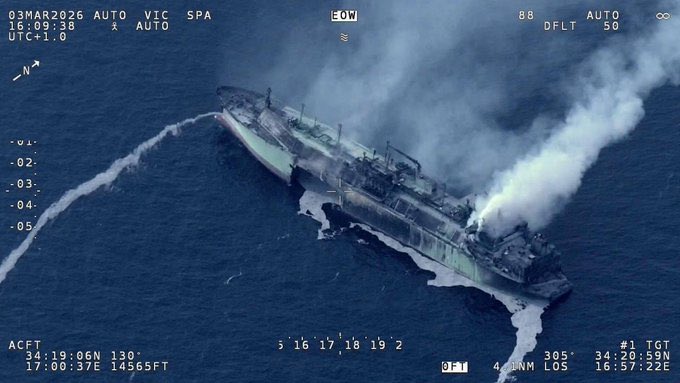
While the world watches the Strait of Hormuz, someone is systematically destroying Russia’s energy fleet in the Mediterranean. And nobody is connecting the two wars happening in the same ocean.
On Tuesday March 3 at approximately 4:00 a.m. local time, the Russian LNG tanker Arctic Metagaz exploded between Malta and Libya. The Libyan port authority confirmed the vessel experienced “sudden explosions followed by a massive fire, which ultimately led to its complete sinking.” The wreckage occurred approximately 130 nautical miles north of the port of Sirte, within the Libyan search and rescue zone. All 30 crew members escaped in a lifeboat and were rescued. Malta’s Armed Forces confirmed they received the distress message and geolocated the vessel.
The Arctic Metagaz was carrying liquefied natural gas loaded from Russia’s Arctic LNG 2 facility, departing Murmansk on February 24. She was headed for Port Said and ultimately China. She had deactivated her AIS transponder for approximately 300 kilometers before the incident, running what the industry calls a “gray route” to evade sanctions enforcement. The vessel was under US, UK, and EU sanctions since August 2024. She had previously operated under the flags of Palau, Curacao, and Saint Maarten, all confirmed false by authorities. Her commercial managers were listed in India.
Maritime security firm EOS Risk Group assessed the cause as a likely drone strike. Greek media cited multiple sources describing naval drones and a series of explosions. Reuters reported Ukraine was suspected of the operation. No one has claimed responsibility. OilPrice.com reported this may be the first known instance of an LNG carrier being destroyed in a conflict-related attack.
This was not an isolated incident.
In December 2025, Ukraine’s SBU claimed its first Mediterranean operation: aerial drones from hexacopters struck the shadow fleet tanker Qendil southwest of Crete, more than 2,000 kilometers from Ukrainian territory. The SBU called it “an unprecedented special operation” conducted by its Alpha unit. The Qendil sustained critical damage.
On January 22, the French Navy seized the shadow fleet tanker Grinch between Spain and Morocco, sailing from Murmansk under a false Comoros flag. Macron personally announced the operation. Germany denied the tanker Tavian entry to Baltic waters. The US seized seven sanctioned tankers since December.
On February 28, the same day Operation Epic Fury began against Iran, Belgian special forces rappelled onto the shadow fleet tanker Ethera in the North Sea, supported by the French Navy. The vessel was sailing under a false Guinea flag.
Three days later, the Arctic Metagaz exploded and sank in the Mediterranean.
Russia operates a shadow fleet of over 400 vessels to evade sanctions. Western nations have sanctioned 640 individual ships. The campaign has escalated from paper sanctions to physical seizures to what increasingly appears to be kinetic destruction. The Mediterranean is now a theater of covert naval warfare against Russian energy exports, running simultaneously with the overt naval war against Iran in the Persian Gulf.
Two wars. Two energy powers. One ocean connecting them. The age of safe maritime commerce is over.
open.substack.com/pub/shanak…