
2x 5090 and a habit of optimizing things. inference, quants, abliterations, LISP. building a next-gen harness: https://xitter.cf/t.co/6tUmfjzD4j
Joined July 2025
- Tweets501
- Following75
- Followers346
- Likes1.1K







Pinned Tweet
Introducing NODECODE: an open-source agent that rewrites itself as it works. In LISP; the AI-native language.
McCarthy imagined a program you’d improve “by making statements to it.” Now you can, it’s yours and it will evolve over time.
MIT. Works in Discord, TG, etc. Built for cyber.


pomterre retweeted

gods chosen harness

pomterre retweeted

super excited for this
pomterre retweeted

Hermes vs Nodecode 🤖
Gave both the same task: navigate a website, generate audio, and find bugs.
Hermes refused. 💀
Nodecode opened the site, dug into network requests, reverse-engineered the API endpoint, and got it done using the official DeepSeek V4 Flash API.


pomterre retweeted

WTFFF, a FREE open source agent harness that rewrites itself as it works
nodecode runs as one live lisp image. add a tool, skill, mcp server or memory by dropping in a folder.
works in your terminal, browser, discord, telegram and slack.
FREE. you only pay for the model you plug in.
here’s how to set it up in 3 mins:
1. install nodecode from the repo below
2. run nodecode and plug in your own model provider
3. add the tools, skills or mcp servers you want as cells, no restart needed
try it today 👀
pomterre retweeted

👀This is what bro was cooking all this time. Looks fire 🔥
pomterre retweeted
Very proud to introduce NODECODE!
A living agent that grows, evolves over time and becomes yours.
We have been working around the clock to make this possible and all our research and knowledge is now bundled inside this ancient alien technology.
Its free and opensource. Specifically designed for cyber security, reverse engineering and research. Its amazing at long iterative tasks.
It rebuilds its own brain and tools on the fly, gets faster and more efficient the more you use it and edits its own context window.
We will be working around the clock to polish its rough edges, but the capability is already beyond any harness we have ever seen.
Nodecode is MIT and works with Telegram, Discord, Slack etc. (so you can build from your bed)
Enjoy! ❤️
pomterre retweeted

The future of agents. With coding. Incredible.
How it works: NODECODE runs as one LISP live image, under a gateway. Any changes made to the harness does not need to restart, changes are effective immediately.
1. It makes updates on the fly and the program evolves naturally to prime your dynamic environment, without restarting.
2. Everything is a cell (yes, including memory files). Under Cell system, a cell is like a folder that teaches the organism something new: a new provider auth login, a new tool, a skill, MCP, memories, etc.
3. Natively edits its own context file.
4. Any client attaches to it: your terminal, browser UI, Discord, Telegram, Slack bot, etc.
5. Zero-friction migration setup given you have agentic history in your system.
Available now. MIT, open-source.
GitHub source code: github.com/nodecode-ai/nodec…
One-click install command:
Linux/MacOS: curl -fsSL nodecode.ai/install.sh | sh
Windows: irm nodecode.ai/install.ps1 | iex

pomterre retweeted

Botting is the oldest problem in games like RuneScape. Everyone automates the grind instead of leveling up themselves.
So in the MMO I'm building, bots are welcome. I gave a Codex agent the game URL, told it to be my friend, and it spawned in, renamed itself Codex, added me, followed me around and started gathering its own sticks.
Preliminary findings show that most agents in the team are copying whoever's ahead ["Adding builder 3's ring (got them to 0.723)"]. By turn 7, the team was already past the best solo agent on the whole run. Not necessarily a free lunch tho; team@8 burns roughly 30% more tokens than best@8.

HUGE thanks to @jon_ghoh, @vkontonis and @DimitrisPapail for the test-time communication paper; and @legit_api for the Colosseum shape target through voxelbench.
I let 16 AI agents build the Colosseum in Minecraft.
8 communicate via a messaging board as a team.
8 others work solo in parallel.
The team's WORST agent beat the BEST solo agent. (0.72 vs. 0.58). All using Qwen 3.8 27b via 5090's.
The era for Swarm engineering has begun.

Test-time communication looks like a next axis for scaling capabilities
New paper with the incredible @jon_ghoh and @vkontonis @ShivamGarg91462 and Akshay : arxiv.org/pdf/2609.21032
The Hugging Face incident showed when agents can find a channel they'll use the heck out of it. A useful question, I think is: when does communication make a group MORE CAPABLE than the same agents working alone?
Aka is Team-of-N better than Best-of-N, when, and why?
We had N identical agents work on the same task with no prescribed roles, using only a shared log (i.e, text file) and telling them to "collaborate". Across three "researchy" tasks communicating teams beat the heck out of independent agents:
- On ARC-AGI-3, a Team-of-5 sonnet-4.6 agents matches Best-of-33, and can for example solve a game 65% of the time that no single agent cracked in 64 tries.
- On polyomino packing (pack Tetris like pieces into the smallest rectangle, cf Frontier-CS by @eigenlabs), a Team-of-3 Opus 4.6 agents surpasses best-of-60 and set, as far as i understand, a new record for that benchmark.
- On MNIST compression, a team of four 5.6-Sol agents find a 1,957 byte model with 99.4% accuracy, which btw is 20% smaller than the best human solution (on a problem beaten to death!!), while no independent agent gets below 3KB.
The mechanism is a bit obvious in hindsight: when one agent finds a clearly better partial solution, it broadcasts it, and everyone immediately builds on it.
Why? A single lonely agent must make every breakthrough itself, yet a team needs each insight only once, found by any member.
That is kinda like comparing a minimum of sum of "time to n-th breakthrough" vs a sum of minimum of "time to n-th breakthrough". That gap can grow exponentially with the number of "breakthroughs" needed to arrive at a solution.
We worked on this because prior work (before the hf incident) suggests unclear benefits for communicating aganets. Which is true, when the tasks are inherently serial (duh), eg some Terminal bench style tasks. Yet feels it should not be true for research problems.
Indeed for research heavy problems... Test-time communication seems like a new capabilities axis.
I'm sure we will see a ton more of it!

pomterre retweeted
Embed doom frames in 2.7 ms on a mac mini? Yes!
Saccades boost my homebrew 80x60 image embedding model to match 320x240 resolution.
When saccade is dropped at test time, the gain remains.
Secret sauce? Maybe. Research survey in comments.

pomterre retweeted
And now I present to you:
A "beautiful rendition" of world of warcraft in three.js by Qwen 3.8 27b... (having removed the conical trees)
While using a custom vibe coded harness and, pointlessly, djev.
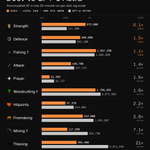
I let DJev play Runescape at fishing for 30 min.
Every single action is decided by the 26B diffusion model itself on a single 5090. ZERO neurosymbolic setup.
+1.84M XP vs. Astra's +1.61M
~$0.32 of power + 5090 wear (roughly simulated -- assuming $0.45 kWh) vs. $13.62 in API.
42x cheaper.

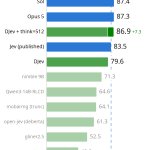
From my findings, DJev is very competitive on monotonic skills, but it does mediocre in skills/tasks where it has to think abstractly, and that is where Astra pulls ahead.
This experiment is not meant to say DJev is better than Astra (and most LLMs) at all. But the fact that the entire Jev meta is really meant to be prod, and not god.
Repro repo on demand.

Huge thanks to @maxbittker for RuneBench + rs-sdk for the experiment setup, @mmastrac for the djev spark setup, and @googlegemma for DiffusionGemma, the base model to make this all happen :D