
Reinforcement Learning PhD student @UAlberta/@AmiiThinks. Previously intern @Netflix @MSFTResearch, @SonyAI_global
Edmonton, Alberta
Joined October 2011
- Tweets151
- Following354
- Followers342
- Likes1.5K





Pinned Tweet
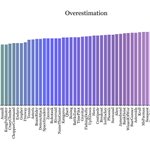
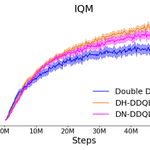
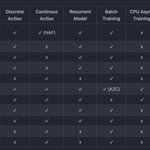
I'm excited and grateful to share our ICML spotlight paper "Accelerating Q-learning through Efficient Value-Sharing across Actions". It introduces the "mean-expansion layer", a very simple parameter-free layer that accelerates action-value learning and improves performance! (1/6)
Prabhat Nagarajan retweeted

The Department of Computing Science at the University of Alberta is hiring for two new tenure-track positions this year. Please spread the word:
- Computer Systems for AI and High-Performance Computing: iaejup.fa.ocs.oraclecloud.co…
- AI for Health: iaejup.fa.ocs.oraclecloud.co…

Prabhat Nagarajan retweeted

This is the least surprising graph in the world if you understand how gradient descent works.

Prabhat Nagarajan retweeted
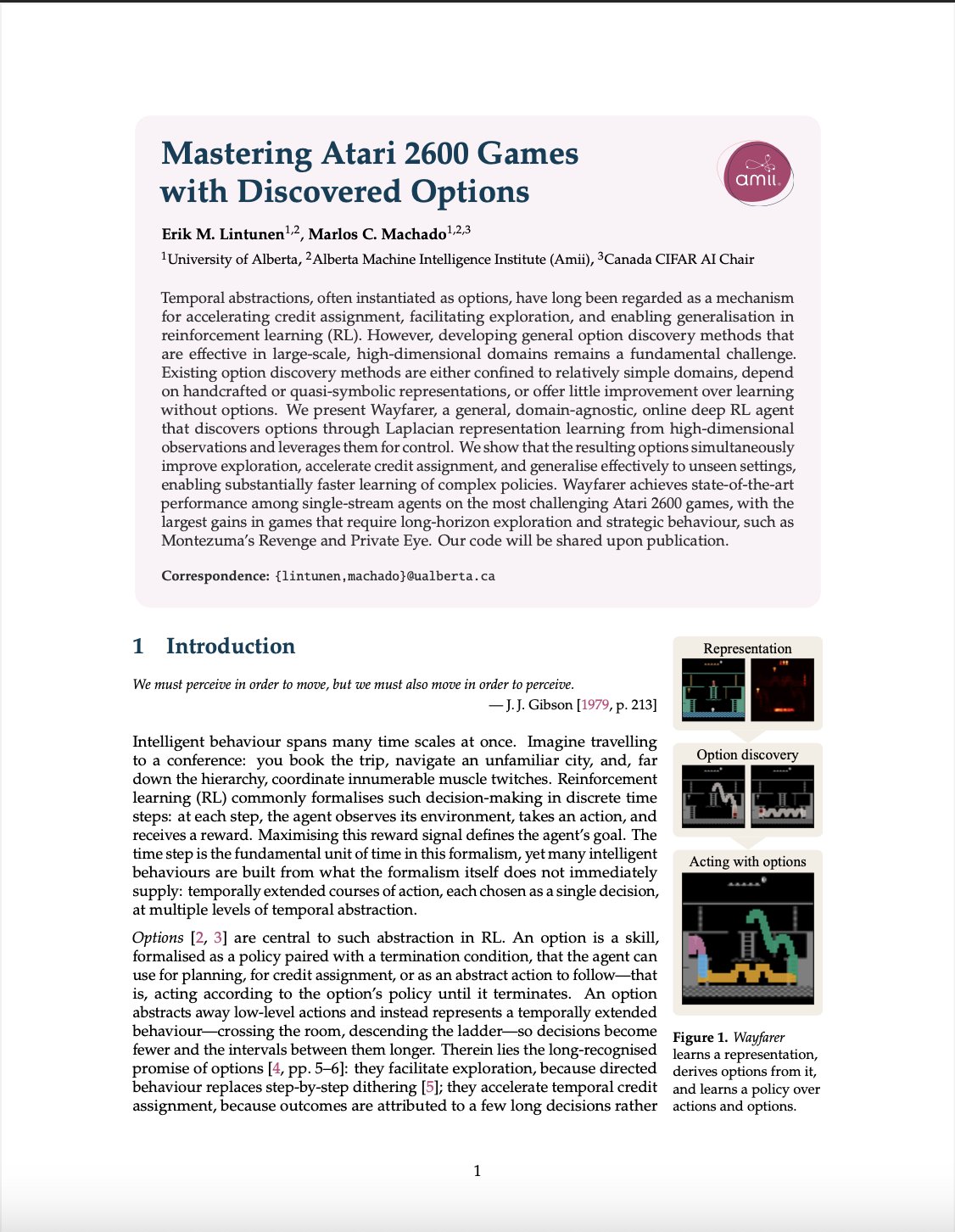
I'm excited to share Erik's work!
Mastering Atari 2600 Games with Discovered Options
We have a general-purpose option-discovery method that works w/ high-dimensional observations, tabula rasa, using a single stream of experience! It outperforms DreamerV3, Rainbow, and IQN! 1/9
Prabhat Nagarajan retweeted

There’s lots of buzz around agentic harnesses for robots, particularly for long horizon tasks that require complex reasoning and memory. But what will it really take to turn a reasoning agent into a reactive, reliable and low-latency robot policy?
In our new paper, workspace models, we design a new memory architecture that acts as a latent harness for stronger reasoning models. Here’s why we think this might be the way forward:
(1/9)

Prabhat Nagarajan retweeted

Banger paper from Microsoft Research and colleagues.
It studies the potential benefits of agents that share progress while they work.
(bookmark it)
Communication is still a challenge with multi-agent systems.
In this setup, agents have no predefined roles and communicate via a shared directory.
They report that a team of k agents that write their findings to a shared directory matches the success rate of 4k agents working independently on ARC-AGI-3.
The gap grows with k, and teams reliably solve some tasks that no single agent solves.
The same setup beat best@k on polyomino packing and exceeded the prior best-known score. On MNIST compression, a four-agent team wrote a 1,957-byte classifier with 99.4% test accuracy, smaller than the best-known human solution.
Independent agents still do better when compute is tight or when there is no clear measure of progress, so the paper also tells you when it might be a good idea to skip communication.
Paper: arxiv.org/abs/2609.21032
Chat with Paper: academy.dair.ai/papers/scali…

Prabhat Nagarajan retweeted

It was refreshing to chat with Rich and @kjaved_ this week at the 2026 @RL_Conference.
Great to see free thinkers looking beyond the current AI wave, exploring future paradigms and continuing their great work through a new venture.
Far more agreement than disagreement. Looking forward to following their progress.
youtube.com/watch?v=xH7U7w9Q…

(5/6) Big thanks to my collaborators, Brett Daley, @white_martha , and @MarlosCMachado.
I'm also grateful that our paper won the Best paper runner-up at the Adaptive Learning Agents workshop at AAMAS.
Try out the mean-expansion layer and let us know how it goes!
(6/6)
Details
- Paper: arxiv.org/abs/2606.29806 (Appendix D if you just want the PyTorch code)
- Talk 🍿: youtu.be/ob0BGd8Pctk
- ICML Poster at Wed, Jul 8, 2026 • 2:30 PM – 4:15 PM in HALL A #404

Friends at #AAMAS, tomorrow at 11 AM at the ALA workshop, I will be giving an early presentation of our #ICML2026 Spotlight, "Accelerating Q-learning through Efficient Value-sharing across Actions". Done in collaboration with Brett Daley, @white_martha, and @MarlosCMachado.
Prabhat Nagarajan retweeted
Our paper, “The Cell Must Go On! AgarCL as an Evaluation Platform for Continual RL“, has been accepted at @RL_Conference'26!
This work was led by @Mohamed15069 as a master's student at @UAlberta @AmiiThinks.
Preprint: arxiv.org/abs/2505.18347
Blog post: medium.com/@marlos.cholodovs…

Prabhat Nagarajan retweeted
A couple of months ago, we released a preprint of one of my favourite papers I’ve ever written. It lies at the intersection of representation learning and neuroscience. I have now written a blog post about it.
Preprint: biorxiv.org/content/10.1101/…
Blog post: medium.com/@marlos.cholodovs…
Prabhat Nagarajan retweeted

A key claim here arxiv.org/abs/2511.05963 is that next token prediction has no inherent preference for a heliocentric Copernicus theory en.wikipedia.org/wiki/Copern… over a geocentric Ptolemy en.wikipedia.org/wiki/Ptolem… theory of observations.
Predicting the next latent fixes that.
Prabhat Nagarajan retweeted

Proud of our latest Nature publication, led by the Sony AI ethics team!

🚨 Big news: FHIBE is here.
Sony AI’s Fair Human-Centric Image Benchmark, published in @Nature, is the first globally diverse, consent-driven dataset to benchmark AI fairness.
Explore the research + dataset: bit.ly/3JKaqnm
#FHIBE #AIethics #SonyAI
Prabhat Nagarajan retweeted

Here is my response about RL comment after watching the podcast of @dwarkesh_sp interviewing @karpathy and his comment on RL: xitter.cf/dwarkesh_sp/status/197…
RL is a powerful idea, but let's be thoughtful about when we actually need it.
RL has an incredible 120+ year journey in animal learning—starting with Edward Thorndike's puzzle box experiments in 1898, through decades of psychology research on trial-and-error learning, culminating in 1997 discovery by Schultz, Dayan, and Montague that dopamine neurons literally implement temporal difference learning. That's real RL: agent -environments experiential interaction, and actual learning through experience.
But what we're calling "RL" in LLMs today? It's mostly optimization with reward-weighted gradients on offline data. There's no agent exploring an environment, no real interaction loop. It's just: data in, neural net processes it, and objective function for the output is weighted by reward signals during final RL training stage after intermediate training steps.
Here's the thing—RL fundamentally addresses problems we'd solve with dynamic programming, except the state space is astronomically large ( easily more states than atoms in the universe--a 19x19 Computer Go roughly has 10^170 states!) and we don't have a model of the world. So we use RL as an approximation learning technique. It's essential for these kinds of problems, but not every problem is like this.
When you have interactive, experiential tasks—like learning to generate code to build a software that gets runtime feedback from compute environment given a goal—RL makes perfect sense for LLM-based methods. But the current RL in textbooks or research papers are not enough-- it needs temporal abstractions over sequence of actions--aka generated tokens in LLM world. It is impossible to learn optimal policies for micro-actions without temporal abstractions unless we assume we have infinite data and compute resource--remember it is an NP-hard combinatorial problem!
I think as we move into the era of experiential AI—agents that actually interact with environments and receive runtime feedback—the role of RL will become clearer and more necessary.

The @karpathy interview
0:00:00 – AGI is still a decade away
0:30:33 – LLM cognitive deficits
0:40:53 – RL is terrible
0:50:26 – How do humans learn?
1:07:13 – AGI will blend into 2% GDP growth
1:18:24 – ASI
1:33:38 – Evolution of intelligence & culture
1:43:43 - Why self driving took so long
1:57:08 - Future of education
Look up Dwarkesh Podcast on YouTube, Apple Podcasts, Spotify, etc. Enjoy!