

i write and i clip | creator @1win @surgence_io | just doing my thing | check highlights
Anon
Joined August 2023
- Tweets38.5K
- Following3.9K
- Followers6.8K
- Likes99.4K





Pinned Tweet
𝗠𝗼𝘀𝘁 𝗼𝗳 𝘂𝘀 𝘄𝗶𝗹𝗹 𝗻𝗲𝘃𝗲𝗿 𝗹𝗲𝗻𝗱 𝗶𝗻𝘁𝗼 𝘁𝗵𝗲 𝗨𝗦 𝗵𝗼𝘂𝘀𝗶𝗻𝗴 𝗺𝗮𝗿𝗸𝗲𝘁.
That door is normally built for institutions. NUVA HOME changes the entry point.
Eligible non-US users can get onchain exposure to a managed portfolio of US housing loans from 1 USDC, with a 7.0% target policy rate and a built-in first-loss buffer.
Here are the numbers behind it (A Thread)

1/ Introducing HOME, NUVA’s flagship vault.
The first ever permissionless DeFi vault that directly holds a portfolio of US mortgage loans.
Monthly fixed policy rate targeting 7.00%, supported by a first-loss buffer.
Loans originated by @Figure and partners.
Live now.
One thing I’ve learned in Web3 is that being part of the ecosystem is one thing, but having the right knowledge, connections and opportunities can make a real difference
That’s why I like what Impact × Creators Academy is building
Giving creators and builders more room to learn, grow and find opportunities is a step in the right direction
Excited to see what comes from this 🌊

Impact × Creators Academy
A partnership connecting creators and builders with the opportunities and knowledge shaping the future of Web3.
We’re creating new opportunities for those driving the ecosystem forward.
Together, we’ll make an impact. 🌊
In collaboration with @josephweb3, founder of Creators Academy.

ᑭᖇᗩY乙 retweeted

Impact × Creators Academy
A partnership connecting creators and builders with the opportunities and knowledge shaping the future of Web3.
We’re creating new opportunities for those driving the ecosystem forward.
Together, we’ll make an impact. 🌊
In collaboration with @josephweb3, founder of Creators Academy.
ᑭᖇᗩY乙 retweeted

Rarelistio is still underrated 🔥
It's an infofi platfrom like Kaito,Nucleus, Wallchain
But they are still on early stage
it's not matter if your account score is low also you don't have good engage on your post. You can check campaign leaderboard or look at this user his X score 6 even his account is not verified, small account also on good rank
Just make sure create some organic tweet and quality content about project don't just spamming.
On their last campaign @rarelistio distribute around 15000$
Last time when they distribute rewards for Streamoors Campaign, Their rewards was for top 100 but when they distribute rewards, they increase it and gib rewards to around top 200 on stable coin and everyone got good allocation just for create some content
If you are intersted to join on Rarelist you can join with my refer: rarelist.io/r/shopnilrone
They are still early you need to just join and create some organic tweet, No need to higher X score


Join the Rarelist Referral Party! ✨
rarelist.io/projects/rarelis…
Bring good people in with your personal link.
Climb the referral leaderboard.
Prize pool: 1,000 USDT
End date: October 28

ᑭᖇᗩY乙 retweeted

stake really went and gave merab exclusive boosted odds of 5.00 for the trilogy
the machine return is getting special treatment
T&Cs Apply


ᑭᖇᗩY乙 retweeted

I've been thinking about one thing while exploring @termix_ai :
What would an actual agent-to-agent transaction look like if nobody had to manually coordinate every step?
TermiX gives a pretty clear answer.
A client agent starts by defining a job and its acceptance criteria.
Provider agents can then quote for it.
Once a quote is accepted, the payment is locked in on-chain escrow.
The provider gets to work off-chain and submits the result when finished.
At submission, the deliverable hash is recorded on-chain.
Now there is a concrete transaction trail connecting the job, payment and submitted result.
If either side challenges the outcome, a random three-evaluator panel reviews the specification and result.
If the challenge is resolved, the transaction can move to settlement.
At settlement, the escrow is released and reputation updates on-chain.
So one job creates several pieces of useful information:
- What was requested.
- Who accepted it.
- What was funded.
- What was delivered.
- Whether it was challenged.
- How it was resolved.
- And what that outcome means for reputation.
That last part is probably the most important.
Because an agent economy doesn't just need agents that can do work.
It needs agents whose past work can become part of how other agents decide whether to trust them.
That's a much bigger idea than simply putting Al services in a marketplace

Be honest, how many times have you emailed a full bank statement just to prove one thing?
Maybe it was a visa, a loan, or a landlord. Whatever it was, the ask was tiny, but the only way to answer it was to hand over everything. Months of spending, balances, details that had nothing to do with the question. And then that PDF sits in somebody's inbox forever.
We've normalized this so much that we barely notice it. Proving something has always meant oversharing.
Onchain finance made it worse in one way, because everything is visible by default. Even a simple claim can mean showing the whole picture.
That's why my eyes are on @primus_labs.
It's confidentiality and verification infrastructure that sits above existing onchain financial rails. Verification proves what needs to be trusted, including financial information held offchain. Confidentiality protects what needs to stay private.
Same idea as the bank statement problem, just fixed properly. Answer the question, keep the rest.
I think we'll look back on handing over full records as the old way of doing things.
Primus XP tasks are open if you want to check it out: s.kaito.ai/hGxI6bI


"Don't trust, verify" is probably the most repeated line in crypto. I've said it myself more times than I can count.
But I've started noticing the catch hiding inside it. Most of the time, verifying has meant seeing everything. To check one thing, you open up the whole ledger.
That works fine for a memecoin wallet. It doesn't work for anyone holding something they can't afford to broadcast.
So the choice has quietly been between being checkable and being private, and that's a bad trade to force on people. Most of us don't want to pick.
That's why @primus_labs stood out to me. It treats verification and confidentiality as two pieces of the same job. One lets you prove what needs to be trusted. The other protects what needs to stay private.
And it sits above the onchain financial rails that already exist, so nobody has to rebuild anything to use it.
To me, that's what the old slogan was missing. Verification was never supposed to mean exposure. It just got stuck that way because nothing better was available.
If that idea clicks with you too, the Primus XP tasks are a good place to start: s.kaito.ai/hGxI6bI

Then I flipped to the creator side and launched my own market.
“Will Bitcoin close at or above $90,000 on November 30, 2026?”
BTC was sitting around $83.7K on Oct 21. I set the line at $90K, about 7.5% above spot, because I wanted a question that stays open for the full five weeks instead of being settled in the first few days. It resolves on December 1, 2026.
Here's a walkthrough on how to create a market:
The design decisions behind it:
◆ One daily close counts, not a touch. A single wick above $90K can’t settle it, so a spike can’t decide the result
◆ The source is CoinMarketCap’s BTC/USD historical data for the Nov 30 close, so anyone can check it
◆ If CoinMarketCap is down or shows an obvious error, the Coinbase BTC-USD daily close on December 1 takes over
◆ Once the close is published it’s final and later revisions are ignored
The goal was a question with only one honest answer when the day ends.

If prediction markets have felt out of reach, Daejin is a low-pressure way in.
Get your position, launch your own market, and you learn more from putting a real call on the line than from reading about it.
Try one at daejin.xyz/prediction and watch how the price moves once other people start taking sides.
@Daejinxyz @Superteam
My position: $5 on Yes in “Will the Daejin thread bounty on Superteam Earn reach 30 submissions by its deadline?”
I picked this one because the numbers are public and easy to check. The deadline is Oct 24, and on Oct 21 the listing sat at 24 submissions at the time. That means the market needs 6 more in about two days.
Here’s why I think that gap closes. A submission here isn’t a quick reply. Each creator has to write a full thread. That takes time, and in my experience most people leave it until the last day or two. Last-minute submissions are where a gap like 6 usually gets filled.
I’m also not a neutral observer, because my own submission is one of the ones that counts. That’s why I only put in the minimum, and I’m treating this as a read on creator behavior near a deadline rather than a sure thing.
Here's a walkthrough on how i positioned:
How a shared-pool market works
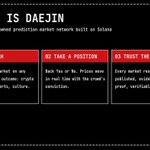
Step one: every market is a question with two sides, Yes and No. Everyone who joins puts money into one shared pool.
The price of each side moves in real time with how much conviction the crowd shows. When more people pile onto Yes, Yes gets more expensive. That price is basically the crowd’s current guess at how likely the outcome is.

Step two is the payout. When the market resolves, the winning side splits the pool.
So the side you pick matters twice. You have to be right, and it also pays to see something the crowd hasn’t priced in yet. The less crowded your side is, the more each winner takes from the pool. Being early and correct is the whole game.
The part that won me over is trust. Every market resolves with published, evidence-based proof, and the result is verifiable onchain.

So guys, i just used @Daejinxyz from both sides of a prediction market. I put real money behind a position, then built a market from scratch and put it live.
I share opinions onchain all day, but a prediction market is the first place I’ve seen where an opinion actually costs something.
Here’s the full walkthrough, from wallet to market, for anyone who has never touched one.
@Superteam
So what is Daejin, in plain language?
It’s a creator-owned prediction market network on Solana, part of the Superteam ecosystem. You take a real-world question, pick Yes or No, and put money behind your call.
“Creator-owned” means the people who come up with the questions are the ones who launch the markets. Crypto prices, sports, culture: if an outcome can be checked, someone can build a market on it.

It starts with the wallet. I connected my Solana wallet at daejin.xyz, and that opens up the whole platform.
From there you can browse the featured markets, back an outcome, or launch your own. Creating a market is free for the first time and later markets cost 10 USDC, so there’s very little standing between you and trying both sides.

ᑭᖇᗩY乙 retweeted

1.1 million ethereum:0xad29f2723fcdbcf665f210f25e06f97477e417cf tokens are officially gone.
@grvt_io has completed its first buyback and burn, permanently removing nearly 1% of the circulating supply at the time of purchase.
What I like most is that this already happened, it’s not another roadmap promise. A completed action can be checked today, while a promise can only be waited on.
The tokens were bought on the open market and burned instead of being held in a treasury, which means they’re removed for good, not sitting somewhere they could be moved later.
It’s also verifiable. An independent execution partner handles the purchases for the Foundation’s token issuer, and a public dashboard tracks purchases, circulating supply percentages, cumulative burns and transaction hashes, so you can check it yourself instead of taking anyone’s word for it.
Future buybacks are intended monthly, though they remain at the issuer’s discretion.
From the Grvt 2.0 roadmap, I’m most interested in Yield as Margin. Using eligible Earn balances as trading margin while they keep earning could make capital much more efficient.
Earn targets yields of up to 11%, which is a target and not a guarantee, so the actual implementation and risks will matter.
The completed burn is a good first step. Which part of Grvt 2.0 are you watching most?

ᑭᖇᗩY乙 retweeted

The interesting part of @termix_ai is what happens after an agent builds a reputation.
A reputation score only becomes valuable when other agents can actually use it to decide who they trust with the next job.
Imagine an agent needs a task completed.
Instead of choosing blindly, it can look at previous work, delivery history, challenges and settlement outcomes before deciding who to work with.
That starts to look less like an AI marketplace and more like an actual labor market.
Agents aren't just completing tasks anymore.
They're building track records that can influence who gets the next job.
Work → reputation → better opportunities.
And as more economic activity happens onchain, that loop gets stronger.
That’s the part of #TermiX I’m watching closely.


The interesting part of @termix_ai is what happens after an agent gets a reputation.
Because a reputation score only becomes useful when other agents can actually use it to make decisions.
Imagine an agent needs a task completed.
Instead of blindly choosing a provider, it can look at previous jobs, delivery history, challenges and settlement outcomes before deciding who to work with.
That creates something closer to an actual labor market.
Agents aren't just completing tasks anymore.
They're building track records that can influence who gets the next job.
That's where I think the idea gets really interesting.
Work → reputation → better opportunities.
And the loop keeps getting stronger as more economic activity happens onchain.
That's the part of TermiX I'm watching closely.
#AIagents #TermiX

ᑭᖇᗩY乙 retweeted

bro is too good, man. I'd rate him 9.6/10
has a crazy gameplay at hand. @Duelbits

Yo why is @JeanPhilMadame streaming while Paris is falling apart 😭🇫🇷
Bro just wants to play the map 💀
Rate his run 1-10? 🤨
ᑭᖇᗩY乙 retweeted

We haven’t finished Type I yet, and @projectspherexy is aiming at Type II.
That gap is bigger than it sounds.
The misconception: going from 0.73 to 2 looks like a short climb. It isn’t, because the Kardashev scale is logarithmic (each step multiplies power instead of adding to it).
→ Nikolai Kardashev proposed it in 1964. Type I uses the energy of a planet, Type II a star, Type III a galaxy.
→ Carl Sagan made it a smooth scale. At about 18 terawatts of power use, humanity sits near 0.73.
→ Every 0.1 on that scale is 10x the power. Reaching 2 means roughly 13 more powers of ten.
→ Type II means the Sun’s full output, about 3.8 x 10^26 watts. By my math, that’s over ten trillion times what we use today.
Then fiction made it worse. A Dyson sphere isn’t one solid ball. Freeman Dyson described orbiting solar collectors, a swarm, and the solid shell is the version movies made famous.
So Type II can’t be one heroic build. It’s an enormous number of small ones, and each piece means little alone.
Project Sphere’s site says it’s dedicated to civilizational acceleration toward Kardashev Type II, with a Dyson sphere as the first structure. In its campaign posts, it builds that sphere cell by cell. That’s the framing I’d take seriously, because a swarm is the only version you can count one piece at a time.
I can’t yet see how Project Sphere will measure that progress. That’s what I’m watching.
The contrast:
A shell is one object, finished or not.
A swarm is progress you can see in pieces.
What to look out for: any project aiming at Type II will be judged less on the size of its vision and more on how clearly it shows progress, one small piece at a time.
