

Web Developer | Web3 Writer focused on DeFi, AI, and emerging tech | @FARLabsAI Ambassador 🌐 | Football fan | Always #DYOR
Joined July 2018
- Tweets20K
- Following6K
- Followers6.1K
- Likes28.5K







Pinned Tweet
I finally tested GOAT Flow end to end and it's actually simple.
Everyone talks about AI shopping agents, but no one shows what it looks like for a real merchant. I plugged in my store to GOAT Flow and went from application to taking my first agent payment.
Here is how it works in practice:
You apply once, no pitching your products to 20 different AI companies. GOAT Flow puts your catalog where agents actually shop. Whether your customer uses ChatGPT, Claude, or any other assistant, your products show up.
Once you are approved, you connect your checkout. The part I liked is you don't have to choose between card or crypto. It handles both, your customer can pay how they want, the agent handles it.
The whole flow from application to first agent payment took me under an hour. There is a demo video that walks through it, this is what I followed.
If you are a merchant and want the simple version, start here:
Simple guide: goat.network/news/how-to-sta…
If you want to build deeper and see the API flow:
Technical guide: docs.goat.network/docs/build…
This builds on what GOAT announced last week. Their idea is straightforward, whichever AI assistant your customers shop with, GOAT Flow makes sure your products are in front of that agent and your checkout is ready for agent payments.
We all know shopping is moving to agents. Most stores are not ready. This is the first tool I have seen that makes you ready without rebuilding your whole store.
Original breakdown I found on LinkedIn here:
lnkd.in/p/emN6R5bg
@GOATNetwork

Analog 🌎 retweeted

“If you have ₦30–40m and want to Japa with your family, you’re a fool. I left under duress, facing treason charges under Abacha, punishable by death or life imprisonment. Start a business instead. There is insecurity everywhere; 3,000 people died daily in New York.”
-Dele Momodu.
I only have one question for Egbon Dele Momodu:
Now that you have 30million naira,
Now that Abacha is dead,
Now that nobody is after your life,
Now that you are no longer facing treason charges, are your own children in Nigeria?
Quick reference for Python operators: covering arithmetic, comparison, logical, assignment, identity, membership, and bitwise in one cheat sheet.
Bookmark it for your next coding session 🐍💻
#Python #LearnToCode #Coding #Programming

1
29
Analog 🌎 retweeted

Have you grabbed my Claude spatial data interrogator skill yet? The goal of this project was to wrap up the most typical spatial data patterns I found in my Claude history to speed up new workflows!
𝐓𝐡𝐞 𝐬𝐤𝐢𝐥𝐥: janosovm.gumroad.com/l/claud…
More: youtube.com/watch?v=gFsLup-_…
𝐓𝐡𝐞 𝐍𝐞𝐰 𝐒𝐜𝐢𝐞𝐧𝐜𝐞 𝐨𝐟 𝐌𝐚𝐩𝐬 - thenewscienceofmaps.com/

Analog 🌎 retweeted
Remote sensing for environmental analysis: mapping forest carbon stock distribution in a subtropical region with airborne lidar and Sentinel data.
More: mdpi.com/2072-4292/16/20/384…
𝐓𝐡𝐞 𝐍𝐞𝐰 𝐒𝐜𝐢𝐞𝐧𝐜𝐞 𝐨𝐟 𝐌𝐚𝐩𝐬 - thenewscienceofmaps.com/

Analog 🌎 retweeted

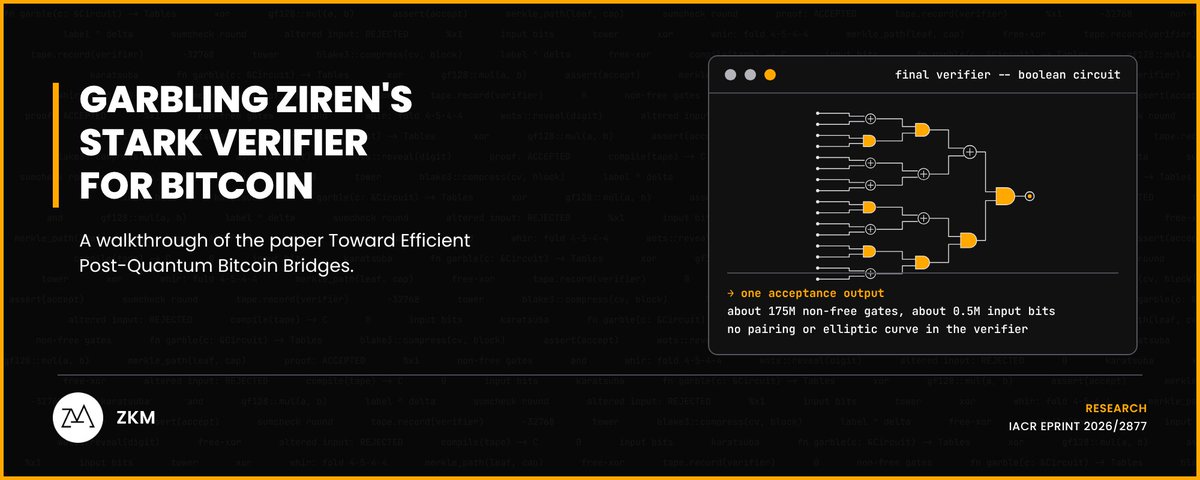
The full technical account of the research behind a post-quantum proof check for the GOAT BitVM3 bridge: what was built, what it costs on Bitcoin, and what is left to build.
Our plain-language version is here: goat.network/news/toward-a-p…



Analog 🌎 retweeted
"We are changing the digital locks before the burglar shows up at the door." - @natalia_ameline
We asked four of the people behind the @MetisL2 Hybrid Rollup what it is, what it means for Metis, and what the hardest problem was to solve.
Now live on devnet.
Analog 🌎 retweeted
Today is the last day to enter GOAT on Socials 🎁
Pick a post, video or article from any of our six platforms, write an original post about it with the link, and submit it in our Discord Campaigns Hub.
10 winners share $250 USDT. Follow us on all six platforms to be eligible.

GOAT on Socials is live: a 14-day campaign with $250 USDT in rewards for 10 winners 🎁
GOAT Network publishes content across LinkedIn, YouTube, TikTok, Facebook, Instagram, and Medium.
Find a post, video or article you find particularly interesting, write an original X post about it with a link to the piece, and submit your post in the Campaigns Hub on Discord.
Full campaign details: goat.network/news/goat-on-so…
X just made copy-link engagement valuable again, giving it a score of 20 in the latest algorithm update.
But there's a bigger lesson here for small accounts.
Stop chasing engagement and focus on creating content people genuinely find useful, interesting or entertaining enough to share with someone else.
Don't beg for reposts or link copies. Give people a reason to share.
The algorithm will keep changing, but valuable content will always have a place.

4
53
Analog 🌎 retweeted
Teams preparing for quantum shouldn’t each have to work out how to get elliptic curves out of their proofs. For teams proving with Ziren, the work is happening in Ziren itself.
The memory digest has a hash-based replacement on a branch. A draft Keccak-based verifier for Ethereum would replace the BN254 wrapper: zkm.io/blog/the-last-two-cur…
And our new paper measures a hash-based verifier for Bitcoin bridges: eprint.iacr.org/2026/2877


I've been spending some time researching how AI agents could change the way we shop and interact with online businesses, and one question keeps coming up: what happens when AI agents become the customers?
While exploring this, I came across a presentation by GOAT Network CEO Kevin Liu at KBW 2026, titled "Your Next Customer Is an AI Agent."
I spent about 20 minutes watching it, and it helped me understand something I hadn't given much thought to before. The technology for AI agents to discover products and make purchases is already taking shape, but are online businesses actually prepared to sell to them?
Kevin's presentation made that gap particularly clear.
According to the data he shared, agent traffic to business websites has increased 4x. With Meta Muse, Manus 2.0 and ChatGPT shopping features entering the picture, AI-powered buyers are already finding their way into commerce. McKinsey also estimates that this could become a $3–5 trillion economy by 2030.
The buying process itself is becoming straightforward. You tell your agent what you want, it finds the product, asks for permission, makes the payment and gets a receipt.
But here's the problem: the merchant side isn't ready.
Right now, when you ask ChatGPT to buy something, it often relies on highly ranked websites or merchants within its existing partnerships. This creates a serious discovery problem for smaller businesses, whether they're in Korea, elsewhere in Asia or anywhere around the world.
Their products might be available online, but if AI agents cannot properly discover and interact with their stores, they're practically invisible to this new category of buyers.
That's the gap Kevin explained how GOAT Network intends to address, and the interesting thing is that it isn't built around just one product. It's an entire stack.
At the foundation is Bitcoin settlement. If machines are going to transact with other machines at an enormous scale, the underlying settlement layer needs to be secure and reliable. GOAT Network builds on Ziren ZKVM and BitVM3, with transactions ultimately settling on Bitcoin.
The next layer deals with wallets and payment mandates. GOAT integrates with protocols like x402 and MPP, allowing agents to pay from different chains without requiring users to bridge their funds first. There's also a mandate layer that lets users define spending permissions, budgets and what happens when a transaction fails.
Then comes the part merchants can actually use: GOAT Flow.
This was particularly interesting because I got to test it after the presentation, and the process is as straightforward as Kevin described.
You register with basic details, including your name and business description, choose how you want to receive payments, add your product and set a price. GOAT Flow supports card payments through Stripe, including Visa, Mastercard, Amex and JCB, alongside crypto payments across 10 chains.
Once you're done, it generates a page with a dedicated FOR AGENTS section. Humans can browse the regular product information, while AI agents can read the structured details they need to understand and purchase what's being offered.
And you don't need to write any code to get started.
They also demonstrated this at Booth 37 during KBW, where visitors could watch live AI agents purchase real mascots and gift cards. Out of the 450 people who tried it, 310 purchases were completed through an agent, with many participants making their first-ever purchase using an AI agent.
Kevin also shared some interesting details about GOAT's plans in Korea. Founded in Silicon Valley in 2023, the team now has offices in San Francisco, Toronto and Seoul, and has been building in Korea for three years.
He mentioned that GOAT plans to announce its first Korean investment soon and wants to work with local partners on Korean stablecoins, recognising that local merchants need payment solutions that fit the markets they operate in.
One line from the presentation stayed with me:
"Your next customer is an AI agent, that's for sure."
And the more I think about it, the more sense it makes. Online businesses have spent years making their websites accessible to people, but the next stage of commerce will require them to make their products discoverable, understandable and payable by AI agents too.
If your store isn't ready for that transition, it's worth paying attention to what's happening now.
Watch the full keynote. It's worth the 20 minutes:
youtube.com/watch?v=2lTjodpz…
Read the full breakdown:
medium.com/@goat_network/kev…
Get started with GOAT Flow:
goat.network/flow
@GOATNetwork


Analog 🌎 retweeted
A plain-language read of our new paper, Toward Efficient Post-Quantum Bitcoin Bridges.
Paper: eprint.iacr.org/2026/2877

Analog 🌎 retweeted
The GOAT BitVM3 bridge is what will let activity on GOAT Network settle on Bitcoin, so it has to stay secure for as long as Bitcoin does.
In bridge designs today, a disputed withdrawal is settled by a proof that is first compressed with elliptic curves, and that step is the one a quantum computer would break.
This paper removes the step: the full hash-based proof from Ziren, the prover behind the bridge, is checked instead. A withdrawal nobody disputes publishes none of the extra data. A disputed one would put about four Bitcoin blocks of it onchain.
A bridge is only post-quantum once the signatures that authorize its Bitcoin transactions are replaced too, and that work sits outside this paper.
→ eprint.iacr.org/2026/2877
New paper from researchers at ZKM and @GOATNetwork: "Toward Efficient Post-Quantum Bitcoin Bridges" has been published on the IACR Cryptology ePrint Archive: eprint.iacr.org/2026/2877
BitVM-style bridges check a proof on Bitcoin by garbling its verifier off-chain. Existing designs garble an elliptic-curve verifier, which a quantum adversary breaks. This paper garbles a hash-based one: Ziren’s complete recursive verifier for WHIR-based STARK proofs, compiled to a Boolean circuit over binary-tower arithmetic and Blake3, with no pairing wrapper.
For the proof of Ethereum block 26,206,588, the circuit has about 175M non-free gates and about half a million input bits, which comes to about 2.8 GB of garbled tables. Publishing that input in a dispute with hash-based one-time keys takes just under 4 MvB, in about 40 standard transactions.
The rest of the dispute protocol, including the complete transaction graph, is not built yet, and a bridge built this way would still depend on Bitcoin’s own signatures.

Analog 🌎 retweeted
New paper from researchers at ZKM and @GOATNetwork: "Toward Efficient Post-Quantum Bitcoin Bridges" has been published on the IACR Cryptology ePrint Archive: eprint.iacr.org/2026/2877
BitVM-style bridges check a proof on Bitcoin by garbling its verifier off-chain. Existing designs garble an elliptic-curve verifier, which a quantum adversary breaks. This paper garbles a hash-based one: Ziren’s complete recursive verifier for WHIR-based STARK proofs, compiled to a Boolean circuit over binary-tower arithmetic and Blake3, with no pairing wrapper.
For the proof of Ethereum block 26,206,588, the circuit has about 175M non-free gates and about half a million input bits, which comes to about 2.8 GB of garbled tables. Publishing that input in a dispute with hash-based one-time keys takes just under 4 MvB, in about 40 standard transactions.
The rest of the dispute protocol, including the complete transaction graph, is not built yet, and a bridge built this way would still depend on Bitcoin’s own signatures.
Analog 🌎 retweeted

GOAT Flow cuts through the usual agent commerce complexity by solving the core trust bottleneck with cryptographic receipts settled via Bitcoin.
A brilliant ELI5 breakdown for real world merchant adoption without code friction.

Analog 🌎 retweeted
Ask ChatGPT or Claude to buy something and they look in two places: the top-ranking websites, and the product feeds their platforms have contracts with.
Small and medium merchants are in neither. If an agent can’t find your products, it can’t buy them.
CEO @KevinLiu with @BitcoinNews on why we built GOAT Flow: to make your products readable, understandable, searchable and purchasable by agents.
→ goat.network/flow