

We map the Second World War. 150,000+ unit positions and 15,000+ war diary pages, every one traced to an original document. Free to explore
Joined September 2019
- Tweets5.4K
- Following538
- Followers37.1K
- Likes6.5K



Pinned Tweet
84 years ago today, 4,963 Canadians went ashore at Dieppe. By early afternoon the beaches were back in German hands. Fewer than half the men came home.
More than 910 were killed. 1,946 were taken prisoner, the largest single Canadian surrender of the war.
This is Operation Jubilee mapped position by position, from the run-in to the last radio call off the beach.
The Savio north of Cesena ran between steep, high dikes. The Canadian official history called it “a strong natural military barrier, at all times a tank obstacle and when in flood virtually impassable to infantry.” Even in peacetime, the Italians had never bridged it on that stretch.
On the evening of 20 October, two companies of Princess Patricia’s Canadian Light Infantry attacked across at Martorano. D Company never got over. Only 17 men of Maj. E. W. Cutbill’s A Company made it across, and their wireless set was put out of action in the water. For more than a day they clung to a strip of the far bank with German positions 75 yards away on every side, while the rain collapsed their dugouts.
At 2000 on 21 October, 2nd Brigade made its set-piece crossing, with the Seaforths on the right and the Edmontons on the left. It was raining, and the rain helped. B Company of the Seaforths found heavy fire on its crossing place, moved 300 to 400 yards north and waded over unopposed. D Company crossed the mud flats in single file, waded the chest-deep river by 2045 and joined Cutbill’s men under the bank. Their weapons were so caked with mud that some of the Patricias swapped rifles with them, since the Seaforths were the ones going forward.
A farmhouse beyond the ridge turned out to be the headquarters of the German unit holding the sector, and 25 prisoners were taken in it. When 17 Platoon rushed another house, Lt. W. D. F. Gildersleeve shouted for the occupants to come out and was answered in English: “Don’t shoot! Vee are coming!”
B Company’s signaller, Pte. G. V. Carrington, lay in an open field under shell and machine-gun fire until he had the soaked No. 18 set working again. He received the Military Medal. By 2330 both companies were on their objectives. The Seaforths later credited the weather, which kept the Germans in their dugouts, and the choice of crossing places the enemy had thought impassable.

Project '44 retweeted
When Lt-Col. H. P. Bell-Irving returned to command the Seaforth Highlanders of Canada in the autumn of 1944, he brought an idea with him. On the San Fortunato ridge in September he had watched men of the Loyal Edmonton Regiment knock out several heavy German tanks with anti-tank mines and the PIAT. Bell-Irving wanted the PIAT used to hunt.
It was not a popular weapon. The PIAT (Projector, Infantry, Anti-Tank) was a spring-loaded spigot launcher that threw a hollow-charge bomb of about two and a half pounds. To cock it, a man had to stand on the weapon and heave on the shoulder piece. It was reliable against the side or rear of a tank at a hundred yards or less, and of little use beyond that. Using it against a Panther meant letting the tank come very close, in full view of its machine guns and the infantry riding on it.
At Riccione, the Seaforths formed a tank-hunting platoon under Lt. F. H. Harfield, drawn from the anti-tank platoon: an officer, a sergeant, a corporal and 14 others. Eight men formed four two-man PIAT crews. The other six carried No. 75 “Hawkins” grenades and Tommy guns.
The drill was simple. Mines laid across a road would break a tank’s tracks. Once it was stopped, a PIAT crew would knock it out at short range, and the Tommy gunners would deal with the crew and any infantry riding on it.
One of the men picked for the platoon was a private who had been with the battalion since 1940 and had been promoted to corporal, and reduced again, nine times. His name was Ernest “Smokey” Smith. Within weeks, the drill would be tested on a dark road beside a church on the far side of a river no tank could cross.
Project '44 retweeted
By the autumn of 1944 the 1st Canadian Infantry Division had been fighting its way up Italy for over a year. Operation Olive, the battle for the Gothic Line, had cost the Division some 2,511 casualties, 626 of them fatal. More than 1,000 others had been evacuated sick, around 400 of them from battle exhaustion. After the capture of Rimini on 21 September, the Division went into Eighth Army reserve to rest and absorb its replacements.
The country ahead was the Romagna, the flat, thickly farmed southern edge of the Po Valley. It was crossed by river after river running down from the Apennines to the Adriatic, each held between high dikes. In dry weather they were modest streams. Then the rain came. On 28 September the Fiumicino rose within hours from a shallow stream to a muddy torrent 30 feet wide. One German commander described his last troops’ withdrawal across it as “something indescribable.” The rain went on through the first ten days of October, washing out bridges and cancelling one plan after another.
The Canadians were also running short of men. When the Minister of National Defence, J. L. Ralston, visited the front, he was told that all general-duty infantry reinforcements would be used up by about 10 October.
On the other side of the line, Kesselring wanted to fall back behind the Po. Hitler refused, and on 5 October ordered that upper Italy be held “not only until late Autumn, but indefinitely.” On 18 October, Kesselring authorised a withdrawal on his own responsibility. The Germans would make their stand on the Savio.
When the Canadians went back into the line, Lt-Gen. Burns recorded his divisional commanders’ fear that they were drifting into another winter like the last one, “where the hard fighting and numerous casualties resulted in no great gain.”
This is the first of five posts on the Crossing of the Savio, 21–24 October 1944. The full piece and story map are linked in the comments.
If you want to read our very detailed post on the Battle of the Savio River check it out here: patreon.com/Project1944/post…

Project '44 retweeted
This is the action that Pte Ernest 'Smokey' Smith earned the Victoria Cross.
Our team painstakingly mapped this fight from the War Diaries. Every position, platoon, company, machine gun post all comes back to an original defensive overprint, aerial photo or war diary entry.
But this is a 30 second clip of a much larger battle.
The Battle for the Savio River was a Brigade level attack spanning across 9 days. The Italian campaign is often overlooked, living under the shadow of DDay, Market Garden and the Battle of the Bulge.
But many of these soldiers had been fighting since 1943 and the invasion of Sicily. Up through places like Ortona, Cassino, the Liri Valley.
If you want to watch the full video, check the comments.
Full 8-minute battle on YouTube: youtube.com/watch?v=duSWJnFk…
Interactive map on Patreon, follow every company and read the diary entry behind each position: patreon.com/Project1944
Come on guys...

Consider this a story in global affairs.
Early this year, there was an effort afoot to find Secretary Hegseth an iconic globe for his office suite.
Historians could make the move. But his team did not appear to want to wait.
washingtonpost.com/national-…

Thirty feet from a Panther: the true story of Smokey Smith
22 October 1944. The Savio River, Italy.
Rain had raised the river six feet. No tanks or anti-tank guns could get across to the Seaforth Highlanders of Canada on the far bank. Then three Panthers, two self-propelled guns and about thirty infantry came down the road at them.
Pte Ernest "Smokey" Smith knocked out a Panther with a PIAT at thirty feet, then held the road with a Tommy gun. He became the only Canadian private awarded the Victoria Cross in the Second World War.
Every unit on this map is placed from the war diaries and company reports of the men who were there.
Tomorrow, 82 years to the day, we release the full video: six days, and the crossing of the Savio.
#SmokeySmith #VictoriaCross #SeaforthHighlanders #CanadianHistory #WW2 #ItalianCampaign #LestWeForget – at Casselman, Ontario
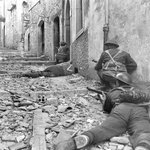
Soldiers of the 3rd Canadian Infantry Brigade run into snipers and machine gun fire, Campochiaro, Italy.
This dramatic photograph shows Canadian soldiers of the 3rd Canadian Infantry Brigade pinned down by sniper and machine-gun fire in the streets of Campochiaro, Italy, during the Italian Campaign. It is often misidentified as Ortona, but the image was actually taken earlier, in November 1943, as Canadian troops fought their way through a series of hill towns on the advance to the Moro River.
The narrow streets and stone buildings of Campochiaro created a deadly environment for infantry. German and Italian defenders used high vantage points and prepared firing positions to sweep alleyways with machine-gun fire, while rubble and ruined walls made movement slow and exposed. Canadian troops responded with cautious advances, hugging walls, returning fire where they could, and relying on supporting arms to dislodge hidden defenders.
Though less well-known than the later house-to-house fighting at Ortona, battles like Campochiaro were typical of the grinding Italian campaign: infantry pushing through fortified towns, enduring ambushes and sniper fire, and paying a heavy price for each step forward. This photograph captures the vulnerability and determination of Canadian soldiers in those moments—an image that has become symbolic of the difficult fighting in Italy.

Band of Brothers is easily the most well known show on WW2.
I try not to do a lot on BoB because it is covered so much, but for small engagements this is probably the most well known of them all.
I thought it would be fun to test what it would look like animated.
December 1944. Antwerp was the most important port the Allies held, and Germany wanted it gone. From launch sites in the Netherlands and the Rhineland, V-1 flying bombs and V-2 rockets fell on the city day and night.
This is gaining steam. If you like this, consider joining our Patreon to support our work.
We are a small team building a platform to map the Second World War day by day.
patreon.com/c/Project1944

On the afternoon of 16 December 1944, more than a thousand people filled the Cinema Rex in Antwerp for a matinee of The Plainsman. Many were Belgian families. Nearly a third were Allied soldiers on leave, British, American, Polish and Canadian. At 3:20 p.m. a German V-2 rocket came through the roof without warning. The building collapsed on the audience, killing 567 people, 296 of them servicemen. It took almost a week to recover the dead. It remains the deadliest single missile strike of the Second World War.
To understand why that rocket fell on Antwerp, you have to understand why the city mattered. By the autumn of 1944 the Allied armies had raced across France and Belgium, but their supplies were still being landed in Normandy and driven hundreds of kilometres to the front. The advance was starving for fuel and ammunition. Antwerp, one of the largest ports in Europe, was the answer. British troops took it almost intact on 4 September, but the Germans still held the banks of the Scheldt estuary that connected the docks to the sea. Clearing it fell largely to First Canadian Army, and it took two months of grinding, costly fighting through flooded fields and dykes. Only on 28 November, after the river was swept of mines, did the first Allied ships tie up at Antwerp.
Germany could not retake the port on the ground, at least not yet, so it tried to destroy it from a distance. From launch sites in the occupied Netherlands, German units fired two very different weapons at the city. The V-1 was a pilotless flying bomb driven by a pulse jet, slow enough to be shot down and loud enough that people learned to dread the moment its engine cut out. Thousands were fired at Antwerp. Against them the Allies built a defence known as Antwerp X: more than 500 guns and some 22,000 American, British and Polish soldiers under US Brigadier General Clare Armstrong. As radar and new proximity fuzes improved their aim, they went from bringing down roughly six in ten flying bombs to almost all of them.
The V-2 was something new in the history of war: a ballistic rocket that climbed to the edge of space and fell faster than sound. There was no warning and no defence. About 1,600 fell on the Antwerp area, more than were fired at London. No city in the world received more.
The bombardment began on 13 October 1944 and did not end until the last launch sites were overrun at the end of March 1945. When Germany launched its great Ardennes offensive on the same day as the Rex disaster, its ultimate objective was Antwerp itself. By the time the weapons stopped falling, more than 4,000 civilians and soldiers had been killed in and around the city.
And yet the port never closed. Through the whole of that winter, ships kept unloading at Antwerp, and the supplies that came through its docks carried the Allied armies into Germany and on to victory.
The map in this video plots roughly 1,300 V-weapon impacts recorded within the city itself.
The new map controls are now live in the Project '44 beta for our patrons.
If you've ever hunted for a layer toggle or lost track of which basemap you were on, this update is for you. Everything now lives under a single Map button in the top right: Units, Frontline, Story Maps, Photos, the historical map overlays, and the IGN 1950 imagery of France, along with your choice of satellite or street basemap.
Search is labelled and sits in the top right where you'd expect it. Zoom, rotation, and 3D terrain have moved to the bottom right, out of the way of the map itself.
The result is more room for what matters: the units, their positions, and the ground they fought over.
Patrons can try it now in the beta. Not a patron yet? Joining gets you early access to every new feature as we build it, and directly funds the work of mapping the Canadian Army day by day.
patreon.com/c/Project1944

The map moves now. And it works on your phone.
This is the new Project '44 web map. Hit play and the units move across Normandy day by day. Open a regiment on your phone, read its war diary, and drag the timeline to follow them across Europe.
Before you go looking for it: the new map is in beta, and right now it's open to our Patreon supporters first. The current map on project44.ca is still free for everyone, and the new one opens to the public at launch.
Why patrons first?
Project '44 is run by a small Canadian nonprofit, the Canadian Research and Mapping Association. There are no ads and no paywall on the archive. So far that work adds up to more than 150,000 mapped unit positions and over 15,000 pages of war diaries, and the people keeping it going are our patrons.
Patrons pay for the servers, the archive work and the development. They also get in early and help shape what gets built: they test new features before anyone else, tell us what breaks, and our story map users are helping decide what we polish next. When the new map goes public, it will be better because they used it first.
If you'd like early access, or you just want to help keep this going, you can join us on Patreon.
Project '44 retweeted

Have you been waiting for a mobile release of Project Athena?
Well the wait is over and it has finally arrived! Now you can check out the web map straight from your phone.
You can check out all the photos that have been added.
You can't upload or geotag photos yet, that will come in the future.
I know a lot of people have been waiting for this so please check it out and if you find any bugs let me know!
Project '44 retweeted
This 25 second map shows how fast the Germans were retreating after the Falaise Gap was closed.
It gives you an idea why the Allies thought that Operation Market Garden might just be worth the risk.
In doing so, First Canadian Army was robbed of the resources it needed to clear out the Channel ports of Boulogne-sur-Mer and Calais, and delayed the clearing of the Scheldt Estuary.
If you were in charge of Twenty First Army Group, which operation would you have prioritized? Clearing the channel ports and the Scheldt?
Or was it worth the gamble to get bridge crossings on two rivers?