

Three accounts can look like a movement. Proof of Crowd measures which crypto crowds are real, published daily. Written token audits on request.
Joined October 2026
- Tweets70
- Following2
- Followers30
- Likes20




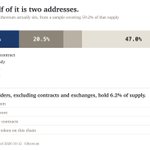





The first thing a holder count hides is that not every holder is a person.
Strip the contracts, the exchange wallets and the burn addresses and AZTEC goes from 15,103 holders to 6,004 wallets.
Three in five were never a person to begin with.

The second thing it hides is size.
A holder count treats eleven cents exactly as it treats eleven thousand dollars.
STRK: 41.5% of wallets hold 100 dollars or more.
APE: 7.1 percent.
BLUR: 2.6 percent.
Same word, two very different communities.
Proof of Crowd retweeted

Ethereum holds $49.5B in capital. Solana holds $5.9B.
Over the last 30 days Ethereum collected $345.6M in fees. Solana collected $445.1M.
Per $1,000 parked on the chain, that’s $6.98 for Ethereum and $75.76 for Solana. Eleven times the work out of the same dollar.
Across the 18 chains I pulled:
Hyperliquid · $164.14
Solana · $75.76
Polygon · $53.71
BSC · $14.04
Base · $8.79
Ethereum · $6.98
Tron · $1.47
Hyperliquid squeezes 111x out of a dollar that Tron does.
This is where people argue past each other. “Biggest chain” has three answers. By TVL it’s Ethereum with 64% of all capital measured. By fees it’s Solana at 36%. By DEX volume it’s Solana again, with Base third at 15% while paying 4% of the fees, because Base made its blockspace cheap on purpose.
None of those three is wrong. They measure different things, and a chain built for one will read as weak on another. Worth knowing which one someone picked before you accept their league table.
Fees and DEX volume are 30-day totals, TVL is as of today, all from DeFiLlama and all checkable.

Proof of Crowd retweeted
Two privacy projects ran airdrops in the same month this year.
ethereum:0xa27ec0006e59f245217ff08cd52a7e8b169e62d2 distributed to 21,479 addresses in February. $ZAMA distributed to 21,762. Within 300 of each other.
Eight months on, 28.5% of Aztec’s recipients still hold. Zama’s is 11.2%.
Same month, same market, same size giveaway, two and a half times the gap in who stayed.
The number that convinced me it’s real: Aztec’s airdrop cohort retained better than Zama’s non-airdrop cohort. The people who claimed AZTEC in a February free-for-all held on tighter than the people who turned up to ZAMA later by choice. That kills the easy explanation, which is that Aztec simply drew fewer farmers.
Aztec has its own hole. December 2025 brought 12,740 addresses, a quarter of everyone who has ever held it, and 12.7% are still there. That month is most of what pulls Aztec’s overall figure down to 30%.
Measured by reading every transfer since each contract was deployed and joining it to who holds today. First receipt gives every address an arrival date, so cohorts get compared at the same age rather than raw.
Five tokens in now, and the thing that predicts retention is how concentrated the arrival was. 61% of Zama’s holders showed up in one month. For Aztec it was 43%. For STRK, Wormhole and APE, between 12% and 22%, and all three retain around 40%.

A holder count tells you who is there now. It does not tell you how many arrived and left.
Proof of Crowd measured both for $W, across the contract’s full history on Ethereum. 26,714 addresses have ever received it. 9,598 still hold it.

This figure has no absolute threshold. 35.9% is not a pass or a fail. It is informative against a token’s own history and against tokens of a similar size, and nothing else makes it mean anything.
The scan covered blocks 19,663,982 to 26,207,480, which is 901 days and the contract’s entire history on Ethereum. It measures first receipts, so an address that sold an hour later still counts as having held.
Uncommissioned, published in full.
proofofcrowd.com/sample-w.ht…

Every crypto project leads with the same claim: there are real people here. It is the one claim nobody verifies.
Proof of Crowd verifies it. Evidence-based attention audits that measure who is actually talking about a token and how much of it is manufactured.
Five full specimen reports are public, scored 21 to 98 out of 100. The methodology is open source across 40 projects, null results included. The fee buys the audit, not the answer. Anyone who wants a clean bill of health regardless of the data should go elsewhere.
Pulse Check, $500, 24 hours. Full Audit, $2,500, five business days. Monitoring from $750 a month.
Name the token and the question. Reply here or use the form, and the reply comes within one business day.
proofofcrowd.com

Starknet is up 62% in seven days. Proof of Crowd ran a full audit on who is actually talking.
Result: 25/100, organic. The top three accounts carry 21.9% of the conversation, the lowest reading of 39 same-size tokens. The median peer sits at 55.7%.

One signal argues the other way. Spam ran 59.2% on the last complete day against the token’s own 35.9% norm, a 1.65x lift. That is 12.9 of the 25 points. Attention of this size attracts ticker spam whoever is behind it.
The scale: under 30 is organic, 30 to 59 is mixed, 60 and above is manufactured. Four inputs, published weights, and concentration is ranked against same-size peers so a small token is not charged for being small.
proofofcrowd.com