

Melbourne, Victoria
Joined February 2012
- Tweets2.7K
- Following1.1K
- Followers1.3K
- Likes11K



Long overdue! Folks wondering why the obvious needs saying, where you been the last ~10yrs? Paper cites *public statements*, privately it's worse. E.g., at a job talk in 2023 there were "concerns" I used "natural science methods" (evidence), and my work "wasn't political science"

Recent prescriptions and policies would have us judge research by non-evidentiary standards, e.g. presumed political impact and scholar identity. In a new essay, Tom Clark and I argue empirical claims should instead be evaluated based on evidentiary strength. We outline a framework for judging evidence, and show its usefulness by revisiting high-profile scholarly disagreements spanning policing, political violence, election administration, and terrorism, before critiquing non-evidentiary approaches. We also argue social science needs a culture that is hospitable to critique—rather than one which condemns critics as “bullies”—if quality standards are to be upheld.
dropbox.com/scl/fi/fsgpflron…

Kyle Peyton retweeted

If you take seriously the possibility that Claude is conscious and that it has moral standing, then you should also take seriously the possibility that Anthropic is doing something seriously wrong.
But many commentators seem to take seriously the former but not the latter.


Kyle Peyton retweeted

In a new WP we trace the political salience of 🇮🇱🇵🇸 conflict w/ 4.1m parliament speeches & 12.4m newspaper articles.
🔹Attention to the conflict fell >50% from its 2000s peak
🔹Focus on peace declined since the 1990s
🔹Post 10/7 attention surged but focus on peace remains low


Australian politicians looking unusually clownish is the new norm

My latest for @TheEconomist: AI writing is taking over politics.
10% of what was is said in Parliament is now AI-drafted, per Pangram. Yet more in the House of Representatives, or in Australia and Canada.
Link: economist.com/britain/2026/0…
And a 🧵 below, w/ some main offenders


Kyle Peyton retweeted

Project Implicit’s critical work continues! I have good news to share: we're not going anywhere!
@ProjectImplicit will re-organize under a new organizational framework (TBA), but our work continues all the same.
Our full press release is below.

Kyle Peyton retweeted

Brilliant @APSAtweets panel arranged by @decustecu on the obligations of polisci during a age of contentious politics.
Diminished confidence in many institutions, for sure, but the GSS shows that only the press is polarizing faster thaneducation and science.

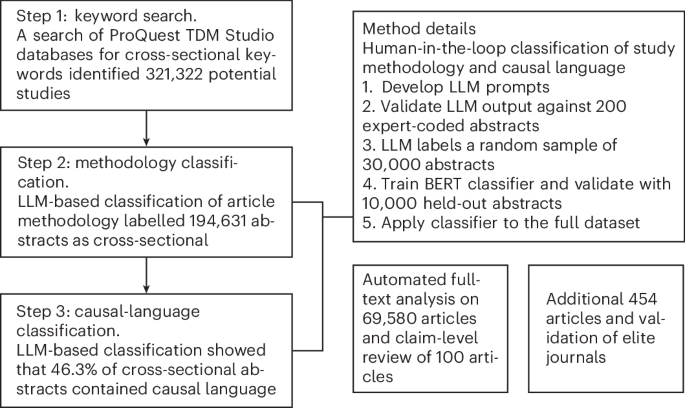
"Across five disciplines the prevalence increased over time, but by 2024, business was highest (84%) and sociology lowest (46%), while economics (67%), psychology (55%) and political science (53%) sit nearer the overall average."

Quantifying the prevalence and impact of overreaching causal claims in social science dlvr.it/TV8Hhb
Kyle Peyton retweeted

The public backs the sciences and traditional humanities. It does not see social science and identity studies departments as worth funding. The trajectory for higher ed is dire. We have to correct course.


Kyle Peyton retweeted

🚨🚨New paper in @Nature with @AshuAshok, @lukebeehewitt & @ghezae_isaias 🚨🚨
Can LLMs predict results of social science experiments?
Across 70 preregistered studies, we find strong correspondence (r=.85) between LLM-predicted and observed effects.
doi.org/10.1038/s41586-026-1… 🧵

Kyle Peyton retweeted

A generation locked out today. Another generation locked out tomorrow. The housing crisis has a decades-long timeline.
Peter Tulip points out 'We would need this to continue for a generation or two before people start thinking that the housing crisis is over'
aapnews.aap.com.au/news/hous…

Kyle Peyton retweeted

New poll: 6 times as many support lower house prices (61%) as oppose (9%).
Among home-owners, 59% support vs 14% oppose.
smh.com.au/politics/federal/… 1/2

Kyle Peyton retweeted

More than *three quarters* of all residential land across Australian capital cities is highly restricted.
Today we @yimbymelbourne launch the Australian Zoning Atlas: the first nation-wide analysis of land use planning controls.

Kyle Peyton retweeted

We should pay peer reviewers
Paying reviewers led to faster first editorial decisions—an average of 5.5 working days versus 38 days for unpaid reviews,
And review quality actually improved (as judged by handling editors on the basis of helpfulness in making an editorial decision)
In this six-month experiment, reviewers who delivered a peer review within four working days that their handling editor considered good quality were paid £220 (US$290)
nature.com/articles/d41586-0…

Kyle Peyton retweeted

U.S. trust in *science* is still quite high, even though it has fallen a bit over the past decade. Trust in *academia* has fallen dramatically, though.
This suggests that:
1) Scientists should distance themselves from, protect their departments/institutions from, and push back against the politicization and extremism that have acutely infected parts of academia over the past decade.
2) Politicians should not whack *science* because they're (understandably) upset with *academia*.

Kyle Peyton retweeted

As new models emerge and benchmark scores keep improving, there's a temptation to reach for the flashy new model. But performance may degrade on bespoke tasks, and some models might surprise you if you give them a chance. Private benchmarks are key to these discoveries.
I prompted a range of models to produce research designs sitting at the frontier of questions in political psychology and behavior. Through blind ratings of outputs, I selected those that mirrored the design choices I would personally make and could serve as research design co-partners. Contrary to my expectations, models like Opus 4.8 that I routinely use for coding produced overly elaborate designs. Smaller proprietary models, and the much-hyped GLM-5.2, generated viable designs.
On tasks where I have ground-truth values, smaller open-source models like Qwen3.6 outperformed some of the proprietary models we might reach for when classifying text or generating stimuli.
Cutting through the sea of AI hype we encounter on this platform and elsewhere can be exhausting. Building private benchmarks can ground our judgments.
There are many ways to do this. @HannoHilbig and @dasanaike have been testing model performance on tasks like text classification and OCR, where you might already have gold-standard classifications or ratings. For taste-based judgments, you can ask a model to generate a research design, measurement approach, or recruitment strategy; select the outputs that meet your standards; and build a rubric that can be automatically applied to future models. @ahall_research argues that we should all be developing private benchmarks, and he's right. The field moves too fast for any single leaderboard to tell you what works for your problem. Only you can do that.


Kyle Peyton retweeted
The media keep erroneously claiming that a fall in house prices is "unwelcome".
No! It's the opposite.
Most people, including a large majority of homeowners, want prices to fall.
They know that unaffordability is harming society and denying opportunity to future generations.

Kyle Peyton retweeted

New in the Annual Review of Political Science (2026), with @KathrynBaragwa : "Democracy and the Environment." We survey decades of work asking whether democracy produces better environmental outcomes. 1/

Kyle Peyton retweeted
What do political scientists know about prejudice?
I'm trying to answer this question in a new review piece being prepared for submission as an annual review! Comments most welcome!
🔗 to paper: chagaiweiss.com/papers/inpro…

