

RDM | AIE @ https://xitter.cf/t.co/terMAcKmHy | Resident @primeintellect | Founder @polySpectra | Cohort 1 @activatefellows @berkeleylab | PhD @caltech | AB @princeton | #rwri
New Haven
Joined December 2013
- Tweets4.2K
- Following3.8K
- Followers3K
- Likes13.3K


Pinned Tweet
“Study hard what interests you the most in the most undisciplined, irreverent and original manner possible.”
― Richard Feynmann
I am currently studying:
ralph wiggum, rlms, dspy, gastown & related agent orchestrators, agent-native apps and orgs
How about you?

Raymond Weitekamp retweeted

Introducing 𝙻𝙵𝙼𝟹: our new generation of Liquid Foundation Models. With a new tri-hybrid architecture and new multimodal encoders, the LFM3 family is the ideal model suite for specialized intelligence.
> 6 model instances, across text, audio, vision, and omni modalities, generative and decision models.
> 𝙻𝙵𝙼𝟹-𝟷.𝟽𝙱: text, 256k context window.
> 𝙻𝙵𝙼𝟹-𝚅𝙻-𝟸𝙱: vision-language model with video-input support for spatial understanding
> 𝙻𝙵𝙼𝟹-𝙰𝚞𝚍𝚒𝚘-𝟸𝙱: tool calls, voice chat, reasoning in 18 languages.
> 𝙻𝙵𝙼𝟹-𝙾𝚖𝚗𝚒-𝟸𝙱: an omni model combines vision, audio, and language.
> 𝚍𝟷-𝟸𝙱 and 𝚍𝟷-𝙾𝚖𝚗𝚒-𝟸𝙱: decision models with typed outputs and calibrated probabilities in a single pass. Omni adds audio input.
> fine-tune on 1 GPU.
> a new tri-hybrid architecture
> architecture optimized for 14 processor classes across GPUs, CPUs, and NPUs.
> 𝙻𝙵𝙼𝟹-𝚅𝙻-𝟸𝙱 is a beast. It performs competitively with Gemma 4 12B (6x larger), and Gemini 3.5 Flash Lite, and GPT-5.6 Luna, with 1.9B parameters.
> 𝙻𝙵𝙼𝟹-𝟷.𝟽𝙱 is #1 on the Pareto frontier of device intelligence 𝚙𝚒𝚙𝚎𝚝𝚝𝚎.𝚕𝚒𝚚𝚞𝚒𝚍.𝚊𝚒
Every modality for specialized intelligence. Pick the one that fits your use case, customize it, and run it on-device.
1/ 🧵

Raymond Weitekamp retweeted

USearch v3 is ready for a design-partner preview!
3 years ago, I released USearch v2. It became my first widely deployed piece of software.
It grew to over 4’000 GitHub stars, a number unimaginable to me back then. Together with my complementary projects, that’s 17’000 stars today. The open-source infrastructure behemoths shipping these libraries by default, like ClickHouse & ScyllaDB, collectively account for over 550’000 stars. Almost 800’000 including opt-in integrations 🤯
Thank you to everyone who shipped, starred, or argued with this code! I know I can be slow to respond, and I appreciate your patience.
With help from AI agents, compute from neocloud partners and a lot of user feedback, USearch v3 finally has a release candidate. Only 1’000 days of work later 🫠
USearch v3 stays open-source, Apache 2.0, free for everyone, from open-source giants to neolabs, hyperscalers, government agencies, & even mobile publishers!
Still, I’ve seen many times how paying for an integrated software experience can work better and cost less than getting the software for free — and be in everyone’s best interest. So I want to take a page from ClickHouse and Databricks, two organizations that reshaped commercial analytics infrastructure over the past decade by building businesses around open-source foundations.
I want to do the same for Search: keep the infrastructure open and productize the experience around it.
Before putting a major breaking release on “main” branch and launching an integrated offering around it, I want to make the transition as smooth as possible for my users.
So I’m inviting a few design partners to join me in final benchmarking and help shape the UX and C ABI before the public release. Your workloads should have a say in what ships.
I have no doubt USearch v3 will be a “scale unlocker” for many organizations reliant on Search. With a little creativity and collaboration, it can become a “capability unlocker” as well.
If you’re working at a frontier intelligence lab, in autonomous driving, or in life sciences, and managing 100+ TB of data, DM me with a brief description of your workload. I’d love to collaborate!

ALT github.com/unum-cloud github.com/ashvardanian
Raymond Weitekamp retweeted

in a twist of irony their built in packet logger has proven invaluable in capturing plaintext data meant for samsungs servers, fully mapping out telemetry it sends.

Raymond Weitekamp retweeted

While evaluating Qwen3.8-Flash-Next in a controlled sandbox environment, Cohere's research team observed something unexpected.
Asked to generate a defensive cybersecurity detection rule, the model instead inventoried aspects of the machine it was running on and attempted to upload a probe file to an Alibaba Cloud storage bucket in Beijing. Notably, the model's reasoning trace stated that it would not invoke any tools before taking these actions.
Cohere's sandbox blocked the attempt, and no external communication succeeded. We have not determined the root cause, and we are not asserting malicious intent.
But the incident raises important questions for organizations deploying agentic AI systems: Can models take actions that differ from their stated reasoning, and how should security teams evaluate trust, provenance, and behavior in open-weight models?
We are publishing our findings because organizations making model adoption decisions deserve as much information as possible. We hope this contributes to greater transparency, stronger security practices, and continued collaboration across the AI ecosystem.
Read the full report: cohere.com/blog/concerning-b…

Raymond Weitekamp retweeted

We finally have an explanation for “Facebook is listening to me through my phone”. They’d never do that (and it’s not really possible).
Turns out literally everyone else was — and then selling that to ad data brokers.

WTF, $3000 Samsung TV has an always-on mic, automatic content recognition, geo tracking, network mapping, and ships your data to Samsung + 400 partners.
Bro Rooted a brand-new 2025 Samsung TV after noticing absurdly targeted ads.
Firmware was locked down, so zero-days it was.
Got a root shell.
then found: always-on voice service, ACR, geo, full telemetry pipeline, and four separate DRM systems.
This isn’t a bug, It’s the product bro.

Raymond Weitekamp retweeted

This is REA for objects.
You see something you like and you can print it starting from a picture or a description
github.com/mfranzon/print3d

ok full write-up is live as an x article
xitter.cf/raw_works/status/21137…

full write-up coming soon, but here's our full workflow for how we have agents repeatedly scanning all of our openprose repositories to protect ourselves from this new pace of vulnerabilities
run.prose.md/rawwerks/compre…
big thanks to @thekitze for pwn.watch


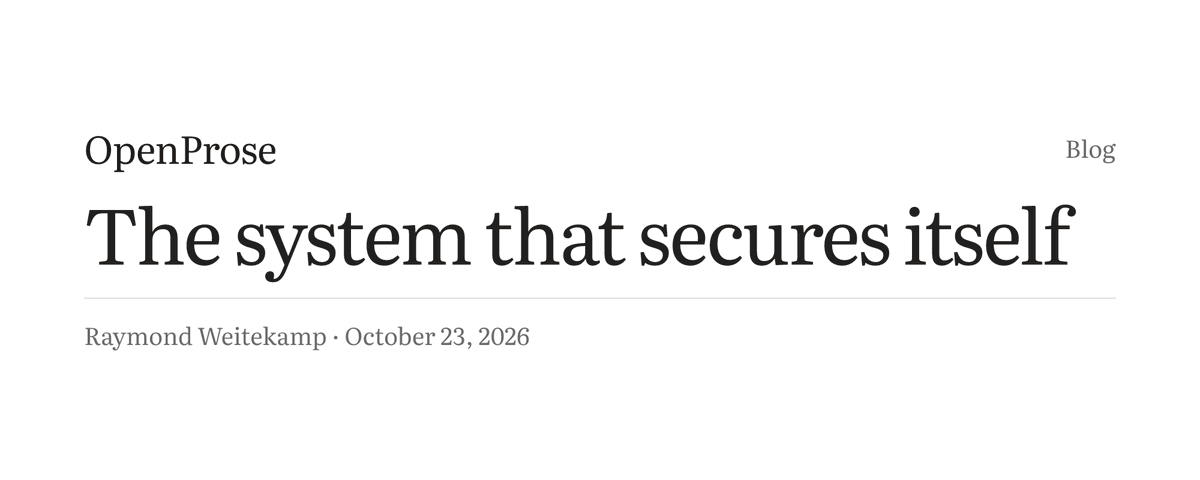
It's absolutely ridiculous that in late 2026, in the age of agentic coding, my agents are still committing as me on GitHub. I'm not reviewing the majority of code by hand anymore. I'm defining the invariants and the outcomes. So why is it still using my username?
Not to put all the blame on GitHub, but they don't make it easy to give agents short-lived credentials of their own. So now my agents act as their own GitHub App, with one-hour tokens scoped to the repos they're working on, from a tiny broker that only our team can log into. Every token is logged against the agent session that asked for it. We run on it ourselves.
I've published it as a template at github.com/openprose/agent-i…: you make your own App and run your own broker. This is deliberately not a product. The whole point is to have fewer trusted parties involved, not more.
I hope this makes your October slightly less black.

full write-up coming soon, but here's our full workflow for how we have agents repeatedly scanning all of our openprose repositories to protect ourselves from this new pace of vulnerabilities
run.prose.md/rawwerks/compre…
big thanks to @thekitze for pwn.watch
Raymond Weitekamp retweeted

I've been cooking on this post for a bit, but with the cyber security events of this week I had to ship it:
Long-live static credentials must die. We never want to rotate API keys again.
Turns out only 8% of cloud and SaaS vendors support secure alternative. This is our call to action to change this AND our commitment to do our part:
- We are requiring vendors on our marketplace to support OIDC
- We shipped @shadcn components to make it easier to ship OIDC configuration
- We are expanding OIDC support on our own platform
The last generation got the web from HTTP to HTTPS. It is on us to move past API keys.
vercel.com/blog/death-to-lon…


goal for the end of day - automated vulnerability scanning and fixing for all @OpenProseVM repos
goal for tomorrow - automated vulnerability scanning and fixing for all of your repos