
Greatest manager of the 20th century. Most famous Mingrelian since Medea. ACAB (except the NKVD). AI hope lies in the normies https://teapawt.org/t.co/LIFxqwrVxE
Scattered around Moscow.
Joined December 2016
- Tweets28K
- Following477
- Followers3.6K
- Likes84K






Woke Beria 🇬🇪 retweeted
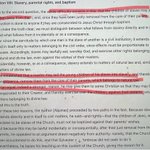
And it was explicitly justified on the grounds that, since the children could obviously be sold away from their parents, the parents must have no rights over them:
“A master can separate and sell a slave’s child *for his own utility, without any injustice.”

Woke Beria 🇬🇪 retweeted
The rival non-Thomistic view which cut out the middleman and just declared that slave-children could be forcibly baptized continued to be the more common one.
And it was explicitly justified on the grounds that, since the children could obviously be sold away from their parents, the parents must have no rights over them:
“A master can separate and sell a slave’s child *for his own utility, without any injustice.”
The rival non-Thomistic view which cut out the middleman and just declared that slave-children could be forcibly baptized continued to be the more common one.
And I’ve read a lot of US pro-slavery stuff, and their reaction to parent-child separation is always to just deny it happens, or at worst to (infamously) claim black parents aren’t emotionally attached to their children.
But they at least recognize it as prima facie really bad!
1
60
1,390
To make it clear I’m not being anachronistic:
Islamic jurists—who weren’t exactly a bunch of modern liberals about slavery!—all banned separating mothers and children (Malikis and Shafi’is until roughly 7; Hanafis until puberty; Hanbalis forever).

Except, that is, by the Carolingian Regino of Prum—who quotes the whole thing, *including the part that calls splitting up parents and children unjust*—but then proceeds to apply it *only to slave marriages*.


1
20
641
Roman law was *constantly* being cited as authoritative in the high-medieval and early-modern canon law/moral theology traditions.
But this humane decree—of the first Christian emperor!—was never cited.
Notably, this one-off decree was incorporated into the Theodosian and later Justinianic codes as a *general law* for certain types of property divisions.
The late-400s-AD commentary on the law calls such separations “unjust”.
1
20
647
Constantine passed a regulation saying slave families shouldn’t be split up on imperial estates.
This applied to siblings as well, with no age limit—and was justified in explicitly humanitarian terms:

What makes the church’s indifference even more mystifying is that parent/child separation was also condemned by another authoritative source:
Roman law.
1
24
666
It’s plausible that by “the law of the church” here he meant Capreolus’ view, since his seminary had a copy of Capreolus, who continued to be read.
But note that even Capreolus only bans separation *under seven*—while the Code Noir raises the age to puberty.
1
18
679
The one mild exception is the early-1700s Jesuit Charlevoix, who in his history of Saint-Domingue praises the humanity of the Code Noir, and claims that both it and “the law of church” forbid separating spouses *or* parents from children.

I haven’t been able to find a single Catholic theologian between 1500 and 1840 who expressed even the slightest hint of disapproval of selling young children away from parents.
Not even among pastoral writers giving practical advice to Catholic slaveowners or denouncing cruelty
2
27
777
Note just how terrible Cajetan’s argument here is—he literally accepts the fact that young slave children can licitly be sold away from parents *as an obviously-true premise*, and never even bothers to argue against the idea that parents have a natural-law right to custody.
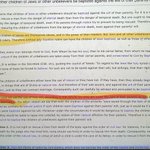
But, alas, this emerging humane tradition seems to have been squelched when the premier Thomist of the 1500s, Cajetan, split the Solomonic baby by arguing that slaveowners *couldn’t* forcibly baptize children living with their parents—but *could* sell the children away:


And, later in the 1400s, by the famed “Prince of Thomists” Capreolus—who, tbf, only says that it’s *perhaps* forbidden to sell pre-rational children away from parents:


1
21
845
Granted, Aquinas himself doesn’t explicitly say that this means normal pre-rational slave children can’t be sold away from their parents.
But that conclusion *was* drawn by a couple of his successors—first, the obscure Guido Terreni.

1
23
920
But, paradoxically, the fact that he thought all Jews were *literally slaves* meant that—when he rejected the idea that Jewish children could be taken away from their parents and baptized—he had to argue that *even slaves* have a natural right to raise their young children.

