

Sr Director of Product @PandaDoc. Building AI agents, MCP, document workflows, CPQ/CLM and APIs. PLG and product-led activation.
Warsaw 🇵🇱
Joined January 2010
- Tweets1.5K
- Following84
- Followers507
- Likes152




Here's one of Claude's best-kept secrets: you can build your own custom interface for the apps you use every day. Seriously, if you're on Claude Desktop and you haven't pinned a few artifacts hooked up over MCP to your favorite tools (PandaDoc, obviously 😉), you're leaving a lot on the table.
Lately I've been digging through our feature requests, and it turns out a ton of them can be solved with artifacts. Users get a level of customization no portal could ever give them, with AI handling their exact problem the way that makes sense to them.
Earlier this week I dropped a quick guide in our community on how to do it, plus a recipe for building an artifact like the one in the video. If you want a head start and some inspiration, grab them. They're totally free :)
community.pandadoc.com/inspi…
1
65
OpenAI just launched “ChatGPT for Sales,” and PandaDoc is one of the essential apps for preparing quotes and agreements 🔥🔥🔥

1
33
Vasil Remeniuk retweeted

Create documents in @pandadoc, without opening PandaDoc 😉
PandaDoc is now live in the Notion Marketplace as an MCP connection. That means you can start designing your documents right where you already think and write: in Notion.
Draft your document in a Notion page, ask Notion AI to "create it in PandaDoc" — and get a ready-to-send document with fields, variables and signature blocks already in place.
Write in @NotionHQ. Close the deal in PandaDoc.
A year ago a lot of us were ready to bury templates. Agents would just write every document from scratch.
Turns out that's expensive in every way. You pay tokens to regenerate text you never wanted changed. You wait minutes for a one-line edit. And you can't fully trust what comes back, because the agent can quietly add terms your legal team or stakeholders never approved.
I've been trying to figure out what could replace a template in an agent system, and I've built a few prototypes along the way. We already have rules (CLAUDE.md, AGENTS.md), skills, tools, MCP and memory.
But none of them is a template. Nothing holds the document itself: the language you trust, the parts nobody may touch, the gaps meant to be filled.
Yes, you can build it yourself. Schemas, renderers, DOCX scripts, validation. It quickly becomes its own little ecosystem, just to send a proposal. And I doubt general agent stacks will ever build it for us. Documents are too specific.
So for now the best answer I've found is one we've been building at PandaDoc for years: really good templates. Variables the agent fills, sections it can't rewrite, approved content to pick from, and a person's yes before anything goes out. That's exactly the part agents are missing.
Has anyone solved this better? How do you handle templates in your agent setup?
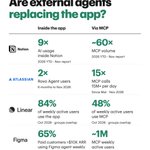
I keep coming back to the same question in conversations with SaaS product teams: if customers can use Claude, ChatGPT or Grok to do the work, what should we still build inside the product?
That includes both the interface and our own AI agents.
The public numbers make the question more interesting. Notion reports roughly 60× growth in MCP volume alongside 9× growth in AI usage inside Notion. At Atlassian, 98% of MCP users were also active on the platform that month. Linear reports growing app usage alongside MCP adoption.
Here are the mental models I'm using:
1. Be the context system, not the chat layer. Don't try to out-build the frontier labs on the assistant. Be the structured, permissioned place every agent reads from and writes to. Your own agents still matter, as the thing that keeps that context current.
2. Bring your own agent first, in-app AI second. Build the foundation: AI-friendly docs, an MCP server, curated prompts. Let users prove workflows with the agent they already trust, then turn the winners into in-app features on the same tools. An in-app copilot still has a job, but it isn't your distribution strategy.
3. Hybrid, not headless. Opening MCP doesn't empty the app; the best 2026 data shows both surfaces growing. The UI's job shifts to review, approval, a shared view, undo, and a clear record of who, or what, did the work.
4. Own the control plane, or become a pipe. Losing the screen doesn't mean losing the value. Companies pay for permissions, a clear line between suggest and execute, a shared data model and an audit trail. If that layer moves to a third-party "agent firewall", you really do become a database.
5. In-product agents matter. Chatbot wrappers don't. A helper chat bolted onto old screens is the old workflow in a new skin. What lasts is agents that move work forward on their own, with clear levels of autonomy, AI actions that are labeled and reversible, and a human at the checkpoint.
At PandaDoc, documents, approvals and signatures make this very concrete. An agent can prepare the work, but someone still needs to decide when it’s ready to become official.
Curious how you’re making this tradeoff: what are you still investing in inside the product, and what are you leaving to the customer’s agent?

3
1
61
One pattern we’re seeing when talking to less tech-savvy customers: people who have never built workflows in Zapier, Make, or n8n find it surprisingly easy to set up routines with agents. They don’t think about triggers, steps, or integrations. They see their Grok Bot agents as teammates and simply give them responsibilities.
For example, instead of building a workflow to check proposals, they can ask their Sales Assistant bot: “Check my unsigned PandaDoc proposals every Monday”. The update comes back in the same conversation.
The most interesting part isn’t that AI can automate the work. It’s that more people can now automate it without ever thinking of it as automation.
***
If you're using Grok Bot with PandaDoc, we’d love to hear what you’re building! lnkd.in/eHhumead
2
3
52
The day has finally come! 🎉
After months of hard work by many incredible people across PandaDoc, we’re launching our very first customer community!
community.pandadoc.com/
As a Product Manager, there’s nothing more valuable to me than having a direct connection with our customers.
I've always loved forums. When Stack Overflow started losing its magic, I genuinely missed that experience of people coming together to share knowledge, help each other, and learn. Reddit never quite filled that gap for me.
That's why I'm especially excited about this launch. We finally have a go-to place where I can share something useful, hear directly from our customers, learn from their experiences, and just be part of the conversation.
Huge thanks to everyone who made this happen! ❤️

1
37
In R&D, it’s easy to assume everyone is already using AI agents. In fact, the data shows that only 10% of PandaDoc users regularly use agents to work with documents. I think part of the gap is simply knowing what to use them for. I see this in the comments on my posts, too.
So I want to start sharing practical examples. Here’s a simple one:
You have a PandaDoc template and need to turn it into a proposal. The information is already there: in your Gong call and one or more HubSpot deals.
With access to those sources, an agent can help you:
◦ Fill in template variables with customer and deal details
◦ Update the actual content, like the scope of work, based on what you discussed
Last Friday, we released our content agent to a limited group of users. It’s designed to make precise changes to document content based on your instructions.
The experience we’re working toward: give Claude, Grok, ChatGPT, or another connected agent the context, and get a document that’s accurate enough to review and send.
2
64
We launched PandaDoc in ChatGPT in May, and early adoption was really low. Honestly, it was a bit scary. I started to wonder if we were overestimating how ready people are for MCP and agents at work.
Then we added Claude, and usage took off right away.
Now Grok. We added it just a few weeks ago, and it's already passed ChatGPT. It's growing faster than Claude did in its early weeks. I didn't see that coming at all.

How I feel every time I see a tip from Aakash on making agents smarter and drop it into Claude without even reading it
🤖 Made with AI

44
I love seeing another great use case for PandaDoc MCP! Fantastic woth with Ollie, @AdamAZJ 👋

You shouldn't be limited to a fixed list of integrations.
With the right Skills, your agent can help connect almost any service with a compatible API, approved write operations included. In our PandaDoc Sandbox test it created a draft and returned the PDF.
1
1
95
Today I had a call with a client, the owner of a small dog-breeding business. Strong revenue, works alone. For him, Claude replaced the whole team.
A developer originally built his website, but he doesn’t need that developer anymore. He first tried to set up the automations himself in Zapier, but he doesn’t need that now either. He talked to Claude, asked questions, and built the automations between his CRM, QuickBooks, and PandaDoc himself. 100% of the business is automated now, and for the first time he actually has order in his bookkeeping.
When he shared his screen, I saw he was on a Max Plan and using Opus 4.8. His “agents” are just dedicated chats that he’s pinned and named for himself, and he’s built skills for them. It works great. He doesn’t need Hermes or anything like it.
And he has no technical background, just curiosity, an understanding of the business, and the knowledge that you can ask Claude.
I believe regulated industries and enterprise SaaS will still be around. But on days like today I seriously wonder what future SaaS still has for microbusinesses, when you may not even need a CRM: you’ve got Claude, QuickBooks, and PandaDoc to send documents and collect legally binding signatures.
3
1
194
One of @bot's biggest benefits is that I can now run 40 customer interviews in about 6 weeks without getting overwhelmed by UX research operations.
Here's the setup:
• Grok Bot coordinates the research and helps avoid overlapping outreach with colleagues.
• Codex and Claude Code find candidates, draft outreach, track bookings, prepare calls, write up notes and do the weekly synthesis.
• A Claude artifact kanban tracks the work from Shortlist to Synthesized. Claude built it from a brief, and agents keep it updated.
For managed accounts, we check with the account team first for permission or an introduction. I approve and send the messages myself.
Before each call, the agent brings together context from previous conversations. So I can skip questions they've already answered and actually help with what they're trying to do.
1
1
113
I moved my whole 2nd Brain setup from Hermes to Grok Bot (@bot) this week: 9 days side by side, one routine at a time. 5 things I'd tell anyone moving off Hermes:
1. Ask Grok to plan its own migration. I just asked how it would move my setup over. It read every Hermes routine and proposed a day-by-day plan.
2. Run in shadow mode first. Each job ran next to Hermes and moved over only after its output matched. No big-bang switch, with daily reports and self-fixes along the way.
3. Expect old bugs to surface. Hermes's audit script had been flagging every transcript as unprocessed every night for over 2 weeks. I only noticed because the jobs moved one at a time.
4. Don't migrate your memory, connect it. Keep Obsidian and expose it over MCP. That's why the move was easy. The SpaceX team we spoke with said that over time Grok learns the facts about you itself, and you may not need the vault at all.
5. Run 2 Groks, personal and work, and use rules to keep them apart. Work-sensitive data stays out of personal and the other way round.
2
151
Our MCP server is now an official plugin in the Cursor and Grok Bot marketplaces, with Skills on top.
So from Cursor or Grok Bot you can say "create a proposal from our template, add the client as signer, send it, and tell me when it's opened", and it all lands in PandaDoc with the audit trail.
teapawt.org/stefanpandeh/status/21…

@pandadoc MCP just landed in the Cursor and Grok Bot marketplaces.
Official plugin with MCP server + Skills. It helps our customers automate document workflows: draft your document, create from template, send for signature and track status by chatting with Grok Bot or Cursor.
Cursor: cursor.com/marketplace/panda…
Grok Bot: x.ai/bot/plugin/80233802


1
72
Vasil Remeniuk retweeted
@pandadoc MCP just landed in the Cursor and Grok Bot marketplaces.
Official plugin with MCP server + Skills. It helps our customers automate document workflows: draft your document, create from template, send for signature and track status by chatting with Grok Bot or Cursor.
Cursor: cursor.com/marketplace/panda…
Grok Bot: x.ai/bot/plugin/80233802
Out of curiosity, I looked at how people use PandaDoc through agents like Claude and ChatGPT, via our MCP.
Clear pattern: AI-native users reuse a trusted template and let the agent fill in the details. Newer users ask the agent to build a doc from scratch.
With template reuse, MCP calls per document halved and follow-up edits dropped ~75%. A rough token estimate suggests ~10x lower cost. That matters when you don't want to burn your monthly budget in a week on an agent rebuilding a 12-page proposal from scratch.
Real autonomy starts with making the repeatable parts boring and reliable. In PandaDoc that means filling the doc from your CRM, validating deal data, flagging what's missing, and never sending for signature when an approval workflow is on.
The agent does more of the work, but you still decide what's ready to send.

2
3
2,298
In this 2 hours lecture Andrey Karpathy shows, how to build from scratch a model similar in performance to GPT-2 youtu.be/kCc8FmEb1nY
1
276
According to the AI Index Report 2023, Chinese institutions currently hold 9 out of the top 10 positions globally in terms of the number of publications per year, with MIT rounding out the list.
What are we talking about at all?..

The leader of the world's number two economy doesn't want to be caught as a laggard in the AI race.
He pushed hard on Friday for China to seize opportunities and advance.
Source: @SCMPNews

1
307
