




Nothing retweeted

How do you stop a software factory from becoming a slop factory?
@dexhorthy of @factory lays out 12 practices: planning, visual alignment, lint rules and review.
Plus the Anti-Slop Manifesto.
Watch: youtu.be/-NFMsM2y0Vk

Nothing retweeted

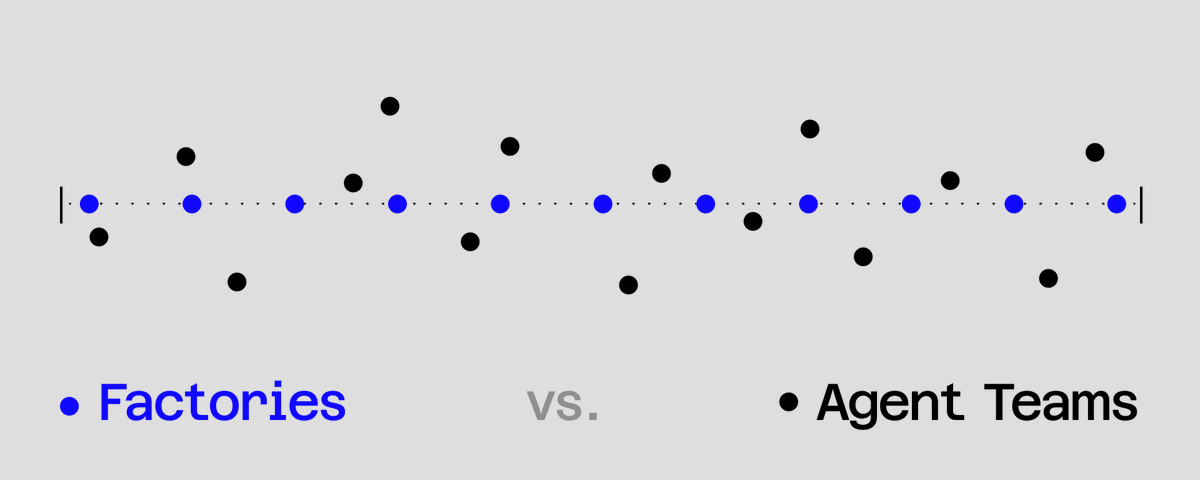
After two years of rapid change in software development, we are again at a crossroads, with two competing visions for what the future might hold:
- agent teams that we orchestrate
- software factories that we build, measure, and improve

Nothing retweeted

a year ago at @aidotengineer Code Summit I spoke about Research Plan Implement, how to apply context engineering to your coding agents, and why every concept in AI is doomed to suffer "semantic diffusion". That talk has over 600k views and changed the way engineers everywhere think about building with AI
On thursday next week at 5pm, I'll be doing the ultimate mash-up talk: "Twelve Factor Factories: Design Patterns for Agentic Engineering"
should be a fun one, see y'all there 🙂

Nothing retweeted

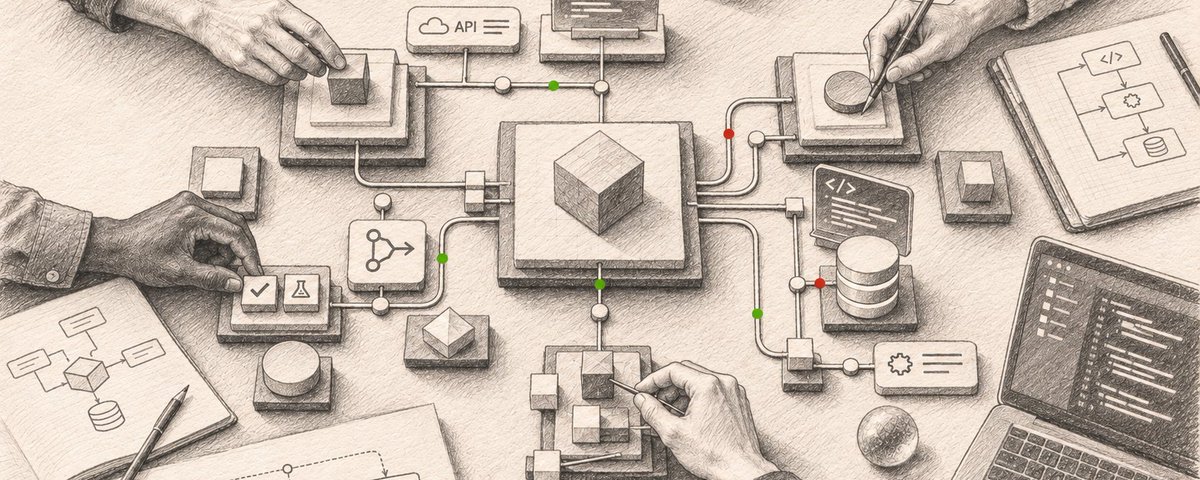
The 𝗦𝗼𝗳𝘁𝘄𝗮𝗿𝗲 𝗙𝗮𝗰𝘁𝗼𝗿𝘆 𝗘𝗻𝗴𝗶𝗻𝗲𝗲𝗿.
An emerging engineering role for the transition from AI-assisted development to L4 Autonomous Software Factories.
Feel free to copy, adapt (, and challenge it)!
Nothing retweeted

Remove your main @github account from your computer. Now.
Give your AI agent a separate GitHub account with minimal permissions per repo.
Let the agent create PRs, then use your main account to review and merge them.
Obvious advice, but essential in the age of AI agents.


Nothing retweeted

A Chinese developer just explained the shift from Loop Engineering to Graph Engineering better than anyone.
most people are still building agents the way that's about to be obsolete.
> why single-agent loops break and go "goal blind"
> the 4 parts of a graph: nodes, edges, state, policy
> 3 topologies that run everything: diamond, supervisor, pipeline
> Anthropic's 5 official workflow patterns
the punchline: it's not how many agents you run. it's the determinism you build with verifiers, code fallbacks, and reality anchors.
I broke the same architecture down with Kimi K3. Full A-Z guide below.


Nothing retweeted

The mistake is thinking the choice is AI or human.
Vibe coding and agentic workflows may get automated, just like prompt engineering got compressed into better tools. But the deeper skill is not “knowing prompts.” It is knowing how to turn ideas into products, systems, media, and leverage.
The real alpha is human, yes: community, mission, culture, belief, identity, movement.
But AI is how those movements scale faster.
So the answer is not to abandon AI.
It is to stop worshipping AI tactics and use AI to scale what machines can’t create on their own:
belief, belonging, trust, and movement.
Nothing retweeted

Introducing the Open Knowledge Format (OKF), an open specification that formalizes the LLM-wiki pattern into a portable, interoperable format.
AI is only as smart as the context we give it. As we build more advanced, agentic AI systems, they need accurate metadata and context to be useful. But in most organizations, that context is locked inside fragmented data catalogs, isolated wikis, scattered code comments, or the minds of senior engineers. Every time a new AI agent is built, teams are forced to solve the exact same context-assembly problem from scratch.
To solve this, we've announced OKF, a vendor-neutral, open specification that formalizes the "LLM-wiki pattern" into a portable, interoperable format. It provides a standardized way to represent the enterprise knowledge that modern AI systems rely on.
— Just markdown: readable in any editor, renderable on GitHub, indexable by any search tool
— Just files: shippable as a tarball, hostable in any git repo, mountable on any filesystem
— Just YAML frontmatter: for the small set of structured fields that need to be queryable: type, title, description, resource, tags, and timestamp
We’ve also shipped reference implementations to help you hit the ground running, including an enrichment agent for BigQuery, a static HTML visualizer, and live sample bundles on @github → goo.gle/4uGvAEe
➕ Knowledge Catalog can now natively ingest OKF!
Stop reinventing data models and building bespoke integrations for every new AI tool. Here's more about how OKF works → goo.gle/4uGvBbg


Nothing retweeted
10 things i learned about harness engineering - how to get the most out of coding agents TODAY
(shouts out to @0xblacklight for the excellent post)

Nothing retweeted
Here’s what’s gonna happen:
- you replace your code review with feedback loops (sentry, datadog, support tickets, etc)
- you stop reading the code
- software factory fixes everything
- one day something breaks at 3am, agent can’t fix it
- nobody’s read the code in 3 months
- you have 3 weeks of downtime trying to re-onboard and fix it
- you lose significant % of your contracts and users
- your company is now dead

Nothing retweeted

.@LakshyAAAgrawal has done an unbelievably nice job collecting successful applications of GEPA to everything from state-of-the-art research to new products and established enterprises at this page.
Staying on top of these is harder than one would think!
gepa-ai.github.io/gepa/guide…


Nothing retweeted
Nope. My lab is making 3 algorithmic bets. One of them is on recursion, RLMs being step 1. Another one is on the power of late interaction retrieval.
Conventional single-vector retrieval was always a bottleneck, even back in 2019 when starting ColBERT. So if you're wondering if that's not ideal, it isn't. Same for single-step RAG.
But better retrieval is both possible and badly needed. Recursion is fundamentally an inference-time mechanism. You wouldn't want to recursively index a 10B-token corpus on each and every request.

Nothing retweeted
The world loses millions of dollars in productivity every day that coding agents aren't RLMs yet.

Nothing retweeted

Part 4 of my deep dive into hexagonal architecture in Rust is live! 🦀 Covering:
🤔 Trade-offs of hexagonal architecture
⛔️ Common pitfalls to avoid
📈 Adopting hexagonal architecture at every growth stage
Read & subscribe for updates: howtocodeit.com/articles/mas…
#Rust #RustLang

