




Pinned Tweet
I'm a momentum and swing trader, and an investor.
I don't trade opinions. I read the data — and I trade what it says.
My charts stay simple:
• EMAs — 9, 21, 50, 100, 200
• Volume profile
• Anchored VWAPs and trendlines, when they matter
Every idea starts with a deep dive: where is the money positioned, where does price want to go, what breaks if I'm wrong?
Momentum tells me when. The levels tell me where. The data decides — I just follow it.
$AMD — fell 10.9% Friday to $504.80 in the chip selloff.
Same AI thesis as Thursday, 11% cheaper Friday. If you believed it at $566, what changed at $505?


$DELL Low is 412, so i missed by 12 points, Sorry guys.
Will try to be accurate next time.

$INTC — Will history repeat itself?
Intel hit its ATH in August 2000 and took nearly 26 YEARS to break that level.
It then rallied to $142.35 in June 2026.
Now trading around $69 premarket, down over 50% from its peak. 💀
Will it take another 20+ years to reach $145?
Is this another example of what happens when investors get caught up in extreme bull-market euphoria?
Trading through earnings is gambling when you’re simply betting on the outcome.
If you win, you feel like a genius. If you followed a trading guru and made money, you might think they predicted everything perfectly.
But the reality is that getting lucky doesn’t make it a good trade.
The sooner traders understand the difference between calculated risk and gambling, the better off they’ll be.
It’s painful to see so many people losing their hard-earned money while some trading gurus continue pushing high-risk earnings plays as if they’re guaranteed opportunities.
Remember, it’s YOUR account, YOUR money, and YOUR responsibility.
Don’t let someone else’s confidence become your financial loss.
A good trader doesn’t need to catch every move. Protecting capital and knowing when to sit out are just as important as making profits.
Take control of your account. Follow a strategy, not a personality.
• Uncle Sam pays 4.07% for 1 month — and 5.37% for 30 years
• The 10-year is at 5.05%, the rate mortgages follow
My take: the longer you lend, the more you get paid.
#Bonds #Treasury #Investing
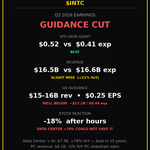
Intel $INTC Q3 earnings are out — and the market hated the outlook, not the quarter.
• $INTC EPS: $0.52 vs $0.41 expected — beat
• Revenue: $16.5B vs $16.6B expected — slight miss, up 21% year over year
• What surprised: Data Center + AI jumped 78% to $7.3B, its best growth in 15 years — but PC revenue fell 5% to $8.1B, and management sees that PC slowdown lasting into the first half of next year
• Guidance: Q4 revenue $15-16B and EPS $0.25, well below ~$17.1B and $0.44 expected — a cut
• Stock reaction: -18% after hours
My take: I think this is a guidance story, not a demand story. The data center business is accelerating, but the PC weakness and the soft Q4 guide give the market no reason to pay up here. I would wait for the guide to stabilize before getting excited.

Amazon just reported Q3 — and the market didn't like the headline, even with AWS flying.
• $AMZN EPS: $1.89 vs $1.96 expected — miss
• Revenue: $201.9B vs $202.3B expected — slight miss, up 12% year over year
• AWS: $46.0B vs $45.7B expected — beat, up 39% year over year, its fastest growth in nearly five years
• Guidance: Q4 sales of $240–247B and operating income of $28.5–33.5B — roughly in line with expectations
• Stock reaction: -4.3% on the day, then about -5% after hours
My take: AWS is doing the heavy lifting, but the AI buildout is the story now — $77.3B of capex in one quarter pushed trailing free cash flow to -$42.4B. I think the question for Amazon isn't demand, it's how long investors will fund this spend before it pays back.

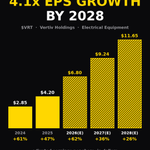
$VRT is the company keeping AI data centers powered and cool, and as hyperscalers race to build more capacity, Vertiv's gear sits inside nearly every new cluster. That demand is turning into earnings at a pace few industrials can match.
Yesterday's Q3 print proved it: revenue up 61%, adjusted EPS up 78% to $2.21, a 21% beat — and management raised full-year guidance to $7.10–$7.20 per share.
My take: this is the AI infrastructure trade with the numbers to back it up.

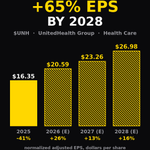
$UNH is the comeback I keep coming back to. After a brutal reset last year, earnings troughed — and the Street now sees profits climbing 65% by 2028, nearly back to their old peak.
The driver is margin repair. Third-quarter adjusted EPS came in at $4.69, beating consensus by 57 cents, and management raised 2026 guidance to at least $20.50. With costs normalizing and buybacks back on the table, that recovery has room to run.
My take: the triangle breakout is the trigger, but the earnings climb is the real story.

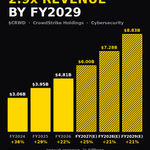
$CRWD is quietly becoming the security layer for the AI era. As autonomous agents flood enterprise systems, companies are consolidating their security spending onto one platform instead of juggling dozens of point tools.
The proof is in Falcon Flex: its ARR more than doubled to $2.29 billion, up 101% year over year, while total ending ARR hit $5.84 billion.
My take: CrowdStrike's consolidation story is still early, and the forward revenue path shows it.

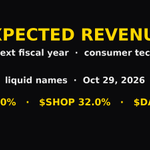
Fastest expected revenue growth, next fiscal year — consumer tech
• $RDDT +54.0%
• $SHOP +32.0%
• $DASH +30.0%
• $META +27.8%
• $GOOGL +23.9%
• $PINS +16.4%
• $ABNB +15.8%
• $AMZN +15.6%
• $SNAP +14.8%
• $AAPL +14.8%
• $SPOT +13.5%
• $NFLX +13.1%
• $EBAY +12.9%
• $UBER +11.3%
• $BKNG +8.7%
• $DIS +7.5%
My take: Reddit is in a league of its own here, and the rest of the list is a reminder that even the biggest consumer names are still expected to grow double digits. I'm watching whether the ad names at the top actually deliver that growth before getting excited about it.

Q3 GDP is out — and growth beat.
• Actual: 3.4% annualized
• Expected: 3.2%
• Prior (Q2): 2.2%
• Surprise: +0.2 points above expectations
• What drove it: investment, consumer spending, and government spending rose
• What dragged: exports fell, while imports rose
• Prices cooled: gross domestic purchases price index +3.0%, down from +5.6% in Q2
• Underlying demand: real final sales to private domestic purchasers +4.9%, up from +4.6% in Q2
• Into the print, futures were mixed: Dow up, S&P and Nasdaq down, with Alphabet dragging tech
• 10-year yield sat just under 5%, dollar index near 102.3
The bull case: growth accelerated while price pressures eased.
The bear case: exports fell and imports rose, so the headline flatters the trade picture.
My take: a solid beat with cooler prices is a good combo — but I want to see the details hold up on revision before calling it strong.
What's your call — hot economy, or headline flattery?

September PCE is out — and the Fed's preferred gauge came in right on expectations.
• Core PCE y/y: 3.1% vs 3.1% expected, up from 3.0% in August
• Core PCE m/m: 0.3% vs 0.3% expected (August revised to 0.3%)
• Headline PCE y/y: 3.6% vs 3.6% expected, up from 3.4% in August
• Headline PCE m/m: 0.5% vs 0.5% expected, up from 0.3% in August
• Personal income: +0.2% in September, below the +0.3% expected
• Personal spending: +0.5%, below the +0.6% expected
• Saving rate: 3.8%
The hawkish read: inflation is still accelerating on the year, and it sits well above the Fed's 2% target.
The dovish read: core came in exactly as expected, so there's no new reason to price in more tightening.
My take: an in-line print keeps the December debate exactly where it was — I see no surprise here worth chasing.
What's your call — does this keep the Fed on hold, or does the hotter headline keep a December hike live?

• $MSFT EPS: $4.89 vs $4.72 expected — beat
• Revenue: $92.28B vs $90.62B expected — beat, up 19% year over year
• Azure stole the show: $33.17B, up 48%, ahead of the 44-45% guide and the $32.32B Street estimate
• Guidance: Microsoft puts no numeric guide in the release — the December-quarter outlook comes on the 5:30 PM ET call, and Azure's guide vs a ~45% Street bar is the number to watch
• Stock reaction: +4.8% after hours, to about $556.66 from a $531.01 close
My take: Azure accelerating to 48% is the story — it says the AI buildout is turning into paid cloud demand, not just spending. I want to see the call's guide hold that momentum before calling this a clean all-clear.

$AMZN, you’re officially the last hope for bulls tomorrow. 🐂😂
$GOOGL crushed the AI theme, $NOW disappointed the software bulls, and $FTNT took down cybersecurity. 💀
One by one, every sector is getting destroyed.
Bezos, the entire stock market is counting on you now. No pressure, just millions of bulls begging you to save what’s left of this market. 😭🤣
Please don’t disappoint us. We’ve suffered enough this week. 💀
$SNOW is quietly turning an AI data story into a revenue machine. After years of steady compounding, growth is re-accelerating just as enterprises move their AI workloads onto its platform, and the chart setup is repairing at the same time.
The proof is in the guide: management has raised fiscal 2027 product revenue guidance twice, to $6.07 billion, after product revenue grew 37% in the latest quarter — its third straight quarter of acceleration, powered by AI demand.
My take: the re-acceleration matters more than the multiple — this is a compounder regaining its pace.

$GOOGL Q3 earnings are out — and the market did not like them.
• $GOOGL EPS: $2.12 vs $3.02 expected — big miss
• Revenue: $127.6B vs $127.9B expected — just short, still +25% YoY
• What surprised: an $8.7B loss on equity securities dragged EPS down, while Google Cloud doubled — +103% to $30.7B, beating expectations
• Guidance: no formal revenue guide, as usual — the 2026 capex plan ($195–$205B) stands, with 2027 spend still expected to rise significantly
• Stock reaction: -8% after hours, from a $321.89 close to around $298
My take: the core business is still growing fast, but the market is voting on the AI spending bill — Cloud has to keep doubling to justify it. I am watching whether the selloff holds into tomorrow's open.
