

Climate Chlimate. Serious challenges with awesome opportunities to build Solutions. avoid the Saviour Complex.
Mumbai, India
Joined June 2023
- Tweets2.6K
- Following79
- Followers1.4K
- Likes652






Global warming is also bringing increases in Aridity with over 75% of the land seeing the evaporative demand going beyond precipitation! The most direct consequence of atmospheric warming is of course the increase in evaporative demand. Population in Drylands has doubled over the past 30 years. Socioeconomic impacts cascade from agricultural losses and vegetation damages to livelihoods, livestocks, dairy production, etc. Aridity monitoring tools are available now. Managing and governing aridification risks are a major adaptation challenge now. Future projections have no good news either. Considering that rainfall is also becoming highly variable and extreme, urgent adaptation in all sectors will be needed in all regions, dry and wet. Especially the food, water, energy and health nexus has to be mapped and managed. #globalwarming #aridity #adaptation #agriculture #water #energy #livestock #dairy #climatechange #peace
youtu.be/Ze3iwTqkqVk?si=cD5R…

It’s always been the definition to look at 3-month running mean ONI to call it an El Niño and then categorise it as strong, very strong, etc. Now the ‘super’ descriptor has caught the fancy but unclear why we coin artificial thresholds without any direct links to impacts. NOAA has been cautious about calling this El Niño even ‘very strong’ because the 3-month running mean ONI is still below 2C. Predictions say there’s over an 80% chance of it becoming very strong in the October-December running mean. It’s also interesting to contrast ONI and Relative ONI or RONI. The role of global warming in the west and over the Maritime Continent is clear as day. California waits for a bumpy winter but hopefully it will provide the much needed precipitation without any serious disasters. Still curious about separating global warming from El Niño although cloud patterns remain true to El Niño in the Pacific. #elnino #globalwarming
youtu.be/PFOoz0jDdJw

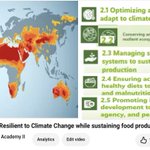
Under the UN Convention to Combat Desertification, CGIAR has a Mission 2030 to make Drylands sustainable and resilient. It’s amazing that nearly 50% of all lands qualify as dryland and host over 30% of the population and nearly 45% of food production. many are degraded and facing the wrath of global warming. The goals are to adapt agriculture and food systems to climate change, synergise with biodiversity conservation, holistic management of soil, land and water to sustainably meet growing food demands, and meet food and nutrition security needs by 2030. CGIAR also focuses on poverty reduction. Drylands are also expanding rapidly in many places. Climate displacement is continuing to hit these regions hard because of water scarcity. Some conflicts are related to water resource sharing issues. I hope CGIAR succeeds in promoting peace! #CGIAR #drylands #globalwarming #sustainability #agriculture #water #peace
youtu.be/Yph3ACdXt7k?si=j7oK…

Once we get away from the gradient index, there’s really no strong upwelling in the eastern Indian Ocean. The change of weekly SSTs from Sept to Oct show a cooling in the western Indian Ocean also. Easterly anomalies in the eastern Indian Ocean are not able to couple the ocean and the atmosphere and grow into an IOD yet. OLR anomalies are also mostly showing the El Niño signature. Will a real IOD make an appearance? Or is time running out for the traditional IOD? Cumulative rain since Oct 01 is a mixed bag over the southern peninsula but we have to see how the northeast monsoon does in the coming weeks. #elnino #IOD

Resilience has to be an integral part of adaptation in every sector and this becomes very clear in flood impacts. A relatively unnoticeable local flood can percolate through much larger road networks based on network links and random remote damages. Critical nodes and links transmit the perturbations from local to remote locations even across continents in some cases. The more interconnected the systems and economies are, the larger the network connections and lack of resilience to floods and other perturbations such as terrorism or wars. Network failure models can identify the nodes that have the maximum potential for percolation across road networks for both pluvial and fluvial floods. 3D modelling will be needed in some cases but it’s important to have failure modelling done to see how vulnerable road networks are to local or remote floods. Globalisation is bringing many socioeconomic perturbations and the system is also only as resilient as the weakest link in the system. #networks #resilience #floods #globalwarming #adaptation #roads #supplychains #peace
youtu.be/ObbpNDl8HKw?si=SOnG…

The seesaw of hurricanes over the Atlantic and the eastern-central Pacific between El Niño and La Niña years is well known. But this year has seen a strong contrast. The Atlantic has seen only one hurricane thus far and that formed only on October 6th which likely tied a 121-year old record. Accumulated cyclone energy or ACE is dramatically below the climatology. The central-eastern Pacific on the other hand saw a record number of hurricanes and is already a record for ACE. The Pacific has been very warm with a warming pattern over much of the northern hemisphere. Winter could bring massive storms to the west coast of the US, especially California. Nothing should baffle us with this monster El Niño. Just a preview of how each additional 0.1C warming will impact the planet with extremes in heatwaves, floods, droughts, hurricanes, winter storms, wildfires, and so on? We haven’t even tracked the food production, supply and energy demand issues globally yet! #elnino #globalwarming #atlantic #hurricanes #pacific #california #peace
youtu.be/_3o-mR_zf20?si=_cKF…

Adaptation and Mitigation are key climate actions but resilience needs to be integral to the transformations. The intuitive sense of resilience brings absorbing shocks to mind but resilience also needs a clear definition and metrics so that it can be tracked for progress. Resilience is not just about returning to previous functionality after a perturbation but also about adapting to changing and cascading risks. Low to high risks and resiliences can determine time of recovery. Recovery of critical functionality should bring us back to the pathways for NDCs, net zero, sustainable development, and steady progress towards an optimistic future. These are not just theoretical concepts. Sectoral and location-specific resilience building is the goal. Risks will keep pulling us away from our goals but resilience is the system property that ensures rapid recovery and return to the pathways to the preferred state. #globalwarming #climaterisks #emissions #climateimpacts #adaptation #mitigation #resilience #netzero #NDCs #peace
youtu.be/c7Lmau-U38E?si=a2bQ…

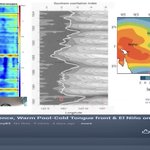
The front between the warm, fresh pool in the west and the cold, salty pool to the east moves back and forth with SOI and has some lead time information on recharge-discharge. Westerly and easterly anomalies also converge into this front and there are surface-subsurface biogeochemical signatures as well. Deep convection stays just to the west of the front. When the convergence zone goes eastward past 170E longitude, onset of El Niño happens. This is not directly used for predictions but this front is being affected by global warming and the rapid warming to the west with a cooling to the east. What does this mean for the El Niño response to global warming? Models don’t do these features well since models continue to suffer from the cold tongue bias and the failure to reproduce the trend in the cold tongue. Can we trust model projections of El Niño intensity and frequency? #elnino #lanina #warmpool #comdtongue #globalwarming
youtu.be/dvvqgmlZC-w

Number of Megacities and their populations will keep growing. So will their flood and storm surge risks. Flood risk mitigation strategies can focus on reducing vulnerabilities to floods and/or reducing flood risk themselves. Integrated flood risk and cost-benefit analysis modelling are needed for effective and efficient choices - retrofitting, barriers, natural solutions such as wetlands, mangroves, etc., levies, and so on. Policies are also needed to decide who pays (residents, visitors, businesses), zoning laws, building codes, etc. Location-specific solutions needed. #floods #megacities #urbanfloods #globalwarming #extremeevents #earlywarnings #peace
youtu.be/rEeZmdOT3Ls?si=hWg2…

Indo-Pacific Tripole is obvious and now the question is whether the Indian Ocean will dance on its own. Alongshore winds are favorable and convection seems to be suppressed but it’s too wavy. Will subsidence and Rossby waves strengthen this into a full blown Bjerknes feedback and a strong cooling in the east? What are the models doing? A flux driven surface cooling or a coupled mode? The gradient definitions are tricky because there are many ‘IODs’ where the gradient doesn’t actually reverse. #elnino #IOD #globalwarming #peace


I am on a Hoysala heritage tour so posting before sleeping. Early outing tomorrow. The tipping point report lists AMOC and the subpolar gyre, Amazon, Corals and mountain glaciers as case studies of tipping risks and provides recommendations for each. AMOC/SPG are a complicated story and IPCC has a more sensible scientific consensus on it. Corals that are responding intelligently to warming need better understanding for potential solutions to saving those that are suffering. Amazon is also complicated by a blend of deforestation and global warming issues and mitigation must address the latter part anyway. The same goes for mountain glaciers with risk based land use management for many of them in addition to mitigation. Adaptation and mitigation with a focus on global warming patterns is the way to go? Decarbonisation and net zero are a part of this solid focus. #globalwarming #adaptation #mitigation #decarbonisation #netzero #peace
youtu.be/2m-23pENe98?si=dDOs…

Risks require governance and we are already struggling with climate change governance. Adding tentative statements about what may already be happening or that somethings are approaching faster than we thought, are like the junk mail we get saying we may have already won a million dollars! All international coordinations, multi-lateral governance issues, additional climate risks that are argued to arrive if we cross the 1.5C threshold and so on are part of the overall climate change negotiations under the UNFCCC. Tipping points have been introduced into COPs now but the unintended consequences maybe that countries transfer national governance issues of deforestation and reckless land use practices on mountain slopes to tipping point issues in the international domain. Real tipping point needed is to focus on adaptation and mitigation along with the global warming targets and avoid adding more uncertain claims about tipping points. #UNFCCC #COPs #globalwarming #adaptation #mitigation #netzero #peace
youtu.be/cQHHq72-SdI?si=pc_U…

Talking about the other zonal mode, the Atlantic Niño, we did three papers showing the impacts (led by a student). And I remembered that I had written about it! I can’t get the pdf but we have to watch out for the street lamp syndrome. Looking for only what we know always leads to confirmation bias. There is in fact an Atlantic Niña right now and it should impact our region. I hope someone can show some interest in that little player also. #elnino #IOD #atlnino #monsoon #floods #droughts #globalwarming #peace
indianexpress.com/article/op…

El Niño is the big gorilla in the room not only in terms of the incomplete understanding and imperfect predictions but also the understanding and predicting of its impacts. Even this robust internal mode has a significantly large internal variability. Its period is not constant and onsets can happen from March to September or later and that corresponds to its intensity. The same aspects of El Niño are pitched in different forms too (internal variability in papers is intentional😅). Westerly wind bursts or WWBs continue to cause such whiplashes because it is the critical question of stochastic forcing or weather noise growing into a signal under some circumstances which are well understood. So the internal variabilities at weather and climate timescales get married to each other to give us Early onsets. Early onsets are almost always associated with WWBs but now we have 2023 El Niño telling us that warming patterns kickoff early onsets and strong El Niños as well! The poor IOD doesn’t know what to do on most occasions. And Atl Niño is happily ignored because it hasn’t been oversold. Recharge-discharge remains fundamental but it also has internal variability. Enjoy the ride by focusing on S2S predictions and early warnings. #elnino #IOD #atlnino #monsoon #floods #droughts #peace
youtu.be/V5-_1nmugvE?si=BJG0…

The Global Tipping Point Report starts with the same amber diagram of warming vs. risks of the Climate Tipping Elements. The obsession about AMOC is not easy to understand considering that it is anything but simple to track it and uncertainties abound. Corals are getting hammered but many are responding with resilience and adaptation and the real scientists are quietly working on saving them. Mountain glaciers, permafrost, and so on need better modelling and decadal predictions for their trends. Brazil is worried about the Amazon and wants tipping points to be part of the COP discussions. Is Amazon a global warming problem or a national and regional governance problem? Who gets elected now may decide its future than any tipping points? The tipping point gang is pitching positive tipping points now. That’s already a part of the mitigation story! More to come on governance. #globalwarming #adaptation #mitigation #decarbonisation #netzero #AMOC #Glaciers #Antarctica #Amazon #peace
youtu.be/WF4okueT7qA?si=taq2…

Strong southeasterlies are blowing in the eastern Indian Ocean, almost a trade wind-like system. But upwelling favorable winds are more obvious near Java. Deep tropical winds seem slightly offshore or is it a model resolution issue? Moreover, these winds are co-occurring with strong convective systems in the tropics and a cyclone pair in the west across the equator. Anticyclones have been spinning for a while in the North Indian Ocean. It’s not unusual for the upwelling to expand northward into the tropics but some coupling needs to happen. With such a monster El Niño brewing, it’s the only Relative Niño index that shows the cooling more clearly in the Western Pacific, Maritime Continent and Southeastern Indian Ocean. Models tend to grab on to such initial conditions and tend to get overconfident about IOD. It will be fun to watch where this goes and what El Niño is doing and what the Indian Ocean warning is doing. #IOD #elnino #glibalwarming #northeastmonsoon
Climate Tipping Points or CTPs became a part of COP discussions and a report was released by the Europeans just before COP30. So scientists are also lobbying! Brazil, Nepal and so on want these to be part of the process but India, Saudi Arabia and some others doubt the science. CTP risks are real but it is anything but easy to predict them and even the indicators are not always solid. When almost 21000 publications are analysed, the CTPs or CT Elements that get most attention are not the ones which are most imminent! Not surprising since the community jumps on bandwagons and those are led by one initial paper or the media hype. Can we project the impact clearly, especially at regional or local scales, resulting from any of the CTPs does become a reality? Not really. I feel that this is an additional burden on the developing and poor countries on top of all the mitigation efforts. What exactly is needed for CTPs in addition to just accelerating mitigation and focusing on global warming targets? If we aren’t even pretending to care about the actual proximal risks of CTPs in our research, then we can at least tone down the alarm? #climatetippingpoints #AMOC #greenland #glaciers #Antarctica #amazon #globalwarming #mitigation #climaterisks #adaptation #climateaction #peace
youtu.be/9QoDixXPd2A?si=-Y5V…
