
Follow @RobotsDigest for latest in Robotics, Humanoids, and Hardware + AI.
Joined August 2025
- Tweets3.2K
- Following0
- Followers6.3K
- Likes276
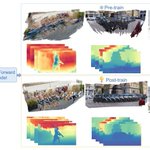




What if we could improve pretrained 3D reconstruction models using unlabeled videos - without adding inference-time overhead?
A promising new direction for dynamic 3D reconstruction: PURE
PURE explores exactly this, targeting more accurate geometry and better temporal consistency in dynamic scenes.
Approaches like this could be valuable for dynamic scene understanding, immersive 3D environments, and building more realistic digital representations of the world.
The balance between reconstruction quality and computational efficiency remains a key challenge.


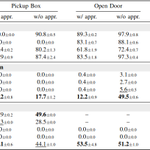
On the real G1: box pickup 6/10, door 4/10, grasping 2/10 (depth on small objects is rough). Everything was trained in sim only. It re-grips an unstable box, leans its whole body into a heavy door, and recovers from a stumble on its knees.
Paper: arxiv.org/abs/2610.24675
Site: fiberaa.github.io

Sim results over 128 variations per task:
FIBER 42.0% mean success
Projected latent replay 11.6%
Kinematic planner 3.5%
Action planner 0%
They also train the BFM with two discount horizons (0.8 and 0.98), which lifts projection success from 68.8% to 72.8% over a single fixed horizon.

A pose target doesn’t say how to react when a box slips. Raw actions make the planner model 50 Hz feedback. So the planner runs at 5 Hz and the frozen BFM handles the 50 Hz part. Each expert is projected in by finding the BFM latents whose actions match the expert’s. A single planner trains on those.

Amazon FAR’s new paper, FIBER: one vision-conditioned policy on a Unitree G1 that picks up boxes, opens doors and grasps small objects.The interesting part is what the planner outputs. Not poses, not raw actions. It outputs latent commands for a frozen behavior foundation model.
Most robotic hands are completely numb because wrapping flat tactile sensors around curved geometry is physically impossible.
@JohnsHopkins and @MIT just fixed this with OpenTac.
This open source ecosystem automatically designs custom 3D tactile skins for any robot surface, delivering normal and shear force feedback at a blazing 1286 frames per second.
Everything is open source: board designs, firmware, OpenTac-CAD, simulation and transfer. Sensors and pre-assembled readout boards can be ordered directly from JLCPCB, at about $80 per sensor with its readout board.

Computer use agents are trapped by rigid human tools. Typing cell by cell instead of executing a script wastes massive compute.
Simular AI just shattered this limitation with Agent S4. This autonomous scientist evolves its own computer use interfaces from raw experience,
scoring 21.3 percent on OSWorld V2 to crush GPT 5.5 and Claude Opus 4.8 at a fraction of the cost.
Not every generated tool is useful. Agent S4 uses population based evolution to filter the repositories.
It selects the best interfaces based on their performance on unseen validation tasks, guaranteeing that the new tools generalize to novel workflows rather than overfitting to specific prompts.

Paper: arxiv.org/abs/2610.28601
Blog: simular.ai/articles/agent-s4…
Code: github.com/simular-ai/agent-…
Hugging Face: huggingface.co/papers/2610.2…
Huge credit to the @SimularAI research team behind Agent S4: @saa1605
, @Toby_Yang_7, @chalo2000, @Bhuvan_Koduru, @Richard_simular, JC, @angli_ai, @xwang_lk
Physics engines scale rollout speeds effortlessly, but generating matching photorealistic visuals usually breaks the compute budget.
Midcentury AI introduced Akari to solve this, bringing learned neural rendering directly into robotics simulation.
By replacing manual ray tracing math with data driven frame generation, Akari produces photorealistic visuals directly from raw simulator state buffers at 0.5s per frame with 0.046 LPIPS visual fidelity across 1,000+ continuous frames.
Standard engines calculate explicit light paths to render realistic shadows, reflections, and surface textures. That approach requires complex hand written shaders and massive compute resources.
Akari learns what physical lighting looks like directly from data. Decoupling visual rendering from traditional ray tracing bottlenecks lets developers run high fidelity simulations without taking massive performance hits.