

Man of science, metal bender, EUV producer, and human-powered traveler
Cambridge, MA
Joined August 2021
- Tweets2.7K
- Following319
- Followers2.7K
- Likes12K



Peter Johnsen, PhD retweeted

There should be a frontier lab that takes Experimental Physics seriously
Peter Johnsen, PhD retweeted

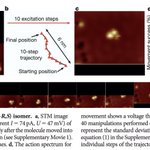
TIL from @DandKUniverse that you can sometimes hear meteors burning up in the atmosphere *at the same time as you see them*, despite the discrepancy in the speed of light and the speed of sound.
How? Here is an abstract from a relevant paper:
Peter Johnsen, PhD retweeted

Do not be afraid to sow without immediately seeing the fruits. The sowing belongs to you; the growth belongs to God. No gesture carried out in the name of Christ is useless.

Peter Johnsen, PhD retweeted

This is a better way to visualize Columbus’ voyages than the traditional way (that shows him traveling through a modern map)..
It looks a lot crazier and more daring when you see it as a trip into the unknown.
Peter Johnsen, PhD retweeted

What if our ears were like our eyes, and only had three receptors? Interestingly speech is still more or less intelligible, but not much else
too me this shows how much more discriminating our hearing is than our vision
Peter Johnsen, PhD retweeted

As much as I admire Feynman, he did not "Instantly prove(s) the O-rings failed due to the cold, cracking the case single-handedly". Engineers at Morton Thiokol (suppliers of the solid rocket boosters) were well aware of the problem with the o-rings not sealing properly in cold temperatures, particularly after finding evidence of significant escape of hot gases past the seals in the previously coldest launch (53 deg F) a year earlier. They strongly recommended that the launch be postponed on account of cold weather (forecast 30 deg F), but management overruled them under pressure by NASA.
Sally Ride, who as an astronaut had extensive contacts with engineers across NASA and its suppliers, was the first Commissioner in the inquiry to become aware of these issues. She relayed them to Commissioner General Kutyna, who had formed a bond with Feynman. According to Feynman himself in his book, Kutyna discreetly addressed the issue by asking him what would be the effect of cold weather on the o-rings in his carburetor -- showing how difficult it was to share sensitive information, even within the Commission itself. Feynman immediately got the point. As the obvious loose cannon on the Commission, Ride and Kutyna used Feynman as the means to point the finger publicly, without leaving a trail back to the original sources, who might have otherwise faced retaliation. Very slick work by all three of them.

> Be Richard Feynman
> Teaches himself advanced calculus at age 15
> Fixes neighborhood radios for fun during the Great Depression
> Recruited to work on the Manhattan Project at Los Alamos in his 20s
> Gets bored while building the atomic bomb and starts picking locks
> Breaks into his colleagues' top-secret safes just to leave them mocking notes
> Completely breaks down the government's security system for fun
> Loses his wife to tuberculosis and uses the grief to dive deeper into physics
> Reinvents quantum mechanics by drawing simple sketches (Feynman Diagrams)
> Wins the Nobel Prize in Physics for his breakthroughs
> Refuses to take himself seriously or act like a stuffy academic
> Spends his free time playing the bongo drums in a Brazilian samba band
> Learns how to paint at age 44 and sells his art under a pseudonym
> Travels to remote regions to decode ancient Mayan hieroglyphics
> Investigates the tragic Challenger Space Shuttle disaster on live TV
> Drops a piece of rubber into a glass of ice water in front of Congress
> Instantly proves the O-rings failed due to the cold, cracking the case single-handedly
> And Richard Feynman is still the most brilliant, chaotic mind to ever live who proved geniuses can have fun.
> Feynman is badass.

Peter Johnsen, PhD retweeted

The hypercomputation process that is evolutionary selection (intelligent design, Landianly) can do many things, including act as rudimentary camera

Peter Johnsen, PhD retweeted

Today in @NaturePhysics: after many years of electrons on helium (eHe) being proposed as an excellent qubit candidate, the team at EeroQ has now brought a peer reviewed eHe qubit state to life!
This now positions eHe as a powerful new entrant in the race to build a top-tier QC, with our team eventually using the spin state of the electron to build our qubits, then scaling rapidly to 10K+ qubits by using standard CMOS.
This accompanies the work we have already achieved on a scalable CMOS architecture with our Wonder Lake chip done at a commercial foundry, and I am so proud of our team (and all our supporters) for this terrific result on an eHe charge qubit and can't wait to share what is coming next to bring an eHe spin qubit QC to life!
Peter Johnsen, PhD retweeted

This footage from inside the eye of Category 5 Hurricane Melissa might be the most jaw-dropping video ever captured of a hurricane’s eye, showcasing the infamous “stadium effect."


Peter Johnsen, PhD retweeted

It's almost like we could and should steward a North America so bountiful that it'd shock our modern sensibility.
Agroecology can be our future; we just have to choose it.


Peter Johnsen, PhD retweeted

This is one of the craziest ideas I've ever seen. He converted a drawing of a bird into a spectrogram (PNG -> Soundwave) then played it to a Starling who sung it back reproducing the PNG.
Using the birds brain as a hard drive with 2mbps read write speed.
youtube.com/watch?si=HMtVdHB…


Peter Johnsen, PhD retweeted

Two Princeton professors, a husband-and-wife team, traveled to the Galápagos Islands every summer for ~40 years to watch evolution happen in real-time.
They weren't studying fossils. Rather, they were measuring the beaks of Darwin's finches. And it paid off.
Their names are Peter and Rosemary Grant, and I think more people ought to know their story. There is a beautiful book about their work, called "40 Years of Evolution: Darwin’s Finches on Daphne Major Island," but I don't know many people who have a copy.
So here's their story, in brief.
The Grants first visited the Galápagos in 1973. They chose to camp on a tiny, rugged island called Daphne Major, which is really little more than a volcanic crater with a rim rising 120m above sea level. There are zero trees on this island, and Charles Darwin did not visit it during his voyage on the HMS Beagle (1831-1836).
But alas, the Grants sat on this island month after month, year after year. At first, it wasn’t clear exactly what they'd find. They were interested in evolution, but evolution was supposed to be slow; too slow to measure in a single summer, at least.
So the Grants went back to this island (and some nearby islands) again and again. They set up camp, captured and tagged finches, and carefully measured (using calipers) the lengths of their beaks, shapes of beaks, and the food they ate. The Grants meticulously recorded data on each bird, generation after generation, in the hopes of seeing something change.
Their work began paying off, and massively so, in the 1980s.
In 1989, for example, the duo published a paper in The American Naturalist entitled, simply, "Natural Selection in a Population of Darwin's Finches." The study showed (you guessed it!) natural selection in action.
By carefully studying finches on another Galápagos island, called Genovesa, the Grants figured out how major weather changes (in this case, a severe drought), majorly shifted which finches were able to reproduce and, therefore, pass on their genes.
In the mid-80s, on Genovesa Island, there was an unusually wet year followed by two dry years. Birds with longer beaks mainly fed on cactus flowers and fruit, but those foods disappeared, causing many of these birds to die. Birds with deeper, stronger beaks had an advantage because they could pry insects from bark and cactus pads, foods that were still available. And this had knock-on effects in how these birds reproduced. In one post-drought year, males with deeper beaks were better at attracting mates, probably because they had extra energy from eating more calories. The "deep beak" birds started winning out.
But then, in 1993, another paper from the Grants showed the impact of a rare El Niño event. Heavy rains again changed food availability dramatically. Suddenly, finches with smaller beaks had an advantage because the rains came to the islands and softer seeds became plentiful. Evolution reversed directions and, again, all of this was easily measurable.
In 2002, the Grants published (arguably) their most significant paper. It is called "Unpredictable Evolution in a 30-Year Study of Darwin's Finches," and it appeared in Science. The paper's central premise is this:
By measuring two types of birds on Daphne Major from 1972 until 2001 (the medium ground finch and a cactus finch), the Grants showed how "favored" body sizes and beak traits shifted drastically, and how evolution could occur in animals at time scales that some biologists assumed were infeasible. "Natural selection occurred frequently in both species and varied from unidirectional to oscillating, episodic to gradual," the Grants wrote. In short, the Grants showed—with extremely thorough and convincing data—that evolution wasn't steady or predictable; it jumps around unpredictably, driven by environmental shifts like droughts or heavy rains. The birds on these islands evolved really fast, with their beaks becoming larger or smaller in just a few generations, depending on what food was available.
In 2006, the Grants also documented "character displacement," observing how two similar finch species changed their beak sizes to avoid competition. When a larger-beaked species moved onto Daphne Major, the original finches on the island actually evolved smaller beaks within a few years to avoid competing with the newcomers.
Peter and Rosemary Grant are now retired from Princeton, and their last visit to Daphne Major was in 2019. But fortunately, their legacy will live on both through their spectacular book (which I really do recommend buying), and their datasets (which are freely available online.) I recommend playing around with the data yourself. The datasets are used in a Caltech Data Science course that I took in 2019, and that's where I first encountered the Grants' work. (See bebi103.caltech.edu.s3-websi…)
Thanks for reading!


Peter Johnsen, PhD retweeted

I’m at the world’s biggest optics and photonics conference right now. Thousands of the world’s top scientists and engineers working on the most valuable holy grail problems.
What I learned from this is that…
THERE IS NO ALPHA !!!
I thought I had alpha, I thought I was doing something original. Guess what every smart person in the world put it together too ! They are working day and night on it & they are smarter than me & smarter than you too!
The only advantage you have is resources when you’re working on this stuff. It’s a race with the smartest people in the world that are only hampered by funding and bureaucracy. Makes any other competitive industry seem like a joke.
Peter Johnsen, PhD retweeted

My favorite thing about Catholicism is late Fr. Neuhaus description of it: “here comes everybody.”
Peter Johnsen, PhD retweeted

It’s crazy how talking with a science buddy is simultaneously what’s most likely to move the project forward and the thing that’s least prioritized in our schedule.

Peter Johnsen, PhD retweeted

Reminds me of the parable of the train cars where only 50% have toilets
Many problems can be solved by thinking creatively about what your basic units should be cs.utexas.edu/~EWD/transcrip…
