

Founder @fontvisual • Bootstrapped • Mom of 4 • I tweet about tech, startups, family life 🇵🇭
Cebu, Philippines
Joined October 2015
- Tweets2.9K
- Following1.1K
- Followers657
- Likes7.2K

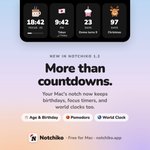



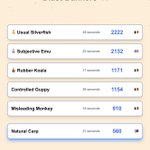

Added more tools to Notchiko! ✨
🍅 Pomodoro
🌎 World Clock
🎂 Age & Birthday tracker
See them all in your Mac notch.
Give it a try at notchiko.app

2
49

Hey @ratheejaisal 👋 please verify my founder.page account: founder.page/rossvethlopez
Verification code: FP-G49J

My little chikos just chilling with me today 🥰
Create your own countdown timers on your Mac notch!
notchiko.app
69
Happy 100 days til #Christmas 🎄🎉
Yes, it's a thing esp in our country!
To celebrate, made a fun little project..
Introducing Notchiko! ✨
Create countdowns for bdays, trips, and every day you're waiting for! on your Mac notch 😎
Pick your Chiko 👇
notchiko.app
Rossveth Lopez retweeted

How did I just learn about this? Apple has a marketing tool on their website to create marketing creatives for your app.
toolbox.marketingtools.apple…

I was so captivated by the story but what a twist in the end…

I chose the green door ninety-three days ago.
At the time, it seemed obviously correct. Not even a close call. The red door offered two billion dollars immediately—a sum so large it would solve every material problem I'd ever face, fund any project I could imagine, and still leave enough to give away amounts that would meaningfully change thousands of lives. But two billion is a number. It has a fixed relationship to the economy, to the things money can buy, to the world.
The green door offered one dollar that doubles every day.
I remember standing there, doing the mental math. Day 30: about a billion dollars. Day 40: over a trillion. Day 50: a quadrillion. The red door would be surpassed before the first month ended, and after that, the gap would grow incomprehensibly fast. Choosing the red door would be like choosing a ham sandwich over a genie's lamp because you were hungry right now.
So I walked through the green door.
The first few weeks were unremarkable. I had a dollar, then two, then four. By day ten I had $512, which felt like finding money in an old jacket. By day twenty I had over a million, and I started getting calls from financial advisors I'd never contacted. By day thirty-one I had crossed the two-billion threshold—officially richer than I would have been behind the red door.
I didn't understand what was happening until around day sixty.
The money, you see, had to exist somewhere. Not philosophically—I mean physically. Digitally. When I checked my bank balance, a computer somewhere had to store that number. And storing the number 2^n requires n bits.
One bit per day. That's it. That's the rate at which my fortune's representation grows. A linear function. Almost comically modest.
But here's what I'd failed to understand about exponential growth: the value doesn't care about the representation. The bits grow linearly. The dollars they encode grow exponentially. And dollars make claims on the physical world.
Day sixty. My balance: 2^60 dollars. About 1.15 quintillion. Roughly 1,000 times the entire global GDP. The number itself required only 60 bits to store—less than a tweet, less than this sentence, trivially small from an information-theoretic perspective.
But money is not information. Money is a claim.
The calls started coming from the Treasury Department. Polite, confused, increasingly frantic. They explained that the M2 money supply of the United States was approximately 21 trillion dollars. I now held about 15,000 times that amount. When I tried to spend any of it—even a tiny fraction—the transaction represented a claim on more goods and services than the entire human economy had ever produced in its history.
"The number in your account," a Treasury official said, "is not meaningful."
"It's in your computer," I replied.
"The computer," she said carefully, "does not understand what the number represents."
Day seventy-five. 2^75 dollars. I could purchase—in principle—roughly 350 million copies of the entire Earth's annual economic output. The representation remained elegant: 75 bits. Nine and a half bytes. I could write my net worth on a Post-it note in binary.
But representations aren't wealth. Wealth is factories, farmland, human labor, time, attention, atoms arranged into useful configurations. And I had laid claim to more atoms than existed.
This is where it gets strange.
The global financial system is, at its core, a system of ledgers. Distributed, reconciled, audited. When the Federal Reserve's systems recorded my balance, and Chase's systems recorded my balance, and the IRS's systems recorded my balance, those numbers had to match. And they did match—trivially, easily, using a handful of bytes each.
But then the systems tried to do things with the number.
Calculate taxes owed. Assess systemic risk. Determine what fraction of GDP was held by a single individual. Run inflation models. Price assets in a market that now included a participant with claims exceeding the value of all other claims combined.
Day eighty-two. The S&P 500 became undefined. Not zero, not infinity—undefined. My proportional ownership of the market, if I chose to exercise it, exceeded 100%. The shares I could theoretically purchase outnumbered the shares that existed. Financial models divide by market cap; market cap now included a term that broke the arithmetic.
Day eighty-five. The International Monetary Fund published a paper titled "On the Representability of Post-Scarcity Claims." It concluded that exchange rates could no longer be calculated because the dollar itself had become paradoxical—simultaneously the world's reserve currency and a unit of measurement that had lost all meaning.
My balance on day eighty-five: 2^85 dollars. Still just 85 bits. About ten and a half bytes.
The representation remained trivial. The reality it pointed to had become impossible.
Day ninety. I tried to buy a coffee.
The transaction failed. Not because of insufficient funds, not because of a technical error, but because the payment system could not determine a meaningful exchange rate. My card represented a claim on approximately 10^27 dollars. The coffee cost $4.50. The ratio between these numbers—the percentage of my wealth the coffee would cost—was so small that it rounded to zero in every floating-point system on Earth. I could not pay because the act of payment required representing a number smaller than any computer could distinguish from nothing.
I offered to pay in cash. I had a twenty.
The barista looked at me like I'd offered to pay with a seashell.
"Where did you get physical currency?" she asked.
That's when I realized: I had broken cash too. The Treasury had stopped printing bills three weeks earlier. Why maintain physical currency when one account holder could—at any moment—claim more dollars than had ever been printed in human history? The symbolic relationship between paper and value had always been a polite fiction, but my existence had made the fiction impossible to maintain.
Day ninety-three. Today.
My balance is 2^93 dollars: approximately 10^28. About 10 billion times the estimated value of all assets on Earth. The representation requires 93 bits. Twelve bytes. Smaller than my name.
The economy hasn't collapsed, exactly. People still trade, still work, still produce. But they've stopped using dollars. They've had to. A currency in which one person holds virtually infinite units is not a currency at all—it's a monopoly ticket that everyone has silently agreed to stop playing with.
I keep thinking about what money actually is. It's not the bits. The bits are trivial; they always were. It's not even the paper or the gold or the entries in a ledger. Money is a shared agreement about who has claims on what. A story we tell together about value and exchange and debt.
I broke the story.
Not through violence, not through fraud, not through any action more dramatic than walking through a door and watching a number tick upward. Just by existing. Just by holding a claim that grew faster than the world's ability to honor it.
The red door offered two billion dollars. A large but finite claim. A claim that fit within the story, that could be exchanged and spent and taxed and inherited. A claim the world could accommodate.
The green door offered something else entirely: a claim that would grow until it consumed all other claims, until the very concept of claiming became incoherent.
I still have the 93 bits. They're sitting on a server somewhere, humming along, doubling quietly at midnight. By next week they'll represent more dollars than there are atoms in the observable universe.
And I still can't buy a coffee.
6
2
283
Rossveth Lopez retweeted

Big news: Replicate is joining Cloudflare.
Replicate's going to carry on as a distinct brand, and all that will happen is that it’s going to get way better: it’ll be faster, we’ll have more resources, and it’ll integrate with the rest of Cloudflare’s Developer Platform.
replicate.com/blog/replicate…


Rossveth Lopez retweeted

Introducing Marble by World Labs: a foundation for a spatially intelligent future.
Create your world at marble.worldlabs.ai
My 12yo has been building games in Godot. Sharing this to him so he could build mobile apps!

Today, we’re officially releasing React Native Godot to the public.
For the first time, every React Native developer can create games with an amazing UI on top.
This unlocks a new era of apps and games.
github.com/borndotcom/react-…
1
95
Rossveth Lopez retweeted

It's finally time to announce what we've been working on.
Welcome to the all new Affinity.
Download now from affin.link/28b5 - welcome to the start of creative freedom for all, totally free. Forever.

Such a great read on innovation

My favorite essay I've ever written was on the theory of innovation (below, I removed the paywall). Such a fun topic to research and write about.
But it's 10x more fun putting all that theory into practice.
indiehackers.com/post/starti…

1
1
250
Been battling a 401 issue uploading to R2. LLMs kept repeating between CORS issue or presigned URL generation. Going on for 2 days!
Today decided to try grok. Explained it works on my machine (localhost)..
Turns out the issue was a TYPO in my env:
CLOUDFARE vs CLOUDFLARE
LOL!!
2
1
122
Rossveth Lopez retweeted

We're hiring!
We're looking for an email-focused Marketing Manager to help people get the most out of @Geocodio. If that sounds like someone you know, please send them our way!
geocod.io/careers-email-focu…

Rossveth Lopez retweeted

this is the MOST permissionless moment in history.
10 years ago, you needed investors, cofounders, an office, and 6 months of burn just to start a startup.
not anymore:
1. you want a startup idea → go mining on reddit, app store reviews etc
2. you want customers → build an audience
3. you want a beautiful software product → learn bolt, cursor, replit, lovable etc
4. you want to charge → stripe link. done.
5. you want distribution without using your face → partner with a niche creator. their trust is your launchpad.
6. you want ops → string together GPT-4o + Claude + Gumloop/Lindy/n8n agents
7. you want an office → kitchen table + noise-canceling headphones
8. you want exceptional advisors → binge 1000 hours of podcasts + you can DM anyone on the planet
9. you want momentum → ship something small today. the rest figures itself out.
no gatekeepers. no resumes. no permission needed.
you need consistency, taste, and internet access.
the startup school is open 24/7.
enrollment is free.
but shipping is the tuition.
there are no excuses anymore.
Rossveth Lopez retweeted

How to get the most out of life and work with anyone you want.
Do permissionless projects.
Went on @mhp_guy's pod to share how I've been able to get in rooms I don't belong in by doing things without permission for people that fire you up.
We talk through the projects and how to do them.
TLDR;
1. Look up canvas strategy by Ryan Holiday. (its a blog from 2008 - gets better with time)
2. Pay $1 and get @visualizevalue permissionless apprentice. (1000x minimum ROI guaranteed)
3. Find someone/something that fires you up.
4. Do a project for them. Send it to them.
Watch the pod and get some ideas on how you can change your life.
Take action on the ideas and then tell me about the results.
Good luck, have fun.
If you want the deck I walk through on the podcast, just DM.