

GPU Software @ NVIDIA - Creator of PyG (PyTorch Geometric) - Founding Engineer @ Kumo - PhD @ TU Dortmund University - Graph Representation Learning
Dortmund, Deutschland
Joined November 2017
- Tweets95
- Following153
- Followers3.3K
- Likes303


Pinned Tweet
It's good to be back in open-source! 🚀 Alongside Kumo Tabular, we are releasing our NVIDIA Kumo engine, a GPU-accelerated library of foundation models for structured data (TabICL, TabFM, etc).
Code: github.com/NVIDIA/structured…
Blog: huggingface.co/blog/nvidia/k…
A thread 🧵


I’m very excited to share @nvidia Kumo Tabular, a new family of foundation models for tabular data.
Kumo Tabular establishes the new Pareto frontier across the entire accuracy–inference-time tradeoff.
Just as importantly, we are releasing it openly: open weights, open-source software, and a permissive license for commercial use.
HuggingFace: huggingface.co/nvidia/Kumo-T…
GitHub: github.com/NVIDIA/structured…
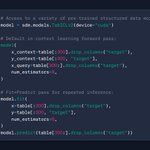
We wanted an in-context learning interface that can go beyond single tabular data and support diverse model families (relational, forecasting, natural language). For example, for multi-table workloads, we can attach additional related tables to context and prediction examples.
We have included reusable neural network building blocks, shared across model implementations whenever possible. This helps us to not only improve efficiency and peak memory of Kumo Tabular but all tabular foundation models (e.g., via Transformer chunking or output buffer reuse).
There’s plenty more we want to build, and we hope we give the community a useful starting point for studying and extending these models. Shoutout to my amazing coworkers for making this happen: @jure @VHudovernik @aki_bayes @JingangQu and others.
The engine allows us to demystify preprocessing of structured data models via generic recipes. TabICL or TabFM may not support datetime or text features. Here, they are just a line of code away. In ensembling, recipes get executed in parallel for maximum efficiency.

We put a lot of thought into its design: from ingestion and preprocessing to model interfaces and execution. Every data modality (numerical, categorical, text, datetime, ID, etc) is supported via its own tensor subclass, allowing for end-to-end GPU processing.

Matthias Fey retweeted

TGM is accepted to #ICLR2026 🚀
We are also releasing TGM Beta 2, continue to build efficient, open library for temporal graph ML. Thanks to my team: Jacob Chmura, @ntgbaoo87, @aliparviza, Farimah Poursafaei, @jure, @mmbronstein, Guillaume Rabusseau, @rusty1s, Reihaneh Rabbany.
Matthias Fey retweeted

🚀 Announcing RelBench V2, a major update to our benchmark for foundation models on relational data!
With V2, we are significantly expanding the benchmark’s scope to catalyze further research in Relational Deep Learning (RDL) and Relational Foundation Models (RFMs).
Key features:
🍺 4 new databases, spanning domains like e-commerce and beer reviews to scientific research and clinical healthcare.
🧩 40 new predictive tasks, including 28 autocomplete tasks, across new and existing databases.
🔌 External data integrations: 70+ datasets from CTU, 7 datasets from 4DBInfer, and your own data via SQL connector, all in RelBench format.
🛠️ Bug fixes and performance improvements.
🔥 Introducing autocomplete tasks: As opposed to forecasting tasks, autocomplete tasks predict existing columns in the database. We found that models need to deeply understand the relational context to autocomplete database fields, a critical capability that expands the scope of real-world RDL applications.
Learn more:
🌐 Website: relbench.stanford.edu
💻 GitHub: github.com/snap-stanford/rel…
Huge thanks to @justingu32 @_rishabhranjan_ @jakub_peleska @VHudovernik @CKanatsoulis @fengyuli607, Tang Haiming, Alistiq and everyone else who contributed to our GitHub for making this possible!

Matthias Fey retweeted

Although relational databases are everywhere, there is no equivalent of the public internet for pretraining Relational Foundation Models (RFMs). Excited to see RelBench bridging that gap, growing from 7 datasets in v1 to 88+ datasets in v2.
Deeply grateful to the numerous community contributions for helping RelBench serve as the central data repository for RFM research. ❤️
🚀 Announcing RelBench V2, a major update to our benchmark for foundation models on relational data!
With V2, we are significantly expanding the benchmark’s scope to catalyze further research in Relational Deep Learning (RDL) and Relational Foundation Models (RFMs).
Key features:
🍺 4 new databases, spanning domains like e-commerce and beer reviews to scientific research and clinical healthcare.
🧩 40 new predictive tasks, including 28 autocomplete tasks, across new and existing databases.
🔌 External data integrations: 70+ datasets from CTU, 7 datasets from 4DBInfer, and your own data via SQL connector, all in RelBench format.
🛠️ Bug fixes and performance improvements.
🔥 Introducing autocomplete tasks: As opposed to forecasting tasks, autocomplete tasks predict existing columns in the database. We found that models need to deeply understand the relational context to autocomplete database fields, a critical capability that expands the scope of real-world RDL applications.
Learn more:
🌐 Website: relbench.stanford.edu
💻 GitHub: github.com/snap-stanford/rel…
Huge thanks to @justingu32 @_rishabhranjan_ @jakub_peleska @VHudovernik @CKanatsoulis @fengyuli607, Tang Haiming, Alistiq and everyone else who contributed to our GitHub for making this possible!
Matthias Fey retweeted
Transformers are great for sequences, but most business-critical predictions (e.g. product sales, customer churn, ad CTR, in-hospital mortality) rely on highly-structured relational data where signal is scattered across rows, columns, linked tables and time.
Excited to finally share what I have been working on over the last year: a Foundation Model architecture which brings the power of Transformers to relational domains, enabling large-scale pretraining and zero-shot generalization in enterprise settings. 🧵1/n

ALT Title and abstract of the paper.
Excited to announce Relational Foundation Models, moving supervised Relational Deep Learning into the in-context learning setting:
✅On-the-fly training-free predictions
✅Impressive out-of-the-box performance
Paper: shorturl.at/M6ciN
Try For Free: kumorfm.ai

Matthias Fey retweeted
🚀 Introducing KumoRFM — the world’s first Relational Foundation Model purpose-built for enterprise prediction tasks!
KumoRFM reasons over complex relational data to deliver instant, accurate, in-context predictions — no task-specific model training required. A true game-changer for solving key business problems like:
✅ Product recommendations
✅ Fraud detection
✅ Customer retention
🔗 Explore KumoRFM: kumorfm.ai
📄 Read the paper: kumo.ai/research/kumo_relati…
💡 Learn more: kumo.ai/company/news/kumo-re…
#AI #EnterpriseAI #RelationalAI #FoundationModels #MachineLearning #KumoRFM #PredictiveAI4o
Matthias Fey retweeted

Introducing the new Kumo platform: Build predictive and embedding models directly on your relational data — without feature engineering. Go from predictive modeling to predictive AI.
hubs.ly/Q035xfgP0
Matthias Fey retweeted

🎉 Excited to announce the release of ContextGNN, our state-of-art and scalable recommendation model from Kumo!
🔗 ContextGNN paper: arxiv.org/abs/2411.19513
What makes ContextGNN unique?
It combines pair-wise and two-tower representations into a single architecture, enabling GNN-based recommendation systems to capture both repeated patterns and exploratory user preferences.
💻 Source Code on GitHub: github.com/kumo-ai/ContextGN…
This milestone wouldn’t have been possible without the incredible collaboration of my amazing colleagues. Thank you all for being part of this journey! 🙌 (Shoutout to: @zechengzh Xinwei He @aki_bayes @weihua916 @yaoyaowd @manans99 @shenyangHuang @BlazStojanovic Alan Krumholz @janericlenssen @jure @rusty1s @Kumo_ai_team)

Matthias Fey retweeted
💠 Stanford Graph Learning Workshop 2024! Join leaders from academia and industry to explore the latest in Machine Learning and AI. Topics include Relational domains, Foundation Models, Agents and more.
Save the date: Tuesday, Nov 5, 2024, 09:00 - 18:00 PT. The event will be held at Stanford University and live-streamed online.
Register and/or submit a talk/poster: snap.stanford.edu/graphlearn…

PyG 2.6 is here, including new models and examples on how to combine GNNs with LLMs! Thanks to many contributors who have made this release possible.
Full release notes👇
github.com/pyg-team/pytorch_…


Matthias Fey retweeted
🚀 Announcing RelBench: an open benchmark for deep learning on relational databases! RelBench is the foundational infrastructure for research in Relational Deep Learning (RDL), which brings modern AI to structured data.
RelBench has databases, tasks, loaders, evaluators, and leaderboards to catalyze research in the field!
Key features:
🌍 7 datasets spanning diverse domains: e-commerce, social, medical, and sports.
🧩 30 carefully curated predictive tasks: including entity classification/regression and recommendation.
📊 Wide data size range: ranging from 74K to 41M rows, 15 to 140 columns, 3 to 15 tables.
⏳ Wide time spans: from 2 weeks to 55 years of training data.
🏅 Comprehensive benchmarks: SOTA tabular learning and GNN baselines for every task.
🔥We hired a data scientist with 5 years of industry experience to solve RelBench tasks using traditional machine learning (feature engineering, model training). The RDL outperforms the data scientist in accuracy while reducing the time/code by 20x (12.3 hors -> 0.5 hours) !!! 🤯
Learn more:
🌐 Website: relbench.stanford.edu
📄 Paper: arxiv.org/abs/2407.20060
💻GitHub: github.com/snap-stanford/rel…
Follow @RelBench for the latest updates
Shoutout to the amazing team: @Josh_d_robinson @_rishabhranjan_ @weihua916 @KexinHuang5 @jiaqihan99 @adobles96 @rusty1s @janericlenssen @yiwenyuan98 @zechengzh @xhe1997 @Kumo_ai_team @PyG_Team @StanfordAILab

Matthias Fey retweeted

Check out our PyTorch Frame tech report arxiv.org/abs/2404.00776
We aim to push tabular deep learning to handle complex multi-modal, multi-tabular data, beyond conventional single-tabular data. We do so by seamlessly integrating PyTorch Frame with LLMs and Graph Neural Nets!


🚀🎉 Excited to announce 🌟 PyTorch Frame 🌟 - our new open-source initiative in PyTorch! Dive into multi-modal tabular deep learning like never before!
Link: github.com/pyg-team/pytorch-…
#PyTorch #OpenSource (1/6)
