💰 Helping Solo Business Owners and High W-2 Earners Plan/Save on Taxes ⭐️ Ex-Financial Advisor 👨🎓 Free Course with 12 Tax Saving Strategies⬇
San Diego, CA
Joined November 2018
- Tweets5.6K
- Following584
- Followers2.4K
- Likes37.5K
Pinned Tweet
To anybody with a full-time W-2 and a side hustle:
You can open a solo 401(k) for your side hustle and make up to $72K in contributions/mega backdoor Roth contributions for 2026
On top of whatever you put into your company W-2 401(k) plan
Employee contributions are the only aggregate max between the two plans
Example:
Let's say I make $200K as a W-2 and contribute the full $24.5K as an employee to my company plan. Then my company matches 3%, so on $200K of wages, they put in another $6K. Total contributions = $30,500. Now let's say I also have a side hustle that makes $80K net. I could, if I wanted, open a solo 401(k) plan for this side hustle and put a full $72,000 into this plan through employer and mega backdoor Roth contributions. All mega backdoor Roth contributions grow tax-free, and the employer contribution is maxed at 20% * $80,000 minus 1/2 self-employment tax for a deduction on 2026 taxes
Such a good option as we approach a 12/31 deadline

A while back, a friend making $89K/year DM'd me asking what he should do with his finances.
My advice is still the same.
Here's what I said:
+ Open a high-yield savings account (Ally, Amex, Cap One 360)
+ Put three months of expenses in here
+ Open a Roth IRA
+ Open a regular taxable brokerage investment account with Fidelity or Vanguard
+ Roth contributions to 401(k), only enough to get the company match for now
+ 100% equities in the 401(k) vs. being in a target-date fund. No reason to have bonds since he is 24 and not risk-averse
+ Max out Roth IRA every year
+ Invest in the S&P500; no need for anything else. Maybe some IBIT if he wants bitcoin exposure
+ Automate $1000 per net paycheck to his taxable brokerage investment account
+ Automate $500 per net paycheck to his high-yield savings. This pays for travel or any near-term savings goals he has/unexpected expenses on top of the 3-month savings I suggest for him
Perhaps adjust for paying off student loans and ideally keep roommates so housing expenses remain very low
Stay on parents' health insurance plan and cell phone plan
Then go out and make more $. I don't know how else to say this. Forget the tax stuff (other than doing a Roth IRA and Roth contributions to his company 401k). Forget picking stocks or worrying about asset allocation (even doubling his money on a $5K investment is $5K). Pointless. Figure out how to make another $50K a year so that you have $50K more to work with every single year. Sales is the highest upside that I see. Network matters a ton. People love to help the young guy or gal getting after it.
Just my perspective. Anything that anybody would add?
1
2
549


CASE STUDY POST: Senior territory sales director. Married. 2 kids. Lives in California. Makes $1m/year in 1099 income paid to his LLC taxed as an S corp.
He's got great foundational stuff in place with his CPA but things still feel reactive and feel like strategic moves are being missed. He's right. We did a quick call and here's what I was able to point out in a short 20-minute intro call:
1.) $100K salary from his LLC. Great that his LLC is taxed as an S corp but the salary is too low. 1.) Good luck defending it in an audit. 2.) It's causing him to pay too much in tax. His current QBI deduction = roughly $50K, when it should be closer to $150K. A $100K missed deduction at a 37% federal tax rate is a $37,000 overpayment in tax. Every. Single. Year. Yes it increases his payroll tax but the net net benefit is still $25K+/year and it allows him to get more deductions with retirement contributions which I mention below
2.) SEP IRA. Every time I see a SEP IRA I know somebody is missing good tax strategy. With his $100K salary he's only been able to do a $25K deductible employer contribution. With his new salary closer to $300K, he could do a full $72K contribution to a SEP IRA but even this would be wrong. Much better to do $24,500 as an employee pre-tax deferral and then $47,500 as an employer contribution to a solo 401K. This gets him a higher QBI deduction mentioned above. Plus he can roll his existing SEP IRA to the new solo 401(k) so that he can do a backdoor Roth at $7,500/year moving forward.
3.) Backdoor Roth for his wife even though she isn't working, spousal contribution
4.) Wages for the kids and custodial Roths. Pay them up to $16.1K/year for real and legit work at a fair rate. Every $1 paid to a kiddo spreads income from his 37% federal and 12.3% state tax rate to their 0% tax rate. It also allows them to contribute up to $7,500 a year to custodial Roth IRAs for tax-free growth. Those funds can then be used for college planning, downpayment on a house, starting a business, etc. - anything that him and his wife would like to do to help their kids get ahead
5.) Some adjustments to his asset location. REITs and bonds in his regular brokerage account are getting taxed at over 40% per year. Not very efficient. These can be moved to ideally pre-tax retirement accounts, then put aggressive investments in tax-free Roth accounts, then ETFs and index funds and such in his regular taxable brokerage account
Then we can have a deeper discussion on other stuff like a cash balance plan, adding his wife to payroll and then adding her as a participant in his solo 401(k) plan so that she can do up to $72K/year in tax-advantaged contributions or 100% of her wages, etc. Direct indexing would also be a great win for him since they have a large taxable brokerage account with large unrealized gains that he'd owe 30.1% tax on for every dollar of gains. Very very important that we are meeting now before a 12/31 deadline on a lot of this
1
1
334
My plan to pay $0 in lifetime capital gains tax
I already have a taxable brokerage account that I've been funding over the last 10ish years
My "problem" is that any time I sell a position in this account I owe 15% federal long term cap gains tax, 9.3% state, and 3.8% NII tax. 28.1%. Every $100K of capital gains = $28,100 tax bill
So here's what I've been doing to reduce/completely offset this tax for future planning:
1 - Started a direct index strategy. I've talked about this way too much already but for great reason and it's been a great addition to my personal planning. I no longer invest in index funds in my taxable brokerage account. All weekly investments go to direct indexing now and have gone here for the last year or so. This still tracks my chosen index (S&P500) for .09%. Yes there can be tracking error but not nearly enough of a concern for me to not use this strategy. All I do is automate this and let losses accrue over time and watch my investment go up (hopefully).
2 - The losses that build over time with direct indexing allow me to sell portions of my taxable brokerage account without paying a capital gains tax. I choose tax lots with minimal gains for now to free up more cash quicker. Proceeds then get used to fund more direct indexing but where it gets even more fun is using proceeds to fund my solo 401(k). $70K last year and $72K this year. There can be separate debate on Roth vs. pre-tax here but let's say I do all mega backdoor Roth here - those contributions grow tax-free forever since they are in a tax-free Roth account and I maintain liquidity since principal contributions for this can be taken out tax-free and penalty-free anytime. Example: $142K of contributions grows to $242K. The $100K of gains is tax-free and the $142K can be withdrawn any time and for any reason. Now imagine the savings over 10, 15, 20, 25, 30 years God willing
^^ If I wanted to take step 2 further I can add my wife to payroll and assign her a reasonable salary of $72K for marketing work in my company (she already helps with all of this - emails, posting, DM outreach, etc). This could shelter another $72K in 2026 and more over time as the limits increase
Then the flywheel builds and builds.
Then to avoid making this all one big tax deferral I can die with the investment and my heirs get a step-up in basis on the account. I can try to hit the 0% capital gains tax bracket in early retirement or retirement. I can borrow against the funds and live off of those proceeds (then when I die the loan is paid back before the rest goes to my estate).
All fun to think about and we'll see how it adjusts with goals, values, etc but the clear problem this solves for me is not paying 28.1% on every $1 of capital gains I have
1
3
388
A fun tax angle on this
I have a reservation to get the now-discontinued Cybertruck AWD for $59,990
Let's say I resell for $79,990 in less than a year
I'd have a $20K short-term capital gain and would owe 32% federal and 9.3% state tax and 3.8% NII tax on this
Aka $9,020 in tax
With a direct indexing strategy to harvest losses that gets $30K of losses in 2027, I owe $0 in tax
@grok verify in the comments for me please

If you want to know how already insane the Cybertruck market is now that production will end in the middle of 2027, here you go.
This $59,990 (at one point) Cybertruck AWD is now being resold at an Audi dealer for close to $91,000.

1
503
Ryan Odom retweeted

Most people wait too long to deal with their taxes
If you’re a business owner or high earner, you can’t afford to be reactive
We are getting to the last couple months of the year
Any real tax planning needs to start now!
Somebody walk me off the cliff
Planning on dropping my Kaiser Bronze high-deductible health plan. Current premium is $375.69. Just me. $7,200 deductible. Haven't been to the doctor in years. Use Function Health to get full blood panel done twice a year. Would likely go to CrowdHealth and do a $15K plan before the "crowd" steps in. $90/month premium. Which feels like where it should be
Thoughts?
Would lose about a $1376 tax savings for HSA

3
4
1,034
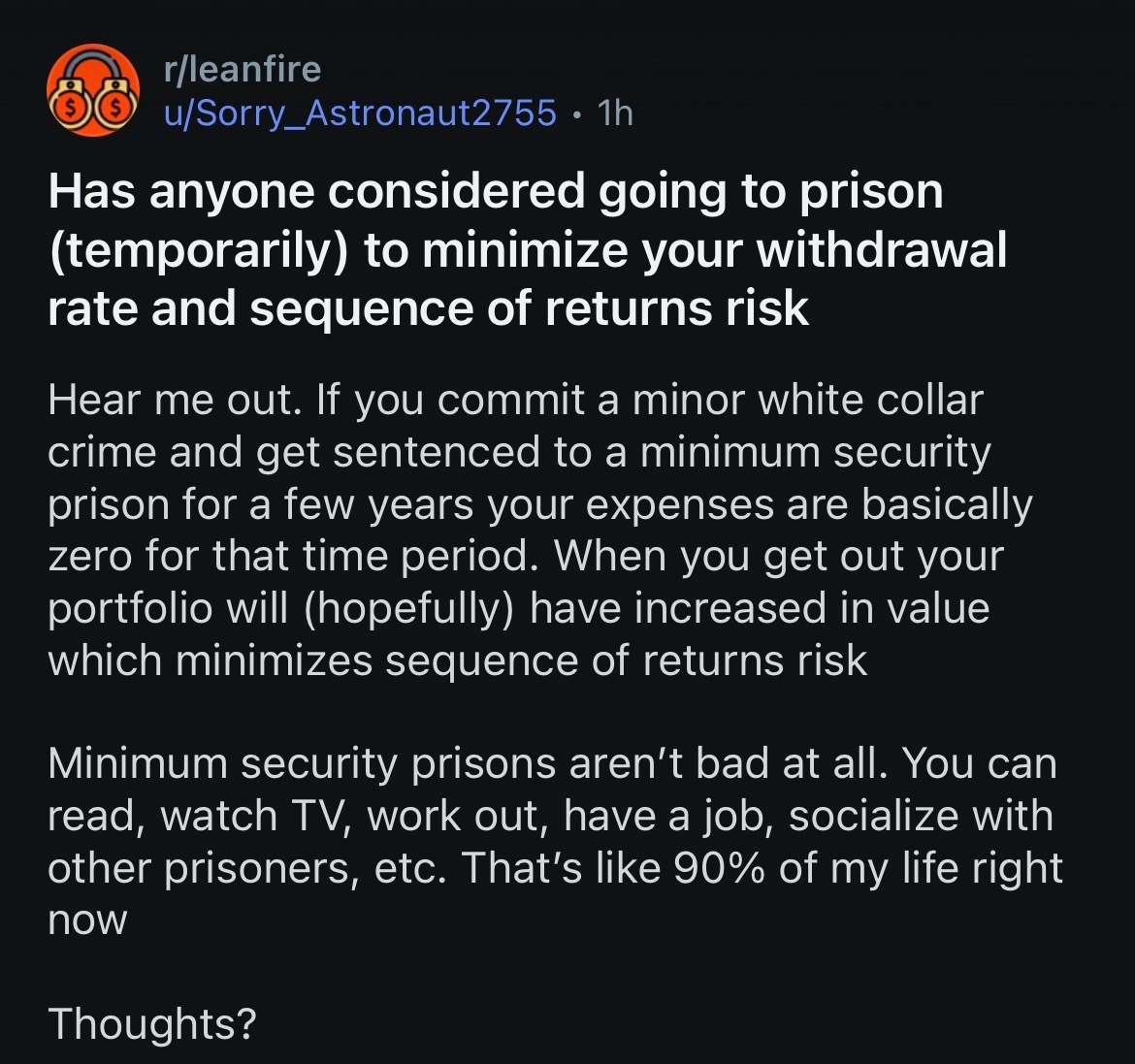
Things I like about this strategy:
- Can't mess up a good plan by being a human (logging into accounts too much, actively trading, trying to time the market with elections, wars, debasement of the dollar, the New World Order, etc.). Just have to sit back and socialize/survive in a minimum-security prison
Things I do not like about this strategy:
- Prison

1
384
I run a 1-person business in California
If I did no tax planning or strategy, I'd owe $260K+ in taxes between federal, state, and self-employment taxes
Here's every move I make (and why):
1 - LLC that elects to be taxed as an S Corp. By electing S Corp, I pay self-employment taxes (payroll) on the reasonable salary I set up myself instead of all of my earnings. Example: $150K salary and $450K in distributions saves about $19.5K in self-employment taxes. Every. Single. Year.
2 - Maximize the QBI deduction. I get a $0 QBI deduction since I am a SSTB (specified service trade or business) but I'm putting it here since so many people miss this. I wouldn't want the lowest possible reasonable salary since I'd miss a good chunk of QBI deductions and my salary could be seen as unreasonable. I also don't want a salary that is too high or I'd pay too much in payroll tax. The goal is to find the sweet spot. Example: $60K salary is a $30K QBI deduction versus a $75K QBI deduction on a $150K salary for non-SSTBs at this income level. Big difference. Plus the low salary limits how much I can put into a solo 401K
3 - Solo 401K. This is an easy one and I talk about this way too much. Please don't use a SEP IRA. I could use this to get a $61K tax deferral but I prefer to use this for after-tax contributions rolled to my Roth IRA. This gives me liquidity and access to every dollar I put in tax-free and penalty-free anytime (not locked up till 59.5) and it'll add up to millions in future tax savings by avoiding 28.1% capital gains tax (15% long-term capital gains tax, 9.3% California, and 3.8% net investment income tax)
4 - Pay CA state income taxes through my business. My business elects to pay my state taxes and then I still take a standard deduction on my personal return. Allows me to double dip and a great way to bypass the SALT cap of $40K or $10K if income exceeds $505,000
5 - Track expenses and keep good books. It's not about being perfect here but bad books = wasted money. All business-related stuff goes on a business card and then an accountable plan is used to reimburse myself for my home office, % of utilities, vehicle, etc.
6 - Augusta rule. One I added this year. My business rents my full apartment from me 1x a month to create content, record higher production value videos vs. what I can do in my home office, review marketing, financials, etc.
Then some other things I do/will do that add up:
- Backdoor Roth
- HSA
- Hire wife and add her to the solo 401k plan. Max it at $72K/year with mega backdoor Roth
- Hire kids to spread the income to 0% tax brackets and do custodial Roths
- 529 plans, minimal but some to get up to the $35K # that can be rolled to a Roth
- Trump accounts to backdoor $ into my kids' Roth IRAs
- Automate and not mess up my plan by being a human (picking stocks, selling, trying to time markets, etc)
- Direct indexing
- Cash in California municipals or US treasuries for a higher tax-equivalent yield
- Asset location
2
5
665
Added a US small cap direct index to my plan in Dec of last year.
Very happy with the results. Gets a bit more in losses than my S&P500 direct index.
Up 18.58% YTD and it has $5,363 in losses harvested YTD.
I've posted about direct indexing a handful of times in the past and why I added it to my plan. If you're interested in learning more and whether or not it might be right for you, I did a past webinar discussing why I love it, who it might be great for, etc. Just comment below or DM me and I'll send you the webinar replay

This is wild
I ran some #s on my 2026 tax liability if married vs. not married. Let's say I make $600K this year as a 1-person business in California.
Option 1 - File single and do no tax strategy. Approx $260K in tax owed between federal, state, and self-employment taxes.
Option 2 - File single and do tax strategy. Approx $190K in tax owed, assuming I do an S corp with a reasonable salary, do a solo 401k, PTET election, Augusta rule, etc. (I'm not including backdoor Roth, mega backdoor Roth, direct indexing future tax savings for simplicity).
Option 3 - Legally get married and file jointly. Approx $98K in total tax. Mostly because I can legally add her as an employee to my company for work she does, add her to the solo 401k plan, have her max out contributions, and then we are under QBI deduction phase-out numbers. Aka get $55K deduction that I currently don't get.
So, what would you do? 😂
This is oversimplified, but it shows the progression of how fun great strategy and tax planning can be
2
5
610
Just keep buying
Seen so many people sit on the sidelines since 2017, 2018, 2019 when I entered financial services and then 2022, 2023, 2024, 2025, 2026.


Once again, I'll share my favorite loophole in the US tax code as we're in the back half of the year
The IRS says if I make over $168K filing single or $252K married filing jointly in 2026, I cannot contribute directly to a Roth IRA. But, thanks to the US tax code, I can still get funds into a Roth IRA every single year (up to $72,000 in the 2026 tax year).
It's called the mega backdoor Roth, and here's how it works:
1 - See if your 401K plan supports the mega backdoor Roth strategy. You need the ability to make "after-tax" (not Roth) contributions to your plan and the ability to do "in-plan Roth conversions" or "in-service distributions of after-tax contributions to a Roth IRA." Note: A solo 401k plan is by far the easiest way to set this up. Most 401k plans don't support this strategy with the exception of a handful of big tech companies-Tesla, Apple, Amazon, Uber, Google, Samsara, Salesforce, Uber, etc.
2 - Contribute. Everything you put in grows completely tax-free, and depending on what your plan supports, you have the ability to withdraw what you put in tax-free and penalty-free anytime (not "locked up" till age 59.5). Example: I contribute $72K as a mega backdoor Roth to my solo 401k plan. I can take out this $72K contribution anytime, tax-free and penalty-free, 10 days from now or 10 years from now. And my investments grow tax-free.
That's it.
There are a few nuances in here, so work with your financial pro or reach out to me if you're interested in seeing if this is something you can do. As a fun note,
if somebody has a W-2 plus an eligible side business, they can max out both plans and get up to $144K sheltered between the two plans; the only aggregate max is the $24.5K employee deferral. Example: Max out company 401K pre-tax with a $24.5K employee deferral, get a match, and do the mega backdoor Roth up to the $72K plan limit, and then get up to $72K into the separate solo 401k plan with a $0 employee deferral, optional company contribution, and then a mega backdoor Roth up to the $72K number. $144K total. Fun stuff. Then, stack a regular backdoor Roth on top of this for another $7.5K that grows tax-free :)

6
884
I thought I knew a lot about running.
Just run the miles. Get shoes that fit. Not that hard. Then I paid for a running coach. Then, I realized I knew nothing. Had all these blind spots that were hurting my progress. Nutrition (turns out no veggies isn't ideal). Form. Tempo runs. Progression runs. Deloads. Lifting to maintain strength. Etc. Just didn't know what I didn't know.
There are lessons in this.
Here are the lessons I picked up:
1 - When I paid somebody, I took it seriously.
2 - Blind spots are blind spots for a reason. Too close to it and can't see it. Can't tell you how many times I see this with finances/tax planning.
3 - Knowing what to do and actually doing it are 2 very different things. Example: I know to sleep more, lift heavier, etc but that does mean I do these things. Figure out what needs to be in place so that the things you know you need to be doing get done (community, paying somebody, etc)

1
293
32-year-old
Makes about $160K base in his W-2 and another $60K net in 1099 income for consulting work he does. Wife makes another $100K/year as a W-2, and they have 2 kids
Before we talked/started working together:
+ Sees my posts
+ Knows there is more stuff he can do but never gets around to it
After we talked/started working together:
+ Confirmed to him that electing S corp on his 1099 consulting wouldn't save him anything in self-employment taxes and would only add the hassle of having to run payroll/file an additional business tax return
+ Confirmed that a SEP IRA could be set up but this would be silly and if he's learned anything at all from my posts, a solo 401k would be the far better option for him
+ Set up a solo 401k not with Fidelity or Schwab so that his plan can support the mega backdoor Roth
+ Claim the $1,500 EACA tax credit for setting up this solo 401k plan ($500 a year over three years)
+ Use the solo 401k specifically for the mega backdoor Roth strategy and not pre-tax employee deferrals or employer contributions since he doesn't want to lock up funds till he is old. Example: Up to his net income minus 1/2 self-employment taxes can be mega backdoored to a Roth IRA which gives him full liquidity/access to his contributions and the account grows tax-free forever. About $58K for him. Fun numbers.
+ Backdoor Roth for him and for his wife. $7.5K each. No issue with pro rata since they don't have rollover IRAs
+ Investments remain simple. VOO. QQQ. Some international. No input from me here; it's the tax code/account being used that makes the same dollars go way further (funds growing in a tax-free account vs. taxable brokerage)
+ His and her 401k contributions are remaining the same. Just contributing up to their company match
+ They adjusted their 401k investments to not be in target date funds since they agreed don't need bonds in their retirement accounts/understand these specific dollars are a 20+ year time horizon
+ 529 plans are opened for the kids and doing $100/month here. No changes made
+ Trump accounts discussed. They've opened them and will likely contribute $100/month to this account as well with the plan to convert to Roth at age 18+. Just have to plan around the kiddie tax
Not much else. Years of procrastination solved in less than 2 hours or so and then it becomes maintenance/iterate from here as things change. I have a consult offer running this week for anybody reading this and interested in doing something similar. Great fit for people in a similar situation
3
400