

Staff Creative Technologist, Web & AI at @prismicio. Building practical AI workflows, content systems, autonomous websites, and small products in public.
Sweden
Joined October 2009
- Tweets1.4K
- Following243
- Followers326
- Likes1.4K






Every rule we give an AI agent is really a bet on what the model can’t do yet.
“Always run the full test suite” is a bet that it won’t know when testing matters. A separate planning agent is a bet that it can’t plan and work at the same time. “Double-check your sources” is a bet that it won’t bother on its own.
When we created them, most of these were good bets. The problem is that nobody goes back to check them when a new model comes out.
Anthropic just cut more than 80% of Claude Code’s system prompt for their stronger models. That’s a lot of bets that stopped paying off.
The best way I’ve heard of to keep track of this came from an engineer who worked on Cursor’s agent harness. His team logs every temporary guardrail each time it fires. When one stops firing, a bot opens a pull request to delete it. In other words, they check their bets all the time instead of once in a while.
It works the other way too. In areas where models still struggle, you place new bets. Outside of coding, some teams are adding guardrails back instead of removing them.
So the harness is never really done. It’s a list of bets that needs checking every time the model changes.
The bets that keep paying off for companies tend to be about what the model can’t know, not what it can’t do: how your team works, what your customers care about, what good looks like.

41
My morning routine these days: coffee, then check which part of the internet broke overnight. Yesterday it was Node.js. And PHP. Same day.
The Node.js one was a bad one. Someone could potentially run their own code on your server. For teams hosting things themselves, that most likely meant a long evening of checking and updating.
It also reminded me why I keep recommending managed hosting. @vercel added WAF rules for it within hours, basically filters that block the attack before it reaches your app. Every project on their platform got them automatically. I read about it in a tweet and thought, yeah, this is what the money goes to.
Managed hosting gets called expensive a lot, and I get that. On the invoice you see compute and bandwidth. You dont see the people who jump on it when something like this comes out so your own team doesnt have to.
You still need to update your stuff afterwards. But Id take doing that during a normal workday over doing it at midnight.
Every damn day I see another panic post about AI taking our jobs. But look at which jobs, or parts of jobs, it’s actually taking.
Most of them weren’t really “human” jobs, but something closer to computer jobs we gave to people because the computers weren’t ready yet.
Writing meta descriptions for 500 product pages. Resizing a banner into 31 different formats. Typing out the same boilerplate code for the hundredth time. This sort of work fueled whole industries.
People did this work the same way every time, with machine-like precision, often leaving their own judgment at the door. Then we measured them on how well they did it.
But the machines have now caught up, and they’re better at being machines than we could ever be.
You can see this as a loss. I see it as a chance to bring back all the things we left at the door.

4
170


The new tech literacy isn't even being taught yet.
A colleague asked me something this week I struggled to answer.
Five years ago he wanted to leave marketing and become a developer. The path was clear, back then - learn Python, then JavaScript, some database basics, build a few projects, land a junior job. Then you're away.
His question was, if he were starting today what should he do?
That path is mostly just... gone.
I’m an experienced developer and I honestly don’t know how I’d start now. Knowing how code works is still huge leverage. But learning code the old way, one language at a time, makes less and less sense. The opportunity cost is sky high.
My best answer so far has three parts.
- First, learn the foundations, not the syntax. How code runs. What data is, how it moves, where it lives. What a file system is, what a loop is, what an MCP is. These mental models carry across languages and tools.
- Second, get good at cutting through the noise. There are a dozen ways to do anything with AI and having the judgement to pick the best one is a key skill.
- Third, bring something the AI doesn’t have. Mario Zechner, who built Pi, showed his wife, a linguist, how Claude Code works. It transformed her work, because she brought a deep domain knowledge. Combined with AI, it's rocket fuel.
I think we’ll see a lot more of these hybrid people. They won’t have a classic dev career, but they’ll be technical enough to build properly in their own field. Some of them will do incredible things.
That’s the new tech literacy, and nobody is really teaching it yet.
What's the best app to run Herdr from iPhone? I tried Moshi and Termius, but quite tired of subs.
Debating on building my own native one, or just use github.com/devswha/herdr-web…, but want to know if there's something better out there that I missed.

This! Been thinking of my own shed lately. It’s definitely compelling, both as a tech nerd that loves the setup, but also separating my AI-agents from my main OS and its files!

Every developer needs an AI shed: An always-on machine running on their tailscale network where the majority of their herdr agents are running.
1
88


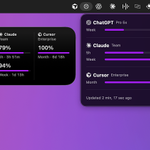
I needed a tool today. So I didn't go looking for one. I had AI build it while I kept working.
The problem: I wanted a quick glance at my AI usage across Cursor, Claude and ChatGPT. Checking each one separately is tedious, and T3 Chat doesn't show Cursor for some reason.
The idea: a native macOS widget.
The process:
→ One prompt to Claude Opus 5.5. Ten minutes later: a menu bar app plus a widget in three sizes.
→ One more prompt for a nicer design. Five minutes later: done.
15 minutes total, and I never stopped doing my actual work.
Fifteen minutes from annoyance to app. I'm still not used to that.

1
128
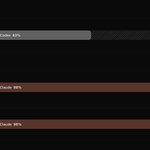
I must say that Opus 5.5 excels in its intelligence-to-usage ratio. I've been using it almost exclusively today, and I'm down to 96% on the weekly. Well done!

34
Homepage updates at Prismic used to mean manually pulling context from 5 different tools. So we built a small agent to handle it.
We already collect useful customer workflows and the evidence behind them in our internal learning system, based on how people use our tools. We wanted to see if we could use that to prepare website updates, without someone having to pull all the context together each time.
The setup is pretty simple. We built it in ChatGPT using connectors and some Markdown files with the instructions and rules. No crazy agent backend or centralized cloud setup. We wanted to try this on our own website first, with something others could easily replicate if it works well.
It runs every day on a schedule:
- Reads opportunities and their supporting evidence from our internal learning system through its MCP.
- Compares them with what's already on the homepage and the agents own logs, so we don't keep trying the same thing.
- Checks Amplitude and Ahrefs for data that supports or challenges a proposed change.
- Reads our voice and style guides through the Notion connector before drafting.
- Uses the Prismic MCP to prepare eligible edits in a release for us to review, then reports back in Slack.
For now, we've limited it to one section of the homepage. There's Markdown setting files that defines which fields it can change and when it should hold off. It can prepare a release, but we still decide what gets published.
Keeping the setup simple also gives us a way to share it later. We could package it as a plugin for ChatGPT, Claude or Cursor, so someone could adapt the instructions to their own website or just run it manually when they need it.
We're still testing it, but this is what I want to get out of it. Less time collecting context and preparing changes, with the team still reviewing what goes on the website.

3
3
121
This is becoming a reality!

We have a problem!
There's a huge token rug pull coming.
Right now, Claude and Codex max subscriptions are SUPER generous, and it won't last.
We've seen it before:
- First, a huge AI credit giveaway.
- Then the models get dumber.
- Credits start running out faster.
- Prices jump / the offer ends.
If you rebuilt your company to be entirely dependent on OpenAI's / Anthropic's generosity, you're in for a bad surprise soon 👇
1
51

I had the chance to head to Barcelona for an AI conference this week, but having just returned from a week in Paris, the timing didn't quite work out.
Luckily, there's something much closer to home to look forward to.
On October 1, I'll be attending TechHeads at Kalmar Castle. I spoke at TechHeads a few years ago about building micro frontends, and I'm looking forward to being back in the audience this time.
Kalmar is a small town, and it makes me really happy that we have a conference like this on our doorstep.
One talk I'm particularly looking forward to is Jesper Bleeke's “A new operating system for knowledge work.”
I recently shared a little about the “Marketing brain” we're starting to build internally. Connecting our context and tools, one useful workflow at a time, and figuring out what a Marketing OS could become.
So a session about how people and AI work together feels very relevant. We're still working out what this looks like in practice, and I'm curious to hear how others are thinking about it.
Anyone else heading to TechHeads?
program.techheads.se/

59
I built small tool last week, for a boring problem. But it's the first slice of something bigger...
A teammate gave me a problem:
We're rebuilding our website, she needed to decide which pages to keep and which to kill. But the data to make those decisions is scattered across search console, amplitude, AHREFs, and a load of other tools.
She was doing a heroic job of switching between dashboards, copying and pasting and hacking around ways to pull it all together - but I knew there was a better way!
I built a small internal tool with a view of every page on the site, the important AEO/SEO signals, and an AI recommendation to keep, kill or merge. She's in the loop to review and mark decisions.
It works, and it works well.
It's a small thing, but it's the first step toward something we're starting to build internally.
The idea is to build a "Marketing brain":
- A SOT layer with key brand, positioning, vision, strategy context
- Connectors into every tool the team uses
- An MCP server on top
We don't know the exact final form yet, but we're building incrementally until we do. Either way, it will make AI much more useful for our work.
Anybody building something similar? I'll be sharing updates as we build it.

2
168
Me: I want to try GPT-6 Astra for parametric CAD modeling and SVG drawing so badly right now.
Also me: hope I get delayed a day or two for some banked resets from @thsottiaux
1
215