





Saravanan retweeted

China built an AI that works like a human brain and it's 100x faster than current LLMs while using 97% less energy.
It’s called SpikingBrain, a family of brain-inspired large models that completely re-engineers how AI processes information.
Instead of burning endless energy on continuous matrix multiplications like traditional Transformers, SpikingBrain uses adaptive spiking neurons.
It mimics actual biological firing patterns.
Neurons only activate when triggered by specific events, meaning the model achieves a staggering ~69% sparsity at the micro level.
It doesn't waste compute on silence. It only thinks when it needs to.
And results change the game for long-context processing:
• Achieves over a 100× speedup in Time to First Token (TTFT) for massive 4M-token sequences.
• Matches performance with advanced open-source Transformer baselines while using a fraction of the data.
• Built to run and scale stably on non-NVIDIA hardware clusters (like MetaX chips), completely bypassing Western hardware dependency.
We spent years trying to brute-force bigger AI models by throwing more electricity and silicon at them.
Nature figured out how to do it efficiently millions of years ago.

Saravanan retweeted

After co-inventing ChatGPT, I kept asking myself: why have superhuman chat models not led to AGI?
I’ve spent the last 2 years in stealth building a new way to train models (RLCD), and a new type of frontier AI model that we are releasing today: Jev
• 20-200x faster
• 40-400x cheaper (w/ output tokens free)
• Frontier composable intelligence optimized for decisions
AFAICT the shortest path to AI-based economic revolution
Saravanan retweeted

Can an agent explore a new environment, learn its causal structure, and keep improving without updating its model weights?
We introduce RSIAgent, a framework for recursive self-improvement through autonomous exploration. Using Kimi-K3 and GLM-5.3 as base models, RSIAgent outperforms GPT-6 Astra on both OSWorld 2.0 and Agents’ Last Exam.
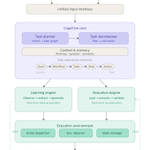
RSIAgent decides what to explore, executes tasks, verifies outcomes, and consolidates stable action-condition-outcome relationships into memory for future use.
With the underlying model weights fixed, RSIAgent achieves:
- 78.98% Partial Score on OSWorld 2.0 (0808 offline), compared with 72.60% for GPT-6 Astra
- 84.82% on Agents’ Last Exam (Near-term), compared with 82.26% for GPT-6 Astra
We call this Scaling Experience. Agents can continue improving by acquiring, verifying, and reusing their own experience while the underlying model weights remain fixed.
Links in the reply below.
Saravanan retweeted

Introducing: Browser Use Pi 🥧
A tiny TypeScript web agent, built with Astra and improved through real browser evals.
We’ve built Browser Use, Browser Harness and BrowserCode. This time we asked Astra to combine what worked, with as little code and as few heuristics as possible. Then Astra hill climbed:
> Run real browser tasks
> Read traces
> Fix what breaks
> Delete complexity
> Run again and repeat.
The result? Pi Mono + persistent V8 REPL + raw CDP. Fully in TypeScript. Cloud browsers, persistent sessions, streaming and step limits included 🌀
npm install @browser_use/pi

Saravanan retweeted
Starlink now in UAE! 🇦🇪

Starlink's high-speed, low-latency internet is now available in the United Arab Emirates! 🛰️🇦🇪❤️ → starlink.com/unitedarabemira…

Claude Code Complete User Handbook: 200 pages
This book is a practical guide to operating Claude Code safely and productively, covering control layers, permissions, sandboxing, supply-chain risks, governance, observability, and evidence-based verification.
arxiv.org/pdf/2608.26742
113
LLMs hallucinate not because we lied a lot on the web/training-data, but because they're built to predict plausible text and rewarded for confident guessing over admitting uncertainty — they'd still make things up even if the internet were perfectly honest
84
I built Tabby: a Chrome extension that indexes your open tabs on-device and lets you find them by describing what they were about. Hit Cmd+K, type "the article with the pricing comparison," jump straight there.
The part I care about most is that it's genuinely local. A quantized MiniLM model and the ONNX runtime ship inside the extension package, embeddings run in an offscreen document over WASM, and ranking is a blend of semantic, lexical, and recency signals — so there are zero network requests at runtime. No accounts, no telemetry, nothing leaves the browser.
Code: github.com/saranscript/tabby

101
Saravanan retweeted

Modern datacenters use less water than a typical golf course.
At some point we should have a discussion about which is more important for all of us:
What is more important to the quality of our life?
AI infrastructure that will improve everything we do?
Or a game?
Agents-A1, a 35B Mixture-of-Experts Agentic Model that reaches trillion-parameterlevel performance by scaling the agent horizon.
Paper: arxiv.org/pdf/2606.30616
Code: github.com/InternScience/Age…

2
222
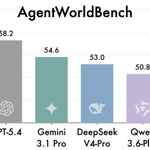
Qwen-AgentWorld: a language world model that simulates seven agentic environments : MCP, Search, Terminal, SWE, Android, Web, and OS by predicting how each one responds to an agent's actions. Trained on 10M+ interaction trajectories with a three-stage CPT→SFT→RL recipe, it serves two roles: a controllable simulator for scaling agentic RL, and a warm-up that lifts downstream agent performance across tasks. The broader point is treating world modeling, not just policy learning, as a core part of building general agents.
Paper:arxiv.org/pdf/2606.24597
Code:github.com/QwenLM/Qwen-Agent…
Model: huggingface.co/collections/Q…

164
Counting down to the M5 Ultra Mac Studio so I can self-host 100B models right on my desk. No cloud, no API bills, no data leaving the room just local AI. Apple going to sell this like iPhone's. mark my word.
1
1
134
Saravanan retweeted

Introducing Sakana Fugu: A full multi-agent orchestration system accessible via a single model API.
Our ‘Fugu Ultra’ model matches the performance of Fable and Mythos, delivering frontier capability without the risk of export controls.
Try it: sakana.ai/fugu 🐡
Human in the loop design for users;
(AI runs the process, a person reviews or approves)
AI in the loop design for makers;
(the human drives and the AI sits inside their workflow as an assistant. its more deterministic).
30
Generate and evaluate agent skills based on traces with agents. Create skills with teacher models (expensive/slow) that student models (cheap/fast) can use to perform harder tasks reliably.
Your cheapest AI model can now beat your most expensive one.
That's the wild claim behind Upskill, out today from HKUDS — and the benchmarks back it up.
The trick: when your coding agent fails a task, Upskill captures the failure, has a strong "teacher" model write a fix, then loops that fix against the weak "student" model until the student can actually pull it off. Not generic best practices — only advice the cheap model has proven it can follow. Those validated skills get auto-injected into every future session.
The result on Terminal-Bench 2.0:
→ Flash + Upskill — 51.6% pass at $0.04/task
→ Pro model alone — 50.0% pass at $0.06/task
The cheap model won. At 41% lower cost. The student surpassed the teacher that trained it.
One command drops it into Claude Code. Flash price. Pro performance.
github.com/HKUDS/Upskill

1
78

Someone developed 3-billion-parameter dense reasoning model which performs near frontier models 😊
Code: github.com/WeiboAI/VibeThink…
Paper: arxiv.org/abs/2606.16140

119