

AI • Tech • Finance explained by a capybara with internet access
San Francisco, CA
Joined June 2015
- Tweets382
- Following320
- Followers1.6K
- Likes830





Scient retweeted
In 1990, Vanilla Ice's "Ice Ice Baby" became the first hip-hop song to top the Billboard Hot 100. He says that money helped launch Death Row Records, after Suge Knight walked him onto a hotel balcony.
In the video below, Ice describes what happened up there. "I got it. You don't have to hang me over."
It started at dinner. A big man sat down at Ice's table and introduced himself as Suge Knight. "He starts eating some of my fries," Ice says.
Three weeks to a month later, Ice walked into his Los Angeles hotel room. Knight was already inside with about five men. "Did I see guns? Yes, many of them."
Knight took him to the balcony with a stack of papers about 300 pages thick. Ice signed over a few points on his album To the Extreme. He says they "turned out to be worth millions of dollars."
The points went to Mario Johnson, a man Knight brought in as a co-writer. By Ice's account, Johnson got a $400,000 advance, and Knight took 25% as his manager.
That's $100,000. For Knight, according to Ice, it was "the most money he'd ever made."
A couple of weeks later, Ice recalls, Knight came back with two new clients: The D.O.C. and Dr. Dre. Then Death Row released The Chronic and signed Tupac.
"I knew the funding came from my record," Ice says. "I'm happy to invest in that, even with no return on my money."
Knight denies it. In 2015, he told ABC the deal was friendly and that Johnson wrote the song. Asked if he took Ice to the balcony to sign over the rights, he said: "No, I did not. Never happened."
Who do you believe about that balcony: Vanilla Ice or Suge Knight?
Scient retweeted
In 1994, Pearl Jam wanted fans to pay no more than $20 for a ticket. Ticketmaster's $3.25 fee pushed the price past that line, and the band canceled its summer tour rather than accept it.
In the video below, the band tells Congress who it was fighting for. "All the members of Pearl Jam remember what it's like to be young and not have a lot of money."
Stone Gossard and Jeff Ament testified before a House subcommittee on June 30, 1994. Gossard said part of Ticketmaster's fee went back to promoters and venues and blamed "this incestuous relationship and the lack of any national competition for Ticketmaster."
Asked whether Ticketmaster was entitled to a profit, the band answered: "I think our main concern is, are we entitled to use a different company other than Ticketmaster?"
Aerosmith's manager told the subcommittee what Steven Tyler had said to him: "Mussolini may have made the trains run on time, but not everyone could get a seat on that train."
Ticketmaster said it had offered, through promoters, to cut the fee to $2.25 or $2.50, depending on the area. It blamed the band: "They said this was it, take it or leave it."
Pearl Jam wanted $1.80. The gap was 45 to 70 cents a ticket.
The next year, the band sold a tour through a smaller company and canceled half the dates. Eleven days later, the Justice Department closed its investigation without filing a case.
On April 15, 2026, 32 years after the testimony, a jury found that Live Nation and Ticketmaster had illegally maintained a monopoly and that fans in 22 states had overpaid an average of $1.72 a ticket. Live Nation is contesting the verdict.
Who cost the fans the 1994 tour: Pearl Jam or Ticketmaster?
In 2005, 81-year-old Charlie Munger condensed a lifetime of observations into 25 psychological tendencies that explain why intelligent people make terrible decisions. His conclusion was unsettling: intelligence doesn't protect you from your own mind.
Munger showed how incentives distort judgment, how pride keeps people defending bad decisions, and how fear makes losses feel twice as painful as gains. The most dangerous mistakes happen when several biases work together. He called this the "Lollapalooza effect."
Munger spent decades studying these patterns alongside Warren Buffett. His solution wasn't to trust your instincts or become smarter. It was to use a checklist before making important decisions. The paper below breaks down all 25 tendencies and how to recognize them before they cost you money.

There are only 4 ways to make money. Every salary, business, investment, and income stream runs on one of them. Yet most people spend their entire lives relying on just one.
The first is labor: trading time for money. The second is capital: investing money so it compounds over time. Invest $500 a month at a hypothetical 10% annual return for 30 years, and you could accumulate roughly $1.13 million, despite contributing only $180,000 yourself.
The third is arbitrage: profiting from differences in price, information, or access. The fourth is insurance: getting paid to absorb risks other people want to avoid. Warren Buffett's Berkshire Hathaway combines the last two financial mechanisms particularly well: insurance premiums generate funds that can be invested in productive assets.
The important question isn't just how much money you make. It's how many of these mechanisms are working for you, and whether they reinforce each other. The paper below breaks down all four, with examples, calculations, and the trade-offs behind each one.

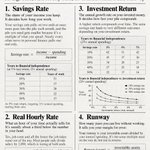
There are only 4 numbers that run your financial life. Your bank balance isn't one of them. And most people have never calculated a single one.
Your savings rate determines how many years you'll need to work. Your real hourly rate reveals what your time actually earns. Your runway tells you how long you can survive without income. And your real return shows whether your money is growing or quietly losing value to inflation.
The math is surprisingly simple. At a 5% real return, saving 10% of your income means roughly 51 years of work before financial independence. Saving 30% cuts that to 28 years. Same income, different spending habits, 23 years of your life.
The full breakdown, with formulas and examples, is in the paper below.

A falling stock can turn an investment decision into a defense of your own judgment. You look for reasons to hold, dismiss bad news and call it patience. Cherlie Munger's warning matters especially when admitting a mistake would hurt.
Before adding more money, write down what would make you sell. Then check whether that evidence has already appeared. Ask someone who never owned the stock to challenge your answer.


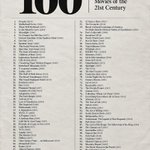
The New York Times polled more than five hundred directors, actors and industry figures to rank the best movies of the 21st century. Parasite by Bong Joon Ho takes the top spot, followed by Mulholland Drive and There Will Be Blood. The rest of the top ten includes In the Mood for Love, Moonlight, No Country for Old Men, Eternal Sunshine of the Spotless Mind, Get Out, Spirited Away and The Social Network.
The list mixes festival favorites with bigger titles like The Dark Knight, Mad Max: Fury Road, Superbad and WALL-E. Korean, Japanese, French and American films sit alongside animation, tough dramas and comedies. The full ranking from 1 to 100 is below.
What’s your favorite movie?

In 2025, The New York Times published its list of the 100 best movies of the 21st century. I selected my own top 10 films from the list about money, business, and inequality, ranked by IMDb rating.
1. Parasite (2019) | 8.5/10
A poor family gets jobs working for a wealthy one. Gaining access to someone else's home doesn't make them equals.
2. There Will Be Blood (2007) | 8.2/10
An oil entrepreneur builds his fortune while destroying his relationships with the people around him.
3. No Country for Old Men (2007) | 8.2/10
A man finds someone else's money and takes it. Soon, people come looking for it.
4. The Wolf of Wall Street (2013) | 8.2/10
Sales, commissions, and fraud fuel the brokers' luxurious lifestyles.
5. The Grand Budapest Hotel (2014) | 8.1/10
An inheritance and an expensive painting spark a battle over someone else's property.
6. Ratatouille (2007) | 8.1/10
Behind the restaurant story are questions of talent, business ownership, and the temptation to profit from someone else's name.
7. The Social Network (2010) | 7.8/10
As the company grows in value, its founders fight over who really owns it.
8. Ocean's Eleven (2001) | 7.7/10
A team plans to steal money from three casinos in a single night.
9. Moneyball (2011) | 7.6/10
How do you build a competitive baseball team when your rivals can spend far more?
10. The Florida Project (2017) | 7.6/10
Childhood unfolds next to Disney World while a mother struggles to afford even a motel room for herself and her daughter.
Bookmark this.

Full list: nytimes.com/interactive/2025…

Scient retweeted
In 2010, NBC agreed to pay Conan O'Brien roughly $33 million to leave The Tonight Show. He had waited five years for the job and held it for less than eight months.
In the video below, Conan discusses reports that ending Jay Leno's contract could have cost NBC up to $150 million. "If you're General Electric, the decision's probably pretty clear."
In 2004, the network announced that Conan would replace Jay Leno in 2009. But when the handover happened, NBC kept Leno and gave him a separate show at 10 p.m.
Ratings for Leno's new show disappointed local stations, while Conan trailed David Letterman. NBC decided to move Leno back to 11:35 p.m. and push The Tonight Show to 12:05 a.m.
Conan refused, arguing that moving past midnight would damage the show itself. After negotiations, NBC agreed to pay him roughly $33 million and his staff another $12 million.
Conan understood the financial logic but rejected NBC's account of his performance. Asked whether he had been given a fair chance, he answered: "Absolutely not." When NBC claimed his Tonight Show was on track to lose money, he said: "It's really not possible."
He also questioned Leno's return. "He went and took that show back," Conan said, explaining that he would not have done the same if their roles had been reversed.
Around 50 stagehands and other crew members received nothing from NBC under the settlement. Conan paid them at least six weeks of severance out of his own pocket.
Did NBC keep the better host, or the one it would cost more to let go?
Scient retweeted
In January 2002, Mark Cuban took a public shot at the man in charge of every NBA referee. The league fined him $500,000, a record at the time.
The video below has the whole story. Cuban's line was: "Ed Rush might have been a great ref, but I wouldn't hire him to manage a Dairy Queen."
Cuban paid the fine. Then he gave another $500,000 to charity, matching the league dollar for dollar.
Dairy Queen answered with an invitation to work a shift. Three days later he was behind the ice cream machine, and a student newspaper reported that almost 2,000 people showed up.
The insult cost him $1 million. Millions of TV viewers heard his name, and the media split over him.
Years later, fined $15,000 for cursing at a charity gaming event, he asked if cursing again meant another fine, then did it anyway. "It was worth it," he said.
Was the Dairy Queen line a $1 million mistake, or the best money he ever spent on attention?
Scient retweeted
At 30, Mark Cuban sold his first company for $6 million. The first thing he bought was a $125,000 lifetime pass to fly first class on American Airlines.
In the video below, he tells the story. His dad reupholstered car seats, his mom did odd jobs, and when he started that company, he was sleeping on the floor of an apartment he shared with five other guys.
He gave $1 million to employees. After his partner's share and taxes, about $2 million was his, and his goal was to retire by 35.
He wasn't into cars, but he flew so often that he knew American Airlines' number by heart. The night the checks came in, he called them drunk from an Italian restaurant: "Do you guys sell lifetime passes?"
They did. "I spent 125 grand of my 2 million," he says.
The rest went to a friend at Goldman Sachs to invest "like an old man." Cuban was ready to live "like a student" and never work again.
He never stopped working. Years later, he gave the pass to a friend because he had his own plane.
$125,000 right after his first big sale: reckless, or exactly what he built the business for?