

Chicago Saluki focused on digital marketing, investing, & sports
Joined March 2009
- Tweets3.7K
- Following987
- Followers258
- Likes6K



Scott retweeted

6/ If you're looking for a particular connector that isn't available yet, just ask your Muse to submit a feature request
If you're a business and want to add your connector to Muse, head over to our Muse Connector Platform at muse.ai/platform

Scott retweeted

Introducing: Musecases
People are already putting @Muse to work already.
Shopify checkout. Marketplace negotiations. Dinner bookings by @pitdesi. A 50-question voice interview. @jeff_weinstein shopping, email inbox by @Casey, signing docs and more.
I pulled the best use-case posts from X into one spot (with embeds):
musecases.netlify.app


Introducing Muse, your personal AI agent from Meta that gets things done across every part of life.
Download the Muse app and get started: Muse.ai
This is exactly why x402 was created….to help facilitate value exchange in an machine driven world


1
53
Scott retweeted

When you hear that data is the new oil, this is ultimately what that looks like. AI has such a thirst for data that we’re entering an era where it’s valuable almost in any form.
In a world of AI, information actually belongs as an asset on the balance sheet. This data sale is just one example of the implications of what that will look like.
Ultimately, the way that companies manage and mine their organization’s intelligence will be one of the deciding factors for competitiveness and value creation in the future.


Scott retweeted

some obvious & non-obvious reasons i think AI agents may not have really been widely adopted yet, even though the tech is ready:
1/ it's not prompt in, answer out. an agent is a process you set up and steer while it runs, and the chatbot muscle memory most people have doesn't transfer.
2/ prompting an agent is closer to writing a spec than asking a question. you have to scope the task extensively and define what "done" looks like.
3/ as @paraschopra puts it, this needs a lot of delegation, which is a hard soft skill to build. it's very close to managing an employee and most people have never done this.
4/ a lot of the actual power still lives inside codex or claude code which is terminal-shaped and a little technical. you have to be comfortable doing the messy setup, so it self-selects for a narrow crowd.
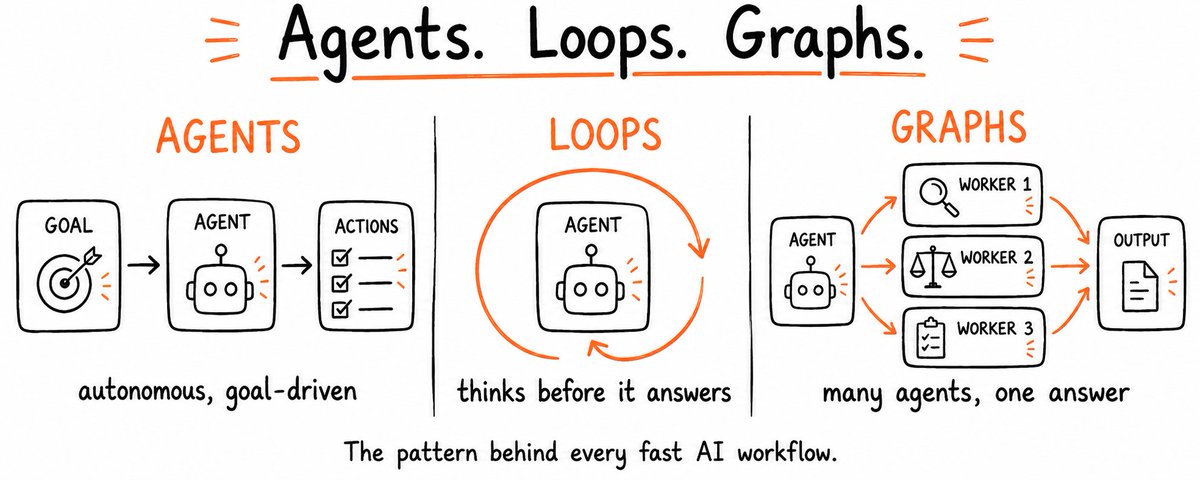
5/ one agent is also just a tool. the unlock is running several at once and getting them to talk to each other like a team, and that handoff between agents is still mostly diy.
6/ same problem across people. your agent's context has to reach your colleagues or everyone ends up working in silos, and right now that handoff is way too manual.
7/ trust is a ratchet. a chatbot that's wrong wastes 10 seconds, but an agent that's wrong sends the email or edits the file. the downside is asymmetric, so most people keep it on a short leash.
8/ lastly, there isn't a job-to-be-done the public actually feels yet. autonomous agents will always be a solution looking for a problem.

Hot take… isn’t it kinda crazy that nobody is really using AI Agents? I don’t mean software engineers or AI early adopters. I mean “college friends talking about it in group chat,” the feeling you got when everyone started using Instagram or TikTok.
These frontier AI models are *insane* (as are the harnesses & tool calls & the like). And every large tech co has an AI agents platform, not to mention all the YC startups doing vertical agents. Yet all of your friends and family outside of tech — who spend all day staring at their iPhones and get paid to work in browser tabs — don’t really care or find themselves using any AI agents yet.
Yes ChatGPT, Claude, etc. are extremely popular… but if you look at the engagement data the vast majority of people are still using these aI chat tools like a glorified Google + Grammarly. That’s why the AGI labs are all pushing desktop apps for Codex, Cowork, etc. so hard to non-technical ppl. And yes exceptions for lawyers and customer service but even those have some asterisks and exceptions to rule.
Look I’m not saying the ChatGPT moment for AI Agents is not coming… it most definitely is! Remember we pivoted from Arc to Dia precisely because we believe computing is going to be radically reimagined around these AI primitives. No doubt. But that’s my point: it’s just so surprising it hasn’t happened yet because all of the tech you’d need is there.
Again if you stop for a second and think about it… for all the press and money and hype and models and crazy ARR numbers… this “AI Agent” moment does not *feel* like the other breakthrough tech moments we’ve lived through (e.g. think the shift to Stories via Snapchat & Instagram, or shift to on-demand via Uber/Airbnb/Doordash).
Which is a long way of saying: if you can figure out the answer to “why” most people don’t care about AI agents yet (and have no enduring interest in using them) — especially since the models and harnesses are here and ready — the answer to that question will allow you to capture a lot of marketshare and make a lot of money in 2027.
Theoretically, the tech is ready for AI Agents to totally transform how we work and live our lives… but alas the general public dgaf… that’s the generational puzzle to solve for the next 12 months for anyone not working on the models themselves.



Sometimes the world is split into 2 camps. You have your chaos muppets and order muppets. I am seeing some interesting splits emerging in the world of AI.
Claude code vs cowork
System thinkers vs business minded
Curiosnauts vs Curiosnots
What splits are you seeing?
27
The great blog collapse… danielstanica.com/posts/Grea…

1
16
Scott retweeted

Cloudflare just reshaped how AI crawlers get classified — and SEO teams need to pay attention before Sept 15.
On its second "Content Independence Day," Cloudflare moved away from the blunt "block all AI bots" model toward a behaviour-based taxonomy. Instead of asking "is this AI?", the question is now what is the bot doing, what does it store, and how does it reshare your content?
The three use cases every site owner can now control (yes, including the Free tier):
☛ Search: indexing your content to answer queries later; the behavior that drives referral traffic back to you. Allowed by default.
☛ Agent: real-time bots acting on a human's behalf (ChatGPT-User, Gemini/Claude driving Chrome).
☛ Training: crawling to permanently absorb your content into a model.
The change with the biggest SEO implications ☛ new defaults land September 15, 2026.
On pages that display ads, Training and Agent will be blocked by default while Search stays allowed (for new domains onboarding). More importantly: multi-purpose crawlers will now be blocked according to all their behaviors. That means if you block Training, combined crawlers like Googlebot, Applebot, and Bingbot get blocked too — because they crawl for both Search and Training.
You can opt out in Security settings before Sept 15 to protect your search visibility. Don't sleep on this one.
For AI-visibility work:
☛ A new use signal extends Content Signals in robots.txt — use=immediate (store nothing), use=reference (index, excerpt, link back — the new default), or use=full (summarize and reproduce). These are stated preferences, not hard blocks.
☛ Bots that reproduce content in full can't be Verified. Abusing signals costs a bot its Verified status.
☛ "Verified" no longer means "allowed by default" — it now just makes a bot allowable within its category.
Also worth knowing:
☛ BotBase — a new searchable directory (Enterprise Bot Management) showing every tracked bot, its classification, and a copyable detection ID for security rules.
☛ Transitive trust — an experiment using the RFC 7239 Forwarded header (e.g. Forwarded: for="openai";use="reference") so operator-level trust decisions hold even through layers of intermediaries.
The through-line: control is getting granular, and the era of "search and training are the same crawler" is ending. If you manage crawl access, audit your Training rules now so you don't accidentally deindex yourself in September.

One year after declaring Content Independence Day, a dynamic market for monetized content has emerged. In this report, we examine how the rise of autonomous AI agents is upending traditional search referrals and detail the new infrastructure required to support a sustainable web economy. cfl.re/442JPbR

What is Prompt Caching? Optimize LLM Latency with AI Transformers youtu.be/u57EnkQaUTY?is=I8vD… automated and explicit caching
24
Scott retweeted

Show Codex a workflow once. Reuse it as a skill.
Record & Replay lets you show Codex a recurring task, like filing an expense report or submitting a time-off request.
Codex turns that demo into an inspectable, editable skill.
You control when recording starts and stops.
Been thinking about capability catalogs for agents. Will be interesting to see how this framework evolves

Agents are part of a massive, interconnected ecosystem. But how do they find and trust each other across different platforms?
Today, we’re proud to announce the Agentic Resource Discovery (ARD), an open specification alongside industry partners (including Cisco, Databricks, GitHub, GoDaddy, Hugging Face, Microsoft, NVIDIA, Salesforce, ServiceNow, and Snowflake). ARD gives any agent a secure, decentralized way to discover and verify capabilities (like tools, skills, MCP servers, and other agents) anywhere on the web.
Read the full announcement and get started: goo.gle/4a2sTWf

ALT This architectural diagram titled "Agentic Resource Discovery" illustrates two parallel paths for an AI agent to find resources: a direct "Catalog" layer where companies self-host discovery files and a centralized "Registry" discovery service. The AI agent searches these sources, then verifies and connects to resources via A2A, MCP, or API protocols. A five-step process flow at the bottom summarizes the workflow: 1) Publish, 2) Crawl, 3) Search, 4) Verify, and 5) Connect.
18
Scott retweeted

In @GoogleAIStudio we are now making more than 1,200,000 apps a week (and growing) with more than 18,000,000 created since late February 🤯
The progress continues!!!
100% agree

There’s a fundamental difference between taking an existing process and applying AI agents to it vs. taking a process from scratch and designing it from the ground up for AI agents. The gap we’re going to see will widen between the teams and companies that are able to do the latter instead of just the former.
In theory it would have been ideal for all the gains of AI to have come “for free”, but there are both clear constraints of AI (like getting the context right) and clear upsides (like being able to execute code and run in parallel) that the workflows themselves must be redesigned to take full advantage of this technology.
One of the biggest implications that will come into focus is that agents that can write and run code, and interact with any API, will lead to agents effectively being expert engineers applied to your business process.
So to some extent one of the biggest ways of reengineering a workflow is to ask yourself: what would you do if you had an infinite number of capable engineers write software for this process. What if those engineers wrote code to connect your disparate data sources, comb thorough any amount of unstructured data, automate your repeated tasks, connect your various systems together specific to your process, and so on.
Not every process has that upside, but there tons of tasks that we do every day across marketing, finance, operations, and even sales, where a programmer with infinite code writing and API access would be able to make something go far faster or produce way more output. The teams that start to think this way will start to operate entirely differently.
49
Scott retweeted
There are some pretty wild downstream effects in a world with trillions of agents using the internet and software.
One very big one is what happens with agents with budgets and wallets. There are lots of business models that never ended up working out for the human-based internet that all of a sudden start to make economic sense in an agent-based internet.
Think of all the proprietary data and research that’s sitting out there right now behind a paywall that a human will never run into. Finance data, medical research, and so on. Most people won’t sign up for a $100 or $1000 subscription for information they need infrequently. The cost is too high. Equally, micropayments for this data rarely worked at scale because the volume was too low to matter.
However, now an agent can have a budget for a specific set of research it’s doing, and the agent might pay $0.1 or $1 to access it in a workflow. And now that data may be relevant in 1,000X’s more use-cases than it was before.
Similarly, there are many APIs and tools out there on the web that don’t make sense to have a subscription for, but now an agent may interact with for a specific exchange, and it could cost $.01 or $0.1 per transaction.
All of a sudden new kinds of software can get built and monetized that would have been uneconomical before. Some new form of commercial open source, essentially.
Obviously lots of infrastructure and agreement across the industry is needed for this -and getting discovered by the agent is going to be a whole new class of search and discovery problem- but there are so many potentially interesting new scenarios here.

“Small talk is a tiny, free and very possibly priceless reminder of our shared humanity.”
theguardian.com/lifeandstyle…

38
Scott retweeted

This is the quiet shockwave moment.
It’s not that Claude “coded faster”.
It’s that a clear problem description now compresses a year of committee debate, alignment friction, and orchestration overhead into an hour.
The bottleneck has shifted:
from implementation → articulation
from coordination → clarity
from teams → thinking
Large orgs weren’t slow because they lacked talent.
They were slow because consensus, interfaces, and incentives diluted intent.
2026 is going to reward people and organisations who can name the problem cleanly far more than those who can staff it heavily.
And yes once you see it, you can’t unsee it.