
Run LLMs fast at any scale 🔗 https://xitter.cf/t.co/F3u6wYESL0 Join our community https://xitter.cf/t.co/fmlOfTOEec For AI tech blogs & deep-dives 👉 @lmsysorg
Palo Alto
Joined May 2025
- Tweets539
- Following54
- Followers11.4K
- Likes435




Pinned Tweet
Today we launch SGLang-TorchTPU, built with @Google TPU team and Meta @PyTorch team.
We’re excited to see it powering production inference at Meta!
SGLang-TorchTPU is a TPU plugin for SGLang that brings:
- Top open models on TPU: Muse Spark Open, GLM-5.3 Flash, Kimi K3, Ling 3.1 Flash, MiniMax H3
- SGLang’s production features for large agentic workloads
- Custom MegaKernel: Muse Spark Open hits 770 tok/s decode at bs=1 on InferenceX 8K/1K
SGLang-TorchTPU is available now: github.com/sgl-project/sglan…


Big day for the @PyTorch ecosystem at #PyTorchConf2026 🚀
We’re officially open-sourcing TorchTPU—enabling native, hardware-accelerated PyTorch execution across Cloud TPUs and custom infrastructure.
Here’s everything we launched to supercharge your training & inference workloads 🧵👇
goo.gle/4Bl0zdG

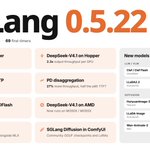
SGLang v0.5.22 is out! 950 PRs from 245 contributors, including 69 new contributors 🧡
Some of our favorite updates:
- InstantTensor brings up to 10x faster weight loading
- DeepSeek-V4.1-Flash gets up to 2.3x output token throughput on Hopper
- Up to 2.1x faster decoding on GLM-5.3, with decode context parallelism with MTP
- PD disaggregation gets up to 27% more throughput and half the p95 TTFT on agentic tasks
- MiMo-V2.6-Pro gets 1.85x decode throughput with DFlash
- Apple Silicon Macs can now use the standard PyTorch/MPS backend alongside MLX
- SGLang Diffusion now supports community GGUF checkpoints and LoRAs on ComfyUI
New models include Clef / Clef Flash, PPLX-Decider v1 / v1.1, EmbeddingGemma 2, LLaDA2.2, HunyuanImage-3.0-Instruct, Kandinsky 6, SANA-Video 2.0, and more.
Full release notes: github.com/sgl-project/sglan…

Thanks @MiniMax_AI 🙌 SGLang Omni keeps the LLM stage pluggable, so M3.1 Flash drops straight into the cascade next to local ASR and TTS. Add streaming and playback-aware interruption handling, and you get voice agents people can talk over. Full blog here: sglang.io/blog/omni-interact…


MiniMax M3.1 Flash + SGLang Omni: building toward a more interactive generation of voice agents. The shift ahead is from “ask, wait, listen” to conversations people can interrupt, correct, and redirect as a task unfolds.
MiniMax M3.1 Flash brings intelligence and fast, concise responses. SGLang Omni adds streaming, conversation state, and interruption handling so users can redirect conversations in real time.
Together, they give developers a foundation to explore proactive tutors, support agents, and hands-free copilots - pairing Flash’s capabilities with infrastructure for continuous interaction.
Thanks to the SGLang Omni team for exploring this direction with M3.1 Flash! ✨

SGLang has Day-0 support for Flint from @Recursive_SI
Flint is a 40B MoE built for fast, local agentic coding. It leads its class on SWE-Bench Pro v2 and Terminal-Bench 2.1. Recursive's Eureka Machine, an automated AI research system, designed its sparse shape, low-bit training, and kernels.
Flint runs fast on your own machine, keeping your code local, even offline. Run it on DGX Spark with our cookbook recipe 👇


Introducing Flint, @Recursive_SI’s first model: a fast local coding model built with our automated research system, the Eureka Machine.
• Best-in-class fast local coding
• Up to 2x faster than comparable models: 125+ tokens/sec on a MacBook Pro, 150+ on RTX Spark
• Built from scratch in under 4 months
Private, unmetered intelligence on your own machine. Open weights available now on @huggingface, run it locally on your favorite framework or try it for free on @opencode or @pidotdev.

Read the full story on our blog! We also ran early RL training on TPU with Miles and TorchTitan, and the results are very promising 🪄
lmsys.org/blog/2026-10-20-sg…

@radixark is also opening a community TPU capacity pool, with free compute for developers who contribute to SGLang-TorchTPU.
Apply here: docs.google.com/forms/d/e/1F…

Day-0 SGLang support for Ornith-1.5-122B! 🚀
Built for coding and agentic tasks, now ready to serve with SGLang, including reasoning, tool calling, and 262K context configurations.
Thanks to the Ornith team for the collaboration and cookbook contribution!
Get started 👇
docs.sglang.io/cookbook/auto…


Aloha!🌺 Meet Ornith-1.5-122B: No Tradeoff Between Strong and Fast
Stronger. Faster. Leaner. Ornith-1.5-122B delivers frontier-level capabilities with exceptional inference efficiency. With superior instruction following, stronger task decomposition, and deeper understanding of real-world workflows, it achieves state-of-the-art performance among open-source models of comparable size, while running on a single NVIDIA DGX card!!
Open weights under the MIT license.
Coding
✅SWE-bench Verified: 0.845
✅TB2.1: 0.813
✅CyberGym: 0.800
✅NL2Repo: 0.512
Agentic
✅HLE: 0.446
✅BrowseComp: 0.785
✅MCP-Atlas: 0.746
✅Toolathlon: 0.708
🤗Hugging Face: huggingface.co/ornith-ai/Orn…
We can’t wait to see what you build with Ornith-1.5-122B.

Congrats to @deepseek_ai on the launch of DeepInfer! 🎉
Great to see the engineering behind DeepSeek's production inference stack being open-sourced, and thanks for the shoutout to the SGLang community 🧡
We're especially excited about the work on large-batch and multi-GPU inference. Can't wait to dig deeper and bring some of these ideas into SGLang!

🚀 Introducing DeepInfer, our in-house inference framework, now fully open source!
Powering DeepSeek-V4.1-Flash at scale with high throughput and low latency. We’re sharing our production stack to help the community lower compute costs, reduce energy use, and make AI more affordable.
🔗 github.com/deepseek-ai/DeepI…
1/4

Specialized low-latency kernels now plug into SGLang. The @NVIDIAAI team ships theirs in sgl-nvidia-mega. The @AMD team ships theirs in sgl-amd-mono. SGLang handles the integration and falls back to its general path for uncovered steps.
Low-latency kernels for GLM-5.3, K3 and MiniMax M3 are in progress on both NVIDIA and AMD, along with stronger CI at the plugin interface. Check out the blog for details 👇

Introducing SGLang Low-Latency Mode, built with @NVIDIAAI and @AMD.
On DeepSeek-V4.1-Flash with DSpark, it delivers up to 1.38× P90 per-user token speed on NVIDIA GB300 (671 to 928 tok/s) and 1.56× on AMD MI355X (332 to 516 tok/s) in @SemiAnalysis_'s AgentX trace replay.
Highlights:
- NVIDIA: overlapping kernels cut decoder layer time from 96.8 to 68.4 µs
- AMD: 2 persistent kernels per layer replace dozens of small ones, with cross-GPU communication overlapped inside them.
- New plugin system: custom kernels plug in from external libraries, with automatic fallback.
- Low-latency kernels for GLM-5.3, K3, and MiniMax M3 are in progress and will plug in next.

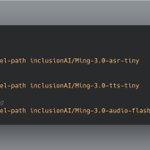
SGLang-Omni supports @TheInclusionAI's Ming-3.0 on day 0!
🎙️ Ming-3.0-asr-tiny — Chinese/English ASR with dialect support
🔊 Ming-3.0-tts-tiny — voice cloning in 7 languages
🧠 Ming-3.0-audio-flash — 126B-A6.5B MoE for audio understanding and reasoning
Cookbooks👇

Congratulations to @AntLingAGI for another awesome release! Check them out on Hugging Face:
huggingface.co/inclusionAI/M… huggingface.co/inclusionAI/M… huggingface.co/inclusionAI/M…

Cookbooks for all three:
Ming-3.0-asr-tiny: sgl-project.github.io/sglang…
Ming-3.0-tts-tiny: sgl-project.github.io/sglang…
Ming-3.0-audio-flash: sgl-project.github.io/sglang…
Proud to welcome our newest sponsors to SGLang Summit.
In just one week since our public announcement, our sponsor lineup has grown from 11 to 36. Thank you to every sponsor helping bring this community together.
Join 2,000+ engineers, researchers, and builders from across the AI ecosystem for technical sessions, hands-on workshops, and the GPU Expo.
Hear from Lip-Bu Tan, Lilian Weng, Soumith Chintala, Aravind Srinivas, and more. Meet the teams building across AI hardware, infrastructure, models, and applications.
🗓️ November 12–13, 2026
🌉 Fort Mason, San Francisco
🎟️ Get your tickets: sglang.io/summit

Congrats to the Beam team on the launch 🤝 It’s been a pleasure for the SGLang team to work closely with you to bring Beam to users. Excited to be part of this milestone!

Thanks to the amazing team at @sgl_project for working closely with us on optimizing Beam both for 3P users and also for our Beam's production API.
Fun fact, Jimmy from SGLang team was working with us in our office till late last night wrapping up the last pieces of this launch. This is the sort of collaboration that has lead us to have such a broad release. 🤝
Congrats to NVIDIA on releasing its next consumer product, RTX Spark, following DGX Spark last year!
SGLang is delighted to have day-0 support for this amazing line of laptops, powered by NVIDIA's N1X chip, with up to 128 GB of combined CPU and GPU memory.
Although these laptops run Windows, you can run SGLang inside WSL2 to get top-of-the-line performance out of these machines!
We've tried Qwen3.6-35B-A3B and achieved 75 tokens/s on this machine, making it a great way to power your local agents effortlessly! 🚀


NVIDIA RTX Spark is here.
Build AI locally, bring your creative ideas to life, and take your favorite games along.
A new beginning for @Windows PCs starts today.

SGLang powers Beam’s production API, with day-0 support now available to everyone!
Built for software engineering and long-horizon agents, Beam delivers frontier-level inference efficiency with more intelligence per token. Serve it on the same production-proven stack: docs.sglang.io/cookbook/auto…
Read more: lmsys.org/blog/2026-10-16-be…

Beam is now available across platforms, with open weights under the Apache 2.0 license - in collaboration with an ecosystem of 40+ partners.
We're releasing:
- Weights, tokenizer, and reference implementation
- BF16, FP8 and NVFP4 weights and a DFlash2 drafter
- The open source harness we built and trained Beam on: Mirror CLI
Weights and model card on Hugging Face: huggingface.co/reflection
