

Application Development as a Software Company | Founder @ https://xitter.cf/t.co/ByOyJNYoii | Co-Founder @ Tokenome AI | Founder/CEO @ SWIRL
Boston, MA
Joined September 2008
- Tweets12.7K
- Following390
- Followers2K
- Likes7.2K





Pinned Tweet
Give four agents the whole problem and you get four stacks, four ideas of done, and nothing you can compare.
Give each one a single job, the same blocks and the same recipe, and the work merges!
Gordon Ramsay would recognise it: every plate that comes to the pass has to meet the standard. Period. I’ve been on about this for a while - for example: lnkd.in/p/gE9t4NdK and lnkd.in/p/gRbhmGX5
The video is a clip from my Boston AI Week talk, “Building an AI Software Factory with a Human in the Loop.”
#AIAgents #HumanInTheLoop #SoftwareFactory
You shipped it in a weekend. Respect.
Now, please add these three things before Monday.
1. An API. Better yet, an MCP server.
Your next big customer... might not have eyes.
✦ Bots now make up 57.5% of web page requests on Cloudflare’s network
✦ Agentic AI traffic grew 7,851% in a year
✦ Gartner expects AI agents to handle $15 trillion of B2B buying by 2028
✦ The official MCP registry passed 43,000 servers, up 36% in one month
Your UI is lovely... but your user’s agent will never see it. The coolest interface is no interface at all.
2. Magic links instead of passwords.
You can’t leak a password you never stored.
Researchers audited 200 live vibe-coded apps and found broken authentication in more than half. One left password checking as a TODO.
Another shipped a back door with a hard-coded login. Email a link, sign them in, and skip the password table, the reset flow and “password123” ... forever.
3. A security check. Before you ship, not after.
Same study: 91% of those apps had at least one vulnerability. A separate scan of 3,680 live Supabase-backed apps found 57% let anyone read their data without logging in.
Cloudflare just open-sourced the security audit skill it built to hunt bugs in its own code. Ask your agent to install it and audit your app. Your agent wrote the bugs. Make it find them.
(Then have a person read the report.)
#VibeCoding #AIAgents #MCP #Founders #StartupSecurity

Sid Probstein retweeted

New in Claude for Legal: a gallery of ready-made artifacts for contract review, regulatory horizon scans, cite checks, and more.
Start from the built-in example, add your own documents and connectors, and share it with anyone across the business.
Sid Probstein retweeted

MikeOSS 2.0 is here: a free open-source AI harness for legal work which you can self-host, connect to any model, or run fully local.
What’s new in 2.0:
- Integrated Drafting Interface (IDE): a Cursor for legal UI with a file explorer, document viewer/editor & chat side by side
- Word add-in + workflows in Word
- Subagents for big reviews
- Web search
- Memory (account and project scoped)
- Side chat
- Slash commands
- Orgs & audit logs
- Wider model provider support: Azure, Bedrock, @grok, @vercel AI Gateway, @MistralAI, @OpenRouter, @opencode Go and more
- Local AI with Ollama integration
Website: mikeoss.com (link to github on main page)
Thank you to all contributors, including @solirvine @Pabz @b1rdmania @Diya_555696 @BitGrateful @SadhakaDev @b1rdmania @antoinelouis_ @snowyukitty
Search your whole team's AI history in one query, and see who said each thing.
Now that everyone works through their own agents, the reasons for a change sit in one person's chat, in one tool, where nobody else can see them. Tokenome Team puts them back in reach: a member searches their own history and everyone's opted-in projects in the same query, and every team result carries the name of the person it came from.
How it stays safe:
* Nothing leaves a laptop until its owner opts a project in, by name.
* Secrets are redacted on the laptop before anything is sent. What the gate cannot make safe is held back.
* Stop sharing a project and purge what was already sent, in one command.
* You run the server: one container image, on Docker or Railway. Tokenome does not host it and receives none of your data.
In the beta now: one search across the team with attribution, per-project opt-in, redaction on the laptop, backfill of the history you already have, retract and purge, device-key enrollment with admin enroll and revoke, and an admin console for people, devices, sharing coverage and an append-only audit log.
Our own team runs on it today.
Coming, not available yet: a pull request provenance bot, a team FAQ from everyone's journals, flags where two people disagree, a provenance API, and SSO and SCIM.
Team is in beta and free while the beta runs. Join the preview, link in the first comment.
#DeveloperTools #AIAssistedDevelopment #EngineeringLeadership

A rank 1 from one system and a 0.63 from another mean nothing to each other. A federated result list is six lists stapled together, unless something puts them on one scale.
SWIRL reads the query and every result together, scores them on one scale, re-scores the top results for confidence, groups duplicates and versions, and puts the approved version on top.
Then, and only then, does it generate the answer.
The whole journey, step by step: swirlaiconnect.com/ranking

Connector is a misnomer here.
According to my analysis, Claude Duet is live querying, not ingesting. It's using MCP.
Ingestion is not necessary to generate insight. Period. And here's the proof...

Claude Duet flips the default: the AI messages you first. Own cloud computer, finished work back, asks before it pays or sends anything. 6,000+ connectors. Assistants that start the conversation. claude.com/product/claude-du…

Sid Probstein retweeted

I highly recommend cloudflare's security audit skill: github.com/cloudflare/securi…
Run it on all your software. Run it with the free models. Use it even if you used a model to audit something - it will find much more things. Works in all agent harnesses and is model independent.

A transcript corpus is the most sensitive text a developer owns. Tokenome keeps it exactly where it already is.
It holds your architecture, your half-formed ideas and the odd pasted secret. So the first question is not what Tokenome does, it is where the text goes. The answer is what is inside the download:
* The index and the search engine, running against a directory in your home folder.
* The embedding model, which runs on your own hardware with no GPU, so no text is ever sent anywhere to be embedded.
* The journal, written locally. The default writer needs no model at all.
* No account, no sign-up, no licence check. The product does not know who you are.
The one connection the desktop app makes on its own is an update check against the public releases page, with no conversation data in it. Only if you switch them on: the Claude Desktop source, which fetches your own conversations from claude.ai with your own session key, and Team, which shares only projects you opt in.
The local service needs a token file only you can read, so another process on your machine cannot read your history over localhost. Tokenome adds no encryption beyond file permissions, so keep full-disk encryption on. To remove it all, delete the app and ~/.tokenome; your original transcripts are untouched.
Nothing leaves your machine. No account. No cloud embeddings. That is the architecture, not a policy we ask you to trust.
hashtag#LocalFirst hashtag#DeveloperTools hashtag#Privacy
Try it: tokenome.ai
* Install the signed macOS or Linux build, from the site
* CLI:
uv tool install tokenome-ai
* in Claude Code:
/plugin marketplace add tokenome/releases

Don't miss John O'Neil's demo/talk of Tokenome AI on Thursday as part of Boston AI Week !!
Register: luma.com/15qeiow8
Git blame tells you who changed a line. It cannot tell you why.
Tokenome indexes your AI conversations on your own machine and links every line of code to the conversation that produced it.
At this talk Tokenome’s creator + founder will install it live and use it on a real codebase showing line to conversation, the reason behind a reversal, the daily journal, and a coding agent that looks up its own history over MCP.

Don't miss John O'Neil's demo/talk of Tokenome AI on Thursday as part of Boston AI Week !!
Register: luma.com/15qeiow8
Git blame tells you who changed a line. It cannot tell you why. Tokenome indexes your AI conversations on your own machine and links every line of code to the conversation that produced it. At this talk Tokenome’s creator + founder will install it live and use it on a real codebase showing line to conversation, the reason behind a reversal, the daily journal, and a coding agent that looks up its own history over MCP.
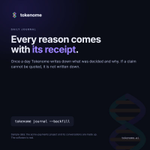
Once a day, Tokenome writes down what you decided and why. Every reason quotes the sentence it came from.
You get a decision record that nobody has to maintain.
If a claim cannot be quoted, it is not written down. That one rule is what makes the record safe to lean on: every line can be checked against the words that produced it.
How it works:
1. Tokenome reads the day's conversations from Claude Code, Claude Desktop, ChatGPT and Gemini, on your machine.
2. It pulls out the decisions and the reason given for each.
3. Under each reason sits the sentence it came from and the turn it was said in. Open it and read the original.
4. A decision that was later undone is marked as a reversal.
5. Entries are plain markdown on disk, so you can read them, grep them and keep them.
Weeks later, "why did we do that?" has an answer with a receipt. Ask in the web UI, or let your agent pull the last few days over MCP instead of asking you to explain it again.
Here is the kind of sentence it keeps, from our sample project: "kept the ledger.post metric inside post_entry, so it fires once per posting instead of once per attempt." A vague summary cannot be quoted, so it does not make the record.
Already have months of conversations? tokenome journal --backfill writes the entries for days that have none yet.
The journal is in the free tier, on one machine. No account, nothing leaves your laptop. acme-payments is sample data made up for demos; the software is real.
Try it: tokenome.ai
* Install the signed macOS or Linux build, from the site
* CLI:
uv tool install tokenome-ai
* in Claude Code:
/plugin marketplace add tokenome/releases

Most AI search builds an index of your documents and a copy of your permissions, then tries to keep both in sync.
SWIRL does neither!!
Every search runs live, as the signed-in user, and the system that holds the document decides who sees it. Delete at the source and it is gone.
There is no second copy to secure, subpoena or purge!
The security and architecture page: swirlaiconnect.com/under-the…

Sid Probstein retweeted

The biggest misread of anyone predicting the end of software engineering was imagining that the world only needed a certain amount of software, and bringing automation to the field would reduce the need for labor.
Exactly the opposite is happening where essentially most things are actually turning into software. Because agents can use tools, work with computers, write software on the fly, and process data like humans (but far faster), we can now throw “software” at problems that never could reasonably be digitized before.
What that leads to is the role of engineering taking on greater importance in the economy, because we can now engineer far more systems and processes than were possible before.
If you’re a bank trying to do new forms of trading, engineers are often your first bet. If you are in life sciences, you expect more and more research and lab work to be engineering centric. If you’re in manufacturing, you’re trying to automate more of the supply chain, all that is engineering. More and more work is shaped like software problems.
Yes we’re not going to be coding manually in the future. But almost everything will be code, which means those that understand it are in a fantastic position.

Some observations about the "total" automation of software engineering:
1. There are more software engineers now than in 2025, and demand is growing.
2. Software engineers have never worked harder than they do now.
3. They largely don't write code anymore, agents write ~100% of the code.
4. The bottom line of the companies that employs these engineers and agents (i.e. the terminal purpose of all this code) is typically not budging as a result of AI adoption.
This is why you have to think in terms of systems. Automating one aspect of a system creates its own friction and moves the bottlenecks elsewhere.



Sid Probstein retweeted

Yes. Undo without the basis is just a mystery in the log. Keep the reason next to the change and an agent can learn from the reversal instead of guessing.
Git can tell you a change was undone. It cannot tell you why.
Tokenome shows the decision, the reversal that followed it, and the conversation each one came from.
An example from our sample project. A cache goes in; the conversation says lookups dominate p95 latency and accounts almost never change. Days later a tenant migration sends two postings to the old account, and the cache comes back out.
Git has two commits, "Cache tenant account lookups" and "Go back to direct account lookups". Neither says why.
Tokenome has the sentence that ended it: "Account lookups went back to direct reads, because a stale account misroutes money and the latency win is not worth that."
So the next person who sees slow lookups does not re-propose the cache and repeat the week. They see it was tried and why it came out.
How it works:
1. The daily journal writes down decisions, each reason quoted.
2. When a conversation states a reversal and gives the reason, that record is marked as reversed, and the earlier answer stays visible instead of being overwritten.
3. Ask in the journal, "why did we go back to direct account lookups", or let your coding agent call why_was over MCP. You get the decision and the reversal together, each linked to its conversation.
It only writes down what someone said. A revert nobody explained has nothing to quote, so it stays out of the record.
Local, no account, free on one machine. acme-payments is sample data made up for demos; the software is real.
Try it: tokenome.ai
* Install the signed macOS or Linux build, from the site
* CLI:
uv tool install tokenome-ai
* in Claude Code:
/plugin marketplace add tokenome/releases
