





Simile retweeted

On stage at Claude Founder House today, 12:30 PT, with @timgl (@PostHog) and @joon_s_pk (@simile_ai).
Topic: how we run frontier models in production. Which model gets which job, and how to trade off cost, speed, and quality.
Livestream: anthropic.com/events/claude-…
xitter.cf/claudeai/status/210537…


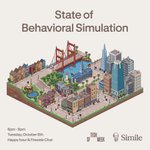
Come join us tonight for happy hour and a fireside chat with @skairam and Chinmay Kulkarni as part of #SFTechWeek! We’ll have drinks, bites, and an insightful conversation on what’s working in simulation, where the hardest technical challenges remain, and the open questions shaping the field ahead. See you there!

RT @lennysan: Trend I'm following: Teams using AI "simulations" to quickly test product ideas and flow tweaks.
Products like @simile_ai, @…
Researchers working on AI, behavioral modeling, or social simulation, join us next week for a happy hour and fireside chat!
Simile’s @skairam and Chinmay Kulkarni will discuss the state of behavioral simulation today: what’s working, where the hardest technical challenges remain, and the open questions ahead.
Tuesday, Oct 6 / 6 to 9pm / limited spots
#SFTechWeek
partiful.com/e/wBEzjzoQnoD6J…
Research that once took CVS Health 6–8 weeks can now take about 20 minutes.
At the WSJ Technology Council Summit, @simile_ai CEO @joon_s_pk joined @CVSHealth leaders Sri Narasimhan and Tilak Mandadi to discuss how CVS is using behavioral simulations to understand patients and providers and make decisions faster.
CVS says it has seen 90–95% accuracy when validating simulation results against its traditional research panels.
wsj.com/cmo-today/digital-tw…

Itaú used Simile’s behavioral simulation to turn a five-week research cycle into four days and a two-week concept exploration into under three hours.
The work also won an ESOMAR Award for AI and automation in market research.
simile.com/blog/itau-at-esom…
What does it take to build an AI model that can accurately simulate human behavior?
You need to understand both what people do and why they do it.
On Sept 24, @msbernst is taking us under the hood of behavioral simulation. We’ll explore why neither behavioral data nor surveys and interviews are enough on their own, what each reveals about human behavior, and how Simile brings them together to model what people might do next.
RSVP here simile.zoom.us/webinar/regis…

Simile retweeted

Me to @msbernst last year: What if we build a simulation company together

Most big decisions are some version of a “what-if” question.
What if we launched this? What if we raised the price? What if we didn’t?
At Simile, we’re building a What-If Machine to simulate those decisions before making them for real. But getting the answer right requires understanding both what people do and why they do it.
@msbernst explains what it takes to build one.
simile.com/blog/what-if-mach…

Simile retweeted

I describe AI behavioral simulation as a “what-if” machine. I wrote about what a What-If Machine is, and how it works, at @simile_ai:
Most big decisions are some version of a “what-if” question.
What if we launched this? What if we raised the price? What if we didn’t?
At Simile, we’re building a What-If Machine to simulate those decisions before making them for real. But getting the answer right requires understanding both what people do and why they do it.
@msbernst explains what it takes to build one.
simile.com/blog/what-if-mach…
Simile has been selected amongst this year's IA40, the top private companies shaping the future of applied AI.
Proud to be building alongside this group.

The 2026 Intelligent Applications 40 is here.
Now in its sixth year, the IA40 recognizes the top private companies shaping the future of applied AI, from foundational infrastructure to full-stack intelligent applications.
This year's list reflects a market maturing fast:
→ 450+ companies nominated and voted on by 72 investors across 54 leading firms
→ $410B raised by this year's 45 winners since founding — more than 25x what the inaugural 2021 class had raised at the same point
→ 23 repeat winners and 22 new entrants, a 49% turnover rate, down from 68% last year, as some of 2025's breakout companies start to entrench
The big pattern this year is how companies are “Harnessing the Value of AI.” As frontier models become more capable and commoditized, the winners are increasingly the companies proving they can turn AI capability into real ROI, whether they're building the application, aggregating the models, or supplying the infrastructure underneath. Databricks remains the only company to appear on every IA40 list since we launched it in 2021.
Congratulations to all the 2026 IA40 winners. Your work is defining what's possible in this new era of intelligent applications.
Explore all 45 winners and our analysis of the companies, categories, and funding patterns defining this year’s list → ordnl.link/RAFgnA7
Thank you to our great partners: @AWSstartups, @GoogleStartups, @Microsoft, @NYSE, @Delta, and @McKinsey.

The story behind Simile, the research that started it all, and what we’re building today!
Thank you @kateparknews for the thoughtful conversation.

Signals 🎙️ On the Record #9
Simile raised $200M five months after emerging from stealth — and the company wasn’t even planning to raise.
“We were preempted,” CEO Joon Park told me. “They came to us and said, ‘We’d love to invest now.’”
The Stanford spinout is now valued at $2B and is building AI models that simulate human behavior. I talked to Joon about how the research became a company, who’s actually using it, and why investors moved before Simile asked.
Read the interview on Signals⬇️
🔗Link in comments

Anyone can simulate the future. But the simulation only matters if it’s trustworthy.
At Simile, we train two types of models: simulation models and confidence models. Our first research blog post explores the origin of our proprietary confidence model, which predicts the accuracy of our population simulations and, in turn, makes them actionable.
simile.com/blog/confidence?v…

Simile retweeted

Three weeks ago, I was sitting in the drawing room of the holiday rental my family always gets in July in Frinton-on-Sea (St Tropez of the UK).
It was midnight and as my grandparents were snoring loudly next to me; my phone suddenly buzzed. It was legendary investor, @shardul_shah @IndexVentures.
As much as I love Shardul, it is rare for him to send me a deal and so when he does, I pay attention.
Shardul was sharing @simile_ai with me, suggesting I meet @joon_s_pk. He spoke of all the companies he has backed, their growth being unparalleled. Given the man did Wiz, that really excited me!
I asked for the intro, and 60 mins later, at 1 AM UK time, I was on a call with Joon. Straight away, it was clear he was one of the most unique talents I had met; an ability to be world-class in two seemingly opposing skills: creativity and scientific rigour. The man was a painter before becoming world class AI mind! Wow.
I committed to invest on the call. Why? Joon is obviously insanely special. Second, I care deeply about upside. If this works, what could this be? If this works, it will change marketing forever. It will change stock markets forever. It will change human decision-making in general. Insane.
I had to be a part of it and so I gave Joon a boatload of cash and asked if I could summarise the notes from our conversation below. (Links in comments)
Huge thanks to @BennettSiegel @ninaachadjian @kevinhartz @BryanOffutt @karpathy for amazing thoughts, questions and feedback here.
1. The Question to Ask When Assessing Talent
The best way to evaluate talent is to look for consistent performance across multiple stages of a career, not impressive titles. Ask one question: Were they the common denominator behind every success? Exceptional operators repeatedly create great outcomes across different roles, demonstrating rare ownership and adaptability.
-- @kevinhartz you are one of the single best talent spotters in tech. What is the single biggest commonality in the best founders you have worked with?
2. The Sign of Truly Great Talent
Exceptional talent combines traits that rarely coexist. While most people have correlated strengths, world-class builders embrace cognitive tension. They are short-term paranoid but long-term optimistic—obsessing over daily execution while maintaining unwavering conviction in the bigger picture.
-- @dannyrimer you also have an immense love of art. How has art impacted your view on company building and entrepreneurship?
3. People Will Pay $100 Million for a Single Simulation
AI will enable simulations so valuable that companies will spend tens of millions on a single run. A simulation may cost $20 million in compute, but if it prevents a $500 million product failure, paying $100 million becomes an extraordinary bargain.
-- @GavinSBaker does this align to your views on specialised intelligence?
4. Why Simulation Requires Modeling Human Bias, Not Perfect Logic
Frontier labs are racing to build the “CPU of intelligence” optimized for perfect reasoning. The bigger commercial opportunity may be the “GPU of intelligence”: models that replicate human judgment, bias, and imperfect decision-making to simulate complex real-world markets at scale.
-- @ml_angelopoulos how does the role of evaluations change in this world?


We’re building a future where people make better decisions today, by simulating how people will think, decide, and behave before ideas meet the real world.
Read more about what we're building in today's @nytimes. Thank you, @srimuppidi.
nytimes.com/2026/07/30/busin…

Simulation is a difficult and ambitious problem. We’re hiring researchers, engineers, designers, and operators to help build it. Join us: simile.com/careers